
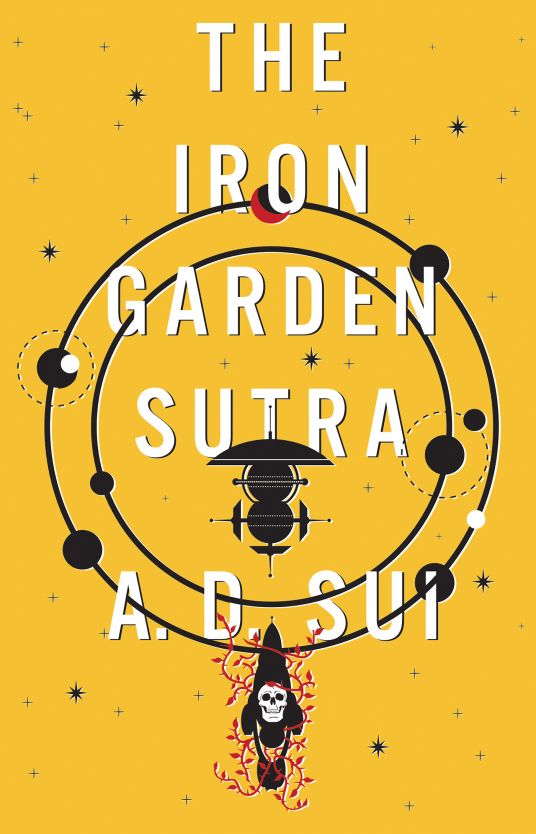
384 pp. February 24, 2026, Erewhon. SF.
Generation ships, like the one suddenly orbiting Doshua Station, had all but disappeared. The last one crossed the galaxy arm not three hundred years prior and docked at P’Ilani before its passengers, seventh-generation descendants from First Earth, hit the dirt and gleefully destroyed all of P’Ilani’s native fauna.
Vessel Iris is a monk in the Starlit Order. He performs death rites for those who’ve perished in space. Iris carries in his head a chatty and quirky AI (VIFAI=Vessel Iris’s Friendly AI) that knows everything about him and that’s mostly his only companion. This suits him: he hates being at the temple, and much prefers solitary service. So when the Counsel of Niceaappears at Doshua Station and is assigned to him, he’s thrilled at the prospect of “finding and laying to rest a thousand souls” because it means lots of alone time on the ship, away from the temple, maybe even months “[basking] in glorious solitude.” So, no; it turns out a research team has also been sent to the ship—adding a frankly delicious dynamic, and crucial to what happens next.
This is the third book I read in 2026 about a generation ship (after The Republic of Memory x Mahmud El Sayed and A Hole in the Sky x Peter F. Hamilton), and it’s among my top reads of the year (in a really very excellent year). It turns out to not be the story you might expect: This isn’t about life aboard a generation ship, because this ship was lost in space, along with others that left First Earth centuries ago, and it’s suddenly reappeared in orbit around Doshua. Everyone on it is dead, of course. And it’s an ancient ship, so there’s no AI on board. So why does a thousand-year-old historical relic seem to have come out of the space gate on its own and positioned itself perfectly in stable orbit?
Things just kept escalating in The Iron Garden Sutra and I honestly didn’t know what to do with myself. So much excitement. The story gets darker and darker, and Iris changes with it. Appropriately, the Iris we meet at the start is touchingly innocent: almost pure in devotion and duty, and any undercurrents in him are things he tries to control and/or mostly ignore (although VIFAI constantly reminds him). He has mantras to keep his sometimes annoying urges under control (some mysterious past events having made this feel necessary to him). Iris is very conscious of his neuroses. He’s just so earnest and just trying so hard and is so endearing. We get some of these early insights from the omniscient third POV, but we also get his future diary, through extracts as epigraphs at the start of every chapter. (This gives us a hint about how famous and consequential he must become at some point in the future, and we see very quickly that it would seem to be connected to his time on this ship.)
The ship’s environment is also a delight, mostly a humid jungle described in lush detail. Sui has imagined every aspect of what a huge abandoned spaceship with plant life that’s grown wild over centuries would be like, and vividly visualises its aesthetics for readers. It’s part of what makes the novel so atmospheric, and is also of course what makes you start to think this may be a horror novel. It does indeed turn out to be an important part of the plot, but is simply a pleasure to read about even without that.
I thoroughly enjoyed how steeped this novel is in religious practice and symbolism—excellent world-building, very thoughtfully constructed and executed. (If you’re a regular reader of fantasy—which I’m not—this may be less impressive to you. But I loved it.) This adds significantly to the novel’s tone; Iris’s religious practice keeps the “bigger picture” aspect of the narrative going, and gives readers a sense of his motivations. It also brings up interesting ideas about religion in a technologically advanced future, and cool thoughts about AI with faith.
The story is—sorry, but yes—also about another kind of ship: the development of feelings between Iris and another character—which you can see coming from a mile away and anyway kind of have to expect where there’s tension between characters, because that’s the law. I didn’t really approve initially, because things really start on an ugly note, and irl I would tell Iris to run (as you will because one starts to feel protective)—but by the end I think was sold, and even possibly really touched (I was).
So this is a novel that’s extremely well-written—coherent plot, stylistic sophistication so the reader is quickly immersed in its unique world, with both thoughtful and highly entertaining elements. But what raises it above just “very good” is Iris’s quest on the ship—his arc, and “dark night of the soul.” He faces profound challenges, both physical and emotional/spiritual, and it’s not at all fun and games on the Nicea, as far from the quiet work he expected as could be. Near the start of the story, Iris is concerned that he’s going to meet the team with the hem of his robes slightly soiled from dragging on the floor, sweet summer child. If only he knew.
I don’t often re-read books, especially not SF, but I’m definitely going to re-read this one as soon as I get the time. A delight to recollect even so many months after that first read. Very highly recommended.
Many thanks to Erewhon and NetGalley for the e-ARC.
Affiliate link: Support independent bookshops and my writing by ordering it from Bookshop here.
Find out more about The Iron Garden Sutra from the publisher’s site here.


Leave a Reply