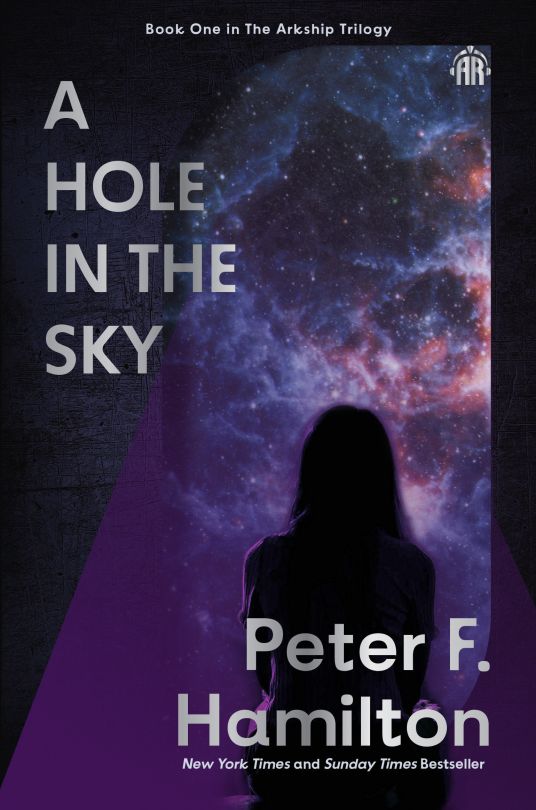
400 pp. January 20, 2026, Angry Robot. SF.
Here’s yet another generation ship story—that enduring SF trope. On this ship that’s been travelling for five centuries in search of a new home for its inhabitants, we meet sixteen-year-old Hazel. She lives in a village on the ship because that’s how everyone’s organised (intriguingly): shipkind have regressed, it must be concluded, after the loss of all of the clever, clever technology they depended on. That happened because of—hewing close to what the trope demands—a mutiny. So far so usual story; the difference here is that there’s an AI captain in charge now, who functions as a sort of distant deity issuing proclamations from somewhere near the ‘front’ of the ship. As for daily life, there’s a system in place to recycle everything, including humans. The social contract seems to hold on this and other issues, but it’s possible that … all is not what it seems.
Peter Hamilton became my favourite author for a long time on the strength of a single novel: Great North Road. After that, I sought out everything he wrote: I’m currently reading the Archimedes Engine duology, and of course I devoured and absolutely loved his amazing Salvation Sequence trilogy. This one, though? A miss for me, and here are my reasons.
A Hole in the Sky reads very YA (possibly because of the quite young protagonist); I can read YA, but rarely enjoy it. There’s also this Thing: One of its characters becomes disabled (losing the ability to walk) and must be carried everywhere for most of the rest of the tale. The tone is pity: he’s a boy who was very active, and is being set up to be a Hero, so readers are asked to feel that what has befallen him is tragic. And then, , a miracle! he gets healed! But, dear reader, this is a problem for me. I’ve learnt not to like sci-fi that says disability must be fixed for a character to ‘work.’
This is something I’ve become firmer on since reading Amanda Leduc’s Disfigured: On Fairy Tales, Disability, and Making Space (which I’ll recommend yet again; also recommend Khairani Barokka’s Annah, Infinite, which talks really thoughtfully about disability), and with my increased interest in monster theory. SFF has this problem, as does most other cultural production in the ‘West’—although it does this less now with so much more representation and inclusion. I am assuming here that Hamilton’s writing from the mainstream perspective—which, understandable, and a writer must always choose what to write; but this reader feels there’s a whole disability rights and justice movement that we should all listen to, if only to tell better stories. Also, as this is YA: How would a kid with a disability read this book?
A couple of other things: A lot of the SF I’ve liked before had robots or other advanced technology solving all of our problems—which is very cool and shiny and fun, sure; but having the worst people on Earth advancing this pernicious idea that tech will fix us (and the resultant refining of my politics) has given me second thoughts about how we save the future. Secondly, and related: in this novel, everyone reverting to a simpler, agrarian past is shown as bad (which exposes a worldview) as against if the mutiny hadn’t happened, and the robots had repaired things as they broke and generally kept things running. So in this story, the way the young humans save the world is by locating those robots and switching them on. I don’t know which direction Hamilton will take things in in the sequels (this is Book 1 of The Arkship Trilogy), but i do know I prefer human-centred future imagining. I think this is how the future will be rescued from disaster, and I wish we’d tell more stories like that.
A quote from the ARC I read to illustrate what I mean about the book’s worldview:
“A world of commonplace miracles that worked smoothly and efficiently. And it belonged to me and my friends. This was the ship that had been taken from us. I’d lived in a bamboo cabin my whole life, yet I’d always known something was missing.”
So my quibbles with this book are, as usual with me these days, political.
I read this a few months ago, read A. D. Sui’s Iron Garden Sutra a little while after that, and then Mahmud El Sayed’s The Republic of Memory; it’s been fun to think about the different ways there are to write about generation ships. Hamilton imagines a regressed society where children lead the way. Sui’s book approaches the idea indirectly, featuring a religious character in a multi-planetary far future—it is extremely cool. And El Sayed’s is about as traditional a generation ship story as Hamilton’s, but with an Arabfuturist twist.
Hamilton excels when he does a lot of intricate far-future worldbuilding. You’ll find that in his most complex stories, where he describes everything from what fashion a society prefers to extremely detailed descriptions of their technology. This story, most unfortunately, does not at all show off his skilfulness. It will probably land just fine for readers who are new to him, or the YA market, but will disappoint those who know him for the aforementioned. Happily, there’s always more Hamilton to look forward to, even if it’s his backlist.
Thanks to Angry Robot and NetGaley for the DRC.
Affiliate link: Support independent bookshops and my writing by ordering it from Bookshop here.
Find out more about A Hole in the Sky on the publisher’s website here.
 Harare Review of Books
Leave a comment