
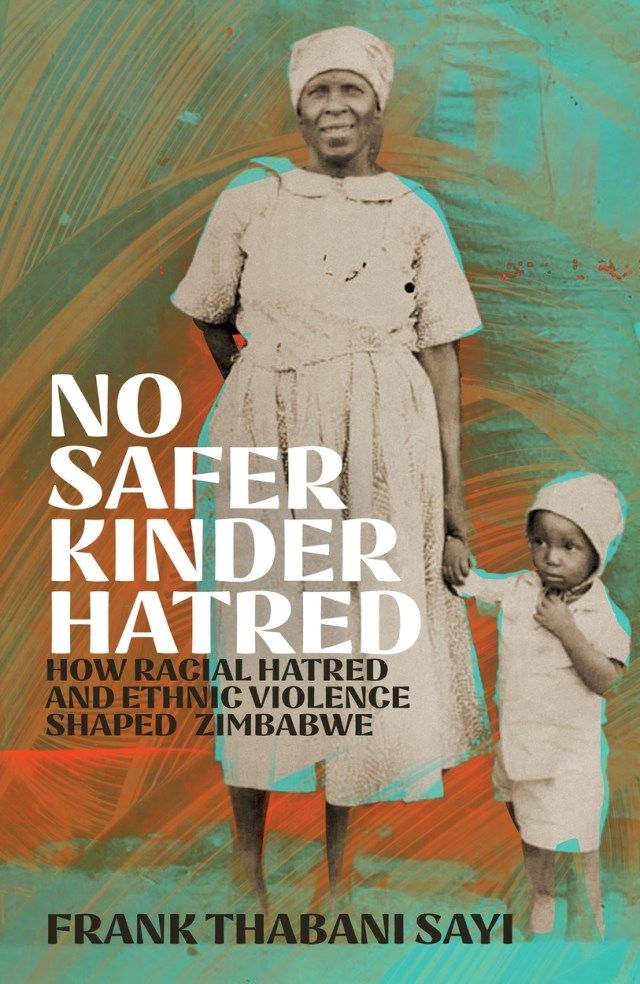
388 pp. October 9, 2025, riverrun. Memoir.
I lived in Gwanda for a few years as a child, and we drove past Mawabeni a lot (it’s just off the highway). It always intrigued me for those very very many rocks, the huge and imposing amadwala, and for the settlements I could see from the highway. This book brought back those treasured memories.
This is how Sayi describes the Mawabeni of the book:
“To the east, the horizon was dominated by a whaleback of a mountain, the Waba. Its countenance rose into the clouds. And on its back rested unsightly barnacles of grey concrete water tanks. The mountain was where the name Mawabeni came from – it simply means ‘the Place of Hills’.
“Mawabeni was held in suspension by two competing but unequal forces: Bulawayo to the north-west and Johannesburg to the south-west. Although hedged in by mountains, it was a boisterous little place. Its soils hosted hard-packed clumps of shrub land, thorn bush and a scattering of mopane trees. Mostly, it was rugged terrain full of stones and nothing else but undulating hills. A permanent layer of dust had settled on everything: grass, trees, road signs, buildings, old newspapers, and plastic bags. There was barbed wire, in every direction, as far as the eye could see. Much land and its residents had been displaced to give way to White farms. Their homes rested precariously on the side of the hills. Mawabeni, like all Native Reserves, served as a containment, intended to discourage deeper roots.
“But people did stay because of a deeply held conviction that, should they find another place – watered, with fertile soils – that, too, would be taken away from them. So they embraced this inhospitable terrain as a respite from an advancing, violent, insatiable White greed.”
Billed as a memoir (or a work of ‘rememory,’ as the author says), this is the sometimes harrowing account of a less well-known aspect of Zimbabwe’s extended liberation war. It begins with a young boy’s experience of the struggle—the “hot” war was not in that part of the country, but ripple effects were felt there too—and then later, near the end, Sayi delves into the post-war “disturbances” (the government’s official term) of Gukurahundi.
Along the way, we learn about the boy’s upbringing (along with his sisters) with a great aunt (“Grandma”) in Mawabeni, necessitated due to his abandonment by his mother who has moved to Bulawayo, ostensibly for work. It’s an often lonely and frequently difficult life: Grandma is alternately violent and cruel, and then loyal and devoted. It’s far from a stable environment for a young child, and society’s wider problems only add to his confusion.
Rhodesia was a terrible place for its Black inhabitants. Everything was militarised; all the settlers had guns. There was racial segregation—for example, Black folk were not allowed to share pavements with white people, and were served from the side windows of cafes and shops. Their (our!) education system was inferior, and they were forced into a second-class lifestyle. There was suppression of indigenous languages and culture. And then there was the war, where they were brutalised by both sides, even by their putative saviours. “We lived on the edge of our nerves,” Sayi says.
However, there are idyllic moments, too, described in the book—the boy’s shenanigans with his friends, chasing chickens, playing in old cars, riding on donkeys, sliding down rocks, turning tortoises upside down; and a very amusing description of his first day at school. The simplicity of childhood, finding joy in play; and Sayi’s images of rural life are incredibly evocative. If you’ve been anywhere in rural Zimbabwe, you’ve probably seen something like this:
“Our school sat at a crossroads of dusty tracks. The gate consisted of two triangular concrete structures, head high, filled to the brim with soil. On top of these grew Christ-thorn bushes, whose intricate branches displayed a crop of red flowers. Both concrete structures on either side of the gate were whitewashed, and the name of the school was emblazoned across them in big, bold black letters: Mawabeni Primary School – Knowledge is Power.”
I really liked the character of Grandma, in spite of everything—”Grandma had three main addictions: tea, snuff, and violence. If anything, it was the scarcity of tea and tobacco that provoked the latter.” She’s an anti-hero, so incredibly flawed but at the same time admirable for how she fights for and continues to care for her charges in her own way. I was also devastated by the absence and indifference of the woman whose role she had taken over. But this was a beautiful portrayal of two women’s choices, and of the reality of difficult families.
An additional content warning: There’s a section near the end of the book, too, that touches on a relationship between a minor and a soldier, from the minor’s perspective. It ponders the line between consensuality and abuse, and is quite difficult to read.
“For the first time in our lives, we felt like real human beings with voices, that from then on, after everything that had happened, our humanity would never be doubted.”
There are still few memoirs of the struggle—neither the main war, not its aftermath in Gukurahundi—and some of these gloss over the horrors. (There is some related fiction now, which is good, I think.) And there’s little recollection in the public space that’s not mediated by the government for its own reasons—mainly about the experiences of those who fought, TV programmes that run around the time of Independence Day and the Defence Forces and Heroes Holidays. That’s one reason Sayi’s memoir is important. A second is that it’s the experience of someone from the southern part of the country, from an area that was not subject to so much direct violence, but one in which civilians still experienced hardships. A third reason is this book’s gutting account of a personal experience of Gukurahundi. So much human suffering is due to the cruelty of powerful men; the people of southern Zimbabwe experienced it three times over, across the independence divide. This, too, is Zimbabwe’s story; our narrative of who we are is incomplete without it.
“We prayed for rain and a miraculous reprieve – but neither came.”
Is there room for “national healing” for the wounds of Gukurahundi? What can be done for its victims? What are their most important needs? This memoir doesn’t deal with these questions—it doesn’t need to, really—but these are things that remain mostly unanswered, forty-six years later.
Thank you to Frank Sayi for a review copy.
“They looked from behind their car windows, their cars overladen, but unable to take our land with them. Wherever they went, the ghost of our country would forever haunt them.”
No Safer Kinder Hatred is available everywhere good books are sold.
 Harare Review of Books
Leave a reply to An interview with Frank Thabani Sayi, author of No Safer Kinder Hatred – Harare Review of Books Cancel reply