
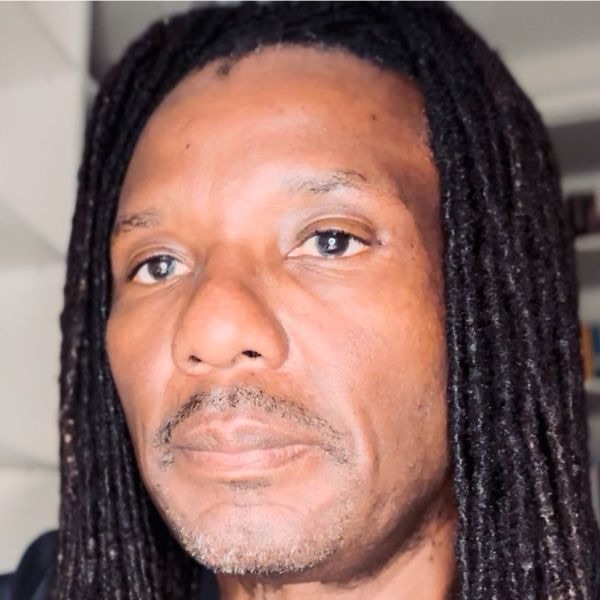
HRB is honoured that Frank Sayi was able to answer some questions about his memoir, No Safer Kinder Hatred: How Racial Hatred and Ethnic Violence Shaped Zimbabwe .
Frank Thabani Sayi is an Open University lecturer in the UK and a former police officer. He grew up in Rhodesia, now Zimbabwe, in the 1970s and later went to England on a scholarship. He was raised on a “native reserve” under white colonial rule where repression was rife. In No Safer Kinder Hatred: How Racial Hatred and Ethnic Violence Shaped Zimbabwe he writes about his family and the impact of war. He highlights the human capacity for extraordinary violence but also for compassion, endurance and survival.
Jacqueline for Harare Review of Books: I lived in Gwanda for a few years as a child, and we drove past Mawabeni a lot. It always intrigued me for those very very many rocks, the huge and imposing amadwala, and the settlements I could see from the highway. Your book brought back those treasured memories.
What was the impulse that led you to write this book?
Frank Thabani Sayi: I suppose I have always carried the heavy memories of my childhood, particularly those of Gukurahundi as a kind of shame. It was as if I had a dirty secret that I could never disclose, not only because the timing wasn’t right, but because I thought there was no longer a hunger for those kinds of stories. Globally, there was a big push for the positive stories of Africa, which was also an oblique injunction against narratives of famine and war in favour of happy stories – there still is. But, remember also, that when I first arrived in England, being a victim of Gukurahundi didn’t even provide sufficient grounds for applying for asylum. Besides, I had no visible scars, or wounds. And so I hid, for decades, behind this double concentric wall of shame, of silence—but then the terrifying nightmares began. And I had to try and find answers because things were happening to me that I could never explain, four decades after Gukurandi. But then in 2015 I enrolled on a PhD programme at Birkbeck, University of London and my Thesis was entitled Language, Violence and Landscape in Yvonne Vera’s The Stone Virgins and Ekhaya: The Years of Childhood. As I wrote the critical component of my thesis, I also wrote short stories. No Safer Kinder Hatred was a synthesis and an amalgamation of short stories that were carefully curated into a broader, coherent narrative. And what brought these short stories together—the tar that glued them together—was their exploration of the harrowing theme of violence in the context of war and its aftermath. But, crucially, what was missing was the singular voice that would unite them. And miraculously, or rather serendipitously, I discovered Thabani’s voice through one of my short stories called “Shadows.” And after that his voice became not only insistent, but also very clear in what it wanted to say; all I could do was follow its lead. And it took me to tragic places that I’d buried deep down for so long. Frankly it was frightening, but also liberating at the same time.
HRB: How long did it take you to write?
FTS: Four years.
HRB: You call this a work of “rememory.” What does this mean?
FTS:: I borrowed the term rememory from Toni Morrison’s groundbreaking novel, Beloved. To me rememory is a political act, a softer, less belligerent kind of defiance; it means reconstructing alternative narratives of the past, especially those that were violently repressed, through a vanishing landscape of memory: the quietly recited ‘tall tales’ of what happened back then—the aural, visual, literary hauntings that keep ghosts of the past alive in the present. Because no one remembers alone. And as the memory of Rhodesian atrocities and those of Gukurahundi fade, Zimbabwe’s dark and troubled past can only be kept alive by these constant reimaginings, because a people can only know and understand itself through a thorough and honest understanding of its past. So, refracted through the prism of rememory, No Safer Kinder Hatred is testimony to the fact that memory is not just one, but a set of recollections attached to oftentimes irreconcilable meanings, conditioned by, but also conditioning, the interpretations available in the present.
HRB: This book has themes of incredibly brutal violence, both within the family and related to the war. Were these things difficult to write?
FTS: Although the violent scenes were difficult and challenging to write, the aim was not to occlude the narrative with thick descriptions of violence, but to find an authentic language with which to respond to the surreal violence of the Gukurahundi massacres. Conversely, the depiction of the violence made me conscious of the possibility of the multiple ways in which to articulate and contextualise the complexity and intensity of the violence which I witnessed as a child. But in order to depict those violent scenes, whether of the physical and emotional abuse, or bearing witness to the distressing acts of violence visited upon others, I had to relive, and re-enter each scene, frame by frame, and invoke each smell, sound and sensation in my own imagination. And that took its toll; for four years, I carried this burden with me. Outwardly I was okay, but inside I was in turmoil; the only thing that saved me, or rather made writing the book bearable, was the humour, particularly in the first part of the book, with Thabani’s escapades!
HRB: You show that the violence within the family and the violence in the society were connected. Could you elaborate on this idea?
FTS: I think across generations, violence has always been an intrinsic part of Zimbabwean-ness. Political violence, and by extension, ordinary violence, forms an integral part of interpersonal relations in the Zimbabwean context. I believe that state violence—the violence perpetrated by soldiers, the police and the whole security apparatus—has contributed to the culture of impunity which pervades Zimbabwe today.
HRB: I really liked the character of Grandma, as crass and violent (physically, verbally, emotionally) as she was—she’s an anti-hero, so incredibly flawed but at the same time admirable for how she fights for and continues to care for her charges in her own way. I was also devastated by the absence and indifference of the woman whose role she had taken over. But this was a beautiful portrayal of two women’s choices, and of the reality of difficult families. You didn’t deal with this in the book, but is there a place for forgiveness for the sins of both these women?
FTS: Women like my grandmother were never given any real choices: their men were either dead, incarcerated, gone to war, or they’d simply abdicated responsibility and abandoned them. And they carried heavy emotional burdens, compounded by the injustice and resentment visited upon them. Not just as women, but as Black women under colonial subjugation. Consequently, and perhaps subconsciously, they raised their children in preparation for a cruel and unforgiving world. And that’s what structural violence does. But I also wanted to dispel the myth that women, as a gender, are softer, kinder, and innocent. But the main question I wanted to throw out there, particularly in the context of the modern crisis in masculinity and the virulent resurgence of gender-based violence is: who raises boys to be the men that they become? Conversely, I wanted to present Ma as a fully rounded character, with all her strengths, foibles and weaknesses, and to complicate our understanding of how and why women are always simply portrayed as victims of war: because I wanted people to see that there were women revolutionaries too, unarmed—Ma and her kind amongst them. Surely that is enough to redeem them?
HRB: I was also very taken with the young protagonist’s (your) shenanigans with his (your) friends, and all of those school experiences—all very well done. Were you really as naughty as all that in your childhood?
FTS: We had a wonderful childhood. We were raised in an environment where we were let loose to explore our surroundings and were given the freedom of the village and its surroundings as our playground. We spent so much time on our own, practically unsupervised; we swam in flooded rivers; walked on the edge of the bridge with a thirty foot drop, arms raised to the side; disturbed hornets’ nests and got stung; fought and tore each other’s clothes and lived to tell! Of course there was the war, the violence and all the other inconveniences—both at home and at school—but we welcomed each day as a challenge and made most of what we had, which was nothing in material terms, but we had the whole world in front of us, and it was free!
HRB: Although most of the book is concerned with the war for the liberation of Zimbabwe, near the end you delve into the post-war “disturbances” of Gukurahundi. This part feels a little less like pure memory and more like creative non-fiction; is that a fair assessment?
FTS: In a way, yes; besides, Thabani had matured somewhat. Also, in terms of historical time, Gukurahundi was, and still is, too raw for many. There is also the unsayability of the Gukurahundi genocide accompanied by the spectral quality of fear that heightens its symbolic impact: in terms of collective trauma, the fear of violence, real or perceived, is a remnant of the past which continually haunts the present.
Therefore, I think creative non-fiction perhaps better describes what I was trying to do in the second part of the book. It allowed me to carefully navigate the porous zone between history, trauma and memory, and to be able to proffer an alternative history of what happened back then. As a silhouette of that war, No Safer Kinder Hatred showcases the human capacity for extraordinary violence—but also aspects of endurance and survival too. And in terms of trauma, what it means to live and tell, thus complicating our understanding of testimony as a literary form.
HRB: There’s a section near the end of the book that touches on a relationship between a minor and a soldier, from the minor’s perspective. It ponders the line between consensuality and abuse, and is quite difficult to read. Why did you feel you had to deal with this, even briefly, in this narrative?
FTS: I also found this chapter perhaps the most difficult part of the book to write. But I wanted to interrogate what happens in those secret, quiet, spaces where the boy child spends a significant amount of time with a grown man. And to highlight the nation’s blind spot, or wilful blindness, when it comes to the sexual exploitation of boys in the context of war. Because when I was growing up, that was never even contemplated—it wasn’t even a thing. So boys were never given the tools nor the language to even consider the possibility of being violated sexually. Conversely, I wanted to explore the fragility of men of war, the complexities of male sexual desire, and the contingency of desire in the sexual economy of war. And I wanted to delve into the deepest recesses of Zimbabwe’s collective psyche and bring up those things that Zimbabweans are unwilling to confront, particularly the sexual abuse of children. But more precisely, I wanted to disarm and to humanise Casper in order to explore more closely the moment of tenderness between two traumatised and brutalised human beings. Because what made Gukurahundi impossible to comprehend was the ordinariness of the boy soldiers who looked so much like their victims.
HRB: How did you feel after finishing the book? Was it catharsis, or did it reopen old wounds?
FTS: I felt exhausted but relieved: strangely lighter and somehow free. And because I’d gone to the darkest hell I’d ever imagined, and confronted everything that I’d avoided, and I spent so much time with my Grandmother, my mother and my sister Gift, even though they’ve been gone for a while. It was then I began to understand what all those dreams and nightmares were about. And in the end I understood this one crucial thing: in this life you don’t get away from anything: what we leave, we carry, and that burden lasts a lifetime, across multiple generations. But the grief, the devastating grief, that had haunted me for so long, had finally found a home, a semi-permanent repository. And, I, finally, could breathe!
HRB: In view of the last question and due to all of the painful experiences the book tells of, have you found ways to deal with the pain, like therapy or other things?
FTS: I am sure you will have noticed from my short biography that when I first arrived in England I worked as a nurse in the Intensive Care and High Dependency Unit. After a few years, I worked as a police detective in Child Sexual Exploitation, Black-on-Black violence, Counter-terrorism and Modern Slavery and Child Criminal Exploitation here in London. Naively, I always thought that I’d chosen to work in those areas. But with hindsight, and given my history of trauma, it would seem that I was subconsciously drawn to those areas of work by something much more powerful than I ever thought possible. And when I left policing after twenty-five years, I had no recourse to counselling or any form of therapy. As you can see, there are so many experiences to unpack, and I mean layer-upon-layer. I am not sure how long it is going to take me to come to terms with everything, but I’ve never thought of therapy as a solution. In the meantime, I’ll just continue to write, perhaps l’ll find most, if not all, the answers to my questions there.
HRB: Do you think there’s room for “national healing” for the wounds of Gukurahundi? Do you have thoughts about what can be done for its victims, what the most important things needs are?
FTS: Because of its violent and traumatic past, in Zimbabwe there is scarcity of an innocent language that has no political implications. The conflict in the language, or, rather in the narratives of the past, is that there are discordances between the different nationalities of groups that see themselves as ethnically distinct, all conflicted by strategic ethnocentrism. The politicised and partisan language of each enclave is resistant to the pull of democracy. There are multi-vocal political oppositions, or political scripts that cast doubt over the assumed and unquestionable legitimacy of one political voice over all the others. Which is to say that if Zimbabweans want peace and reconciliation, their needs can never be diametrically opposed. And the tragedy is that so many things have happened in between and we must ask: Whose responsibility is it to forgive? And whose to forget? All these things are connected, solutions too. Collectively, Zimbabweans have to identify real transformations—the forms of radical searching—that would get them out of their current predicament.
HRB: What’s your most favourite memory of growing up in Mawabeni?
FTS: I miss swimming in the Mzingwane river, foraging for wild fruit as a kid; the intoxicating fragrance of the overripe amarula fruit in the heat; I miss the freedom of speaking isiNdebele and the simple pleasures of sharing food with my people; the buzz of the Growth Point on Friday nights, and the attitude and the spirit of the place! As an exile, I am always haunted by the possibility of what might have been, had I stayed. And as the memory of Mawabeni fades, I strive to retain, intact, the memory of old places, and faces. And as Salman Rushdie so poignantly suggested, in relation to the India of his childhood: We cannot reclaim precisely what we lost. So, to me, Mawabeni will always be an imaginary homeland. After all, people and places have their own unique identities, and identities mutate, shift and change across time and space. As I’ve changed, so too has Mawabeni. But its landscape will remain frozen, etched in the sacred corner of my mind as a permanent repository of beautiful but also very painful memories—and it will always be that way.
HRB: Do you ever go back to any of the places in the book? If so, what has this been like, with the vantage of time (and your leaving) providing distance?
FTS: The last time I went ‘home’ was in 1997/8 when I visited my grandmother’s home following my mother’s death. Mawabeni is always on my mind, always will be. And I think about old friends and where they might be in the world, as I reminisce about things past. And I always find it hard to talk about home, because I was supposed to come back but never did. And when it comes to Mawabeni, and by extension Zimbabwe, I will always be in the grip of an unresolvable melancholia, the loss of an object whose exact coordinates will always elude me: the elusive home, but always on the edge of my memory—a permanent grief. But the world is changing again. In the West there is a growing and worrying anti-African sentiment. And so it may well be that one day I’ll come home and confront the ghosts of my past. But for now, as a writer and emigré, I think home is in the imagination.
HRB: Do you plan to write more, perhaps even fiction?
FTS: There is certainly more in the pipeline!


Leave a Reply