
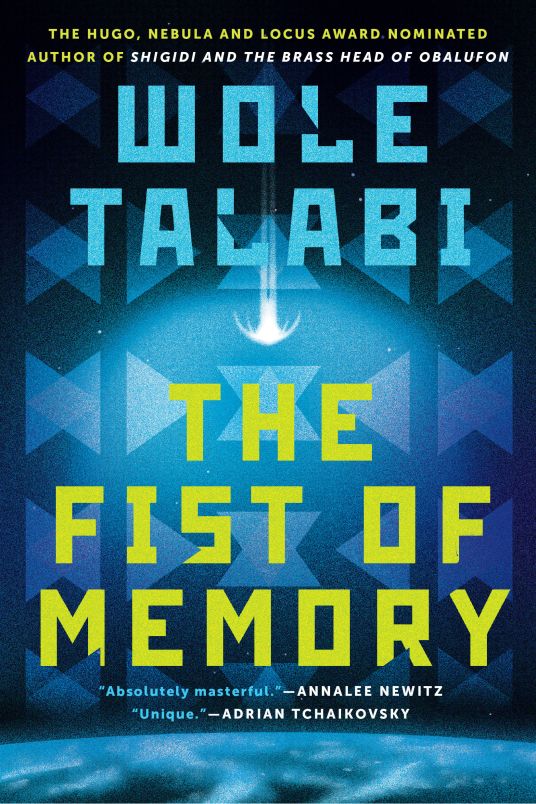
416 pp. October 27, 2026, DAW Books. SFF/African SFF/ Africanfuturism.
Talabi is a reliably excellent and imaginative writer, but this could be his best work so far. He’s drawn deeply from African traditions, customs and beliefs for this novel.
It opens, mildly enough, with an assassin on assignment, about to kill a corrupt prosperity gospel pastor (rather cathartically). “Here’s the thing about killing people,” Tope says: “I don’t like it, but I’m good at it.” Tope’s in Warri, Nigeria, there’s an “augmented intelligence system” talking to her, and she’s surrounded by an EM bubble. She also has Afeeri on her, described as teleportation juju, which she proceeds to use. It’s a stunning start to a novel that will take readers on a wild ride.
Tope, written in the first person, is the novel’s central character; but another, Itumeleng, written in the third, is crucial to the story. A previously unknown object is discovered to be heading towards Earth. Naturally, it must be an asteroid—except that it appears to be under some kind of propulsion, and soon manages an evasive manoeuvre when Earth shoots at it. Itumeleng is an astronomer at the South African Astronomical Observatory and is the first to observe the object, described as cylindrical and made of stone. His discovery coincides with vivid dreams about—visions of, really—a similar object entering Earth’s atmosphere, and of a strange woman. Itumeleng is a typical scientist, of the Western school of thought in his outlook, having rejected his grandmother’s beliefs and the call to serve as iSangoma because of a traumatic childhood loss. So it takes him a while to come round to seeing his visions as connected to the mysterious object.
Shortly after killing the pastor, Tope receives an assignment that she initially finds suspicious. Looking into it, she finds herself excited for the first time in a long time. It turns out to be the most dangerous undertaking of her extremely dangerous career, but is also the thing that causes her path to cross with Itumeleng’s. Threads and connections.
Something about this novel feels different to Talabi’s previous work. He’s always written from an African and Nigerian perspective, but this novel is much more deeply rooted and grounded in African spirituality than any of his work so far. It feels both consequential and monumental. There are threads that run through the story and that connect the characters: the presence of the spiritual in everyday life; the dimension of the ancestors, a plane that exists whether the characters believe or not; a corresponding connection to family (“extended” in Western parlance); and a connection to place and ethnicity, because that shapes and influences these characters and is from where they derive their identity. The Fist of Memory presents an important principle in understanding fiction from the Global Majority/”The Rest”: for most of the world, there’s no division between the physical and spiritual worlds[1], or science and faith. In this novel, these worlds co-exist and are of equal importance. Itumeleng’s journey shows this most clearly, as he moves from the “rational” science of his adulthood back to the faith of his childhood and culture, a belief in ancestors. That faith is also the “magic” that Tope uses frequently in her work. This blend of different knowledge systems is not only central to the story but is also extremely well executed. Talabi must know Nigerian customs and tradition well, but his representation of southern African belief in this novel is very impressive. In short, this novel is Nnedi Okorafor’s Africanfuturism.
The Fist of Memory is intense and full-on, and certain scenes are graphic and very violent. It’s confrontational and unapologetic about it. Visualising it as a film comes very naturally; the fight scenes in particular are very cinematic on the page. There’s apparently a reason for this: Talabi speaks about the evident influence of Hong Kong cinema on Coode podcast here… It turns out he wanted to work in film before he became an engineer! (Related: Here’s a cool piece from Stewart Hotston on writing fights.)
Something else that was fun: the perspective of the Irunmole, the aliens (or are they). One disappointment: that the “coup” plot line wasn’t fully resolved in the novel, most of the rest of the action there only happening in the background. It would have been cool to go back to Aso Rock to learn more about what happened after … things. But that’s not this book. Also yes, Nigerian politics is still complex in the future; not everything is fixed in Talabi’s Nigeria, and that’s completely realistic, but it’s fun to see all of the ways Nigeria’s moved with the times, all of the cool tech. Some of the novel’s other loose ends are tied up very late in the narrative; a few things make one wonder if The Fist of Memory will have a sequel, or perhaps spin-offs following some character or another; that would be great.
So, this is a novel about assassins and first contact and a fun African future. It’s also about the blending and co-existence of different knowledge systems, not privileging some ways of knowing over others, and the numinous being a fact of life. Life is full of strangeness, and most of the world accepts that. Itumeleng learns to do so, too. The Fist of Memory’s also about the importance of community over the individual, a Global Majority concept that goes by different names in different parts of the world, but that’s called Ubuntu in Nguni languages: “I am because you are.” In the novel, things work better when individuals work together (including those who are not physically with us anymore): like in Gestalt theory, the whole is greater than the sum of its parts[2].
What Talabi has done in The Fist of Memory is exciting, and demonstrates what SF can be. A fantastic read. Thank you to DAW Books and NetGalley for early access.
- Strange Horizons – Collective Dreaming: The Schrödinger’s Cat Approach to Framing Futures By Jacqueline Nyathi↩︎
- Again, Talabi explains and explores his thoughts on this much more on this podcast, along with really thought-provoking ideas about hive minds and why ancestral belief in this novel and Ubuntu are a completely different thing: Episode 733: Wole Talabi, The Fist of Memory and the Importance of Connectedness | The Coode Street Podcast↩︎
Affiliate link: Support independent bookshops and my writing by ordering it from Bookshop here.
Find out more about The Fist of Memory from the publisher’s site here.


Leave a Reply