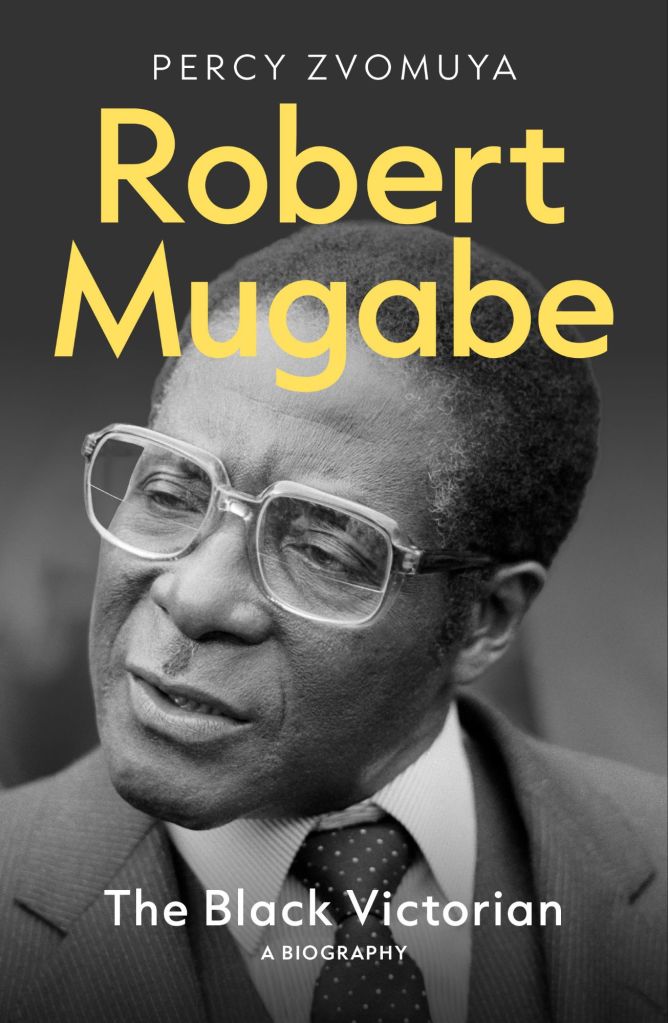
356 pp. October 15, 2026, Jonathan Ball Publishers. Non-fiction.
My middle sister, when she was small and could still be carried, was obsessed with “The President”; so of course when one day we were at the Trade Fair—a local event for business that we all went to because what else was going on in Bulawayo—we heard he was walking about, she had to see him. We stood waiting with many others along the path he’d take, my sister in my mother’s arms; and when he came along, he headed straight for her (probably because she was a gorgeous little thing) and shook her tiny hand. She wouldn’t wash that hand for a while after.
For decades, only one man in Zimbabwe could be called The President. No matter that he started out as Prime Minister, with a (ceremonial) president above him; we all knew that wasn’t a real thing. It was a bit of a relief when he made himself executive president; then we all knew what was what, all made clear. He had a stranglehold on our country, and it was just easier for us all to accept it—sadly, for decades and decades to come.
This is a book about The President.
Robert Mugabe wasn’t always a man stuck in the past. But by the end of his rule,
[If] he looked outside the narrow confines of patriotic history, he would see not only a living, heaving, embittered history of the present and future, but his active role in rolling back the gains of the freedom for which he himself had suffered. ‘Mugabe’s Zimbabwe has been turned on its head,’ the Jamaican Observer wrote in an editorial, ‘for, looking hard at Mugabe, you may just see Ian Smith. Each looking at himself.’
This passage is from journalist Percy Zvomuya’s excellent new book Robert Mugabe: The Black Victorian. It’s the story of Mugabe’s life from his beginnings as a goatherd at Kutama to the dramatic events that ended his rule and, perhaps, shortened his life.
Mugabe was a man of contradictions, most of them ones he created or perpetuated; reading Zvomuya’s book, one gets the sense he was constantly self-(re)inventing based on the exigencies of whatever was going on around him. The real man is someone we may never truly know, no matter how many biographies are written—and he did not seem to want to be known—but Zvomuya’s is the first full-length book by a Black Zimbabwean, and a very successful one.
Zvomuya’s done his research. (Mugabe was his obsession for many, many years. This book was inevitable; it had to come out of him.) He had what looks to be unparallelled access to Mugabe’s surviving relations (although not his widow), friends, enemies, former colleagues, former counsellors, and many more. Zvomuya used this access to painstakingly construct a kind of effigy of the enigma: it feels as if this is probably what Mugabe was like, but he was also a slippery and famously reticent character who left no memoirs by which we might peer into his soul. Still, Zvomuya’s book is immensely revealing, and has the added advantage of cultural knowledge. Zvomuya not only belongs to the same people as Mugabe, the Zezuru, but grew up in a neighbouring rural area to his Zvimba, separated only by a highway. His deep cultural knowledge (including the sharing and explication of Zezuru customs and idioms) is brought to bear in his analysis.
For Mugabe was profoundly shaped by his Zezuru culture, much as the Catholic Church tried to remove it from him, and him from it, starting from before he was born. His mother, Bona, had been absorbed in her youth into a small community created by a Jesuit priest at Kutama; she became much more immersed into Catholic rhythms when Mugabe’s father deserted the family. At that point, Mugabe, who had been the third-born child but whose older siblings had died, became the family’s “patriarch.” He was raised by his family and community, but mainly under the influence of a Jesuit priest, Father O’Hea. He was therefore profoundly shaped by his Catholic faith—so much so, in fact, that he considered entering the priesthood himself. He became a teacher instead, and after years of wandering, fate thrust him into the limelight on his return to Salisbury in the 1960s as a ‘spokesman’ for nationalism. The rest, as they say, is history.
But what a very long and complicated history! In the almost-century of his life, Mugabe managed to be a chameleon, somehow changing from a revered figure to a hated one—sometimes back again, at other times being both at once. It’s impossible to imagine the history of Zimbabwe without him, and it’s not an understatement to say he put the country on the world stage. The history of Mugabe is the history of Zimbabwe, whether we like this idea or not. Zvomuya’s book understandably does not and cannot cover every little thing that happened in its rather truncated chapters, but it provides a valuable sketch, focussing most on his earliest years, covering in some detail his surprising rise to power, and then his post-independence consolidation and crystallisation of that power through brutal and illegal means.
It’s only unfortunate that Zvomuya doesn’t explore more explicitly what the book’s title suggests, and what we all thought when we saw and heard Mugabe—that he was a noted Europhile, a “Black Victorian”—although this idea may be construed from Zvomuya’s portrayal. Zvomuya focusses mainly on how Mugabe was shaped early on by external forces of Eurocentricity: he was raised by Jesuits, dislocated from his own culture. The way Mugabe spoke and carried himself and what he thought of as appropriate dress were things that tended to impress everyone who met him, Black or white. To what extent was this ’nature’, a matter of agency, or a calculated decision by the time he came to power? And what part ‘nurture’? Did Mugabe genuinely love ‘whiteness’? It feels like a question remains somewhat unanswered. Zvomuya’s analysis never quite coheres to the level the book’s title may imply. Perhaps Zvomuya putting the question directly to all of his interlocutors would have produced some interesting answers.
Robert Mugabe: The Black Victorian is both immensely illuminating and a true pleasure. Even for a Zimbabwean reader, it’s possible for the length of the book to set aside the terrible burden of memory of living under a man who was often a monster. Zimbabweans suffered terribly under Robert Mugabe; but he was also an exceedingly fascinating figure, inarguably one of the giants of twentieth century African history. This book lays out why through poring over the details of how he came to be: man, teacher, leader, demagogue and dictator. It’s deeply compelling for the questions at its heart: How did that studious goatherd become an itinerant teacher become a hated national leader and obdurate enemy of the West? Why did he kill so, so many people along the way? Did he mean any of the things he said in his famous reconciliation speech in 1980, on winning the election that freed Zimbabwe? How did he maintain his aura of absolute power? Was he really a Marxist? What was he like in private? Who were his favourite authors? What led to the shocking events of the coup that removed him from power? Was he lonely in his final days? Why did he become somewhat erratic? These are all questions Zvomuya probes, and more.
It’s notable how much Zvomuya has managed to extract and write down for another reason: For decades, Zimbabwe’s been a place of secrets. Talking was sometimes a thing punishable by death or disappearance. Zimbabweans were taught that certain topics were off-limits, but it was not always completely clear what those limits might be … So it was better not to talk about anything at all, in case the person you were talking to or the one who overheard you took your tales to the scary men in dark glasses and cheap, shiny suits.
Some of Zvomuya’s interlocutors would likely have been quite nervous to reveal what they did. Perhaps for this reason, the people who would and should have written Zimbabwe’s history down—including the nationalists who made it—mostly did not. Zimbabwe’s history has mostly been whispered about, including Mugabe’s; certainly it still feels sticky to talk about. Zvomuya’s book, therefore, must also be considered courageous for breaking through this veil of silence.
Robert Mugabe: The Black Victorian must take its well-deserved place among the world’s most important and interesting biographies. Zvomuya has done admirable and comprehensive work here. This is the study of a monumental man’s rise and fall, an attempt to understand the forces that made him, and those that brought him down. Again, we will likely never fully understand Robert Mugabe, but Zvomuya’s book shows us a much clearer, more rooted picture of this forever controversial figure.
Find out more about Robert Mugabe: The Black Victorian from the publisher’s site here.


Leave a Reply