
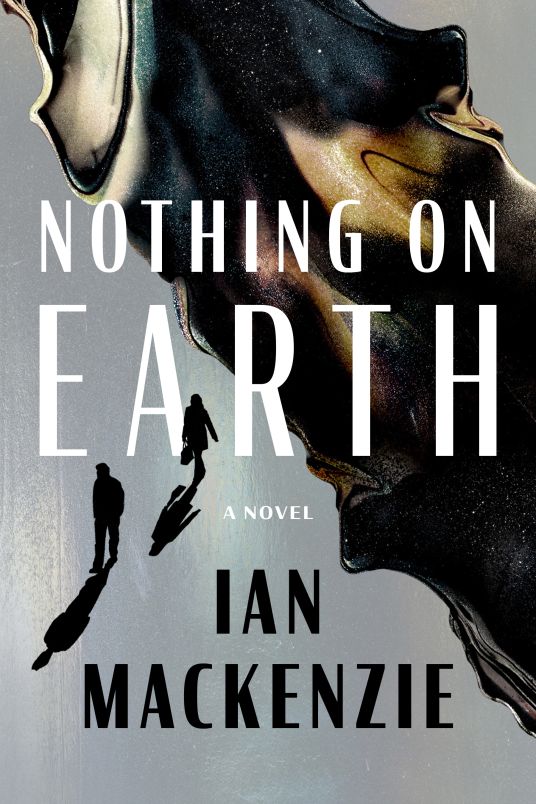
448 pp. May 26, 2026, Unnamed Press. Speculative fiction.
Nothing on Earth opens with the narrator recalling a time in Addis Ababa in 2011, seemingly—to casual observers—just a white woman wandering around an African capital, unusual enough to stare at but not to notice. She’s, in fact, following a man. She’s a US government spy; he has something the Chinese found in rural Ethiopia. And if it interests the Chinese, then it must be of interest to the US government, too.
What this object is, however, is not clear at first: it turns out to be metal-like, but doesn’t behave in any way that makes sense, and its true origin is unknown. Could it be used to make or power a weapon? That’s the US’s immediate concern. It’s the narrator’s mission to find out, and to acquire another piece of it, too.
The speculative element of the novel—the unearthly metal—is the simple device that holds together a story that’s really about the ways the world changed in the 2010s. It’s mainly (not solely) about the geopolitical rivalry between the US and China; but it feels unusually international, chronicling in remarkable detail, among other things, dramatic changes in Ethiopian and US politics, and the rise and fall of Aung Sang Suu Kyi in Myanmar—all mediated through this narrator’s mission.
A great part of the appeal is the unusual protagonist—a woman, a spy, a mother. But the novel confounds too, because her interiority becomes almost exasperating (somewhat reminiscent of Patricia Lockwood’s No One Is Talking About This); it dances on the blade’s edge, and I’m still not sure it succeeds completely. Yet … this same interiority is definitely compelling, and creates the novel’s atmosphere. Her views of the world and behaviour towards other people seem to be profoundly shaped by being a spy (for the US, with all of the hubris that must bring), and also eventually by operating while mothering a small child, which MacKenzie writes unexpectedly well (my prejudices are showing here, probably). But also, other characters are fascinating for their remove—they’re often comically one-dimensional; one does get the sense that perhaps the narrator was always like this (she had/has odd parents, and drifted at university); and so the way of this job suits her. Surprisingly for her, motherhood, initially unplanned and bewildering, increasingly becomes her method of making meaning in a world—a universe—that’s really too large for one human.
So yes, readers will be somewhat mired in her interiority—but remove that, and you lose a significant part of what sets the novel apart It matters that she’s all three things—woman, US spy, and mother—and how she sees the world shapes her decisions. The psychological study of one woman, in this novel, is not separate from, and is just as important as what’s going on in the bigger, wider world.
And if the resolution—or lack thereof—of the story of the un-metal is rather unsatisfying (it kind of has to be, if the novel’s not going to veer into fantasy), that’s perfectly fine for Nothing on Earth. It’s the best of things: a novel that’ll keep you up late, and while doing so, make you forget everything that’s going on around you.
Affiliate link: Support independent bookshops and my writing by ordering it from Bookshop here.
Find out more about Nothing on Earth from the publisher’s site here.
A version of this review appeared in The Sunday Long Read, September 20, 2026.


Leave a comment