
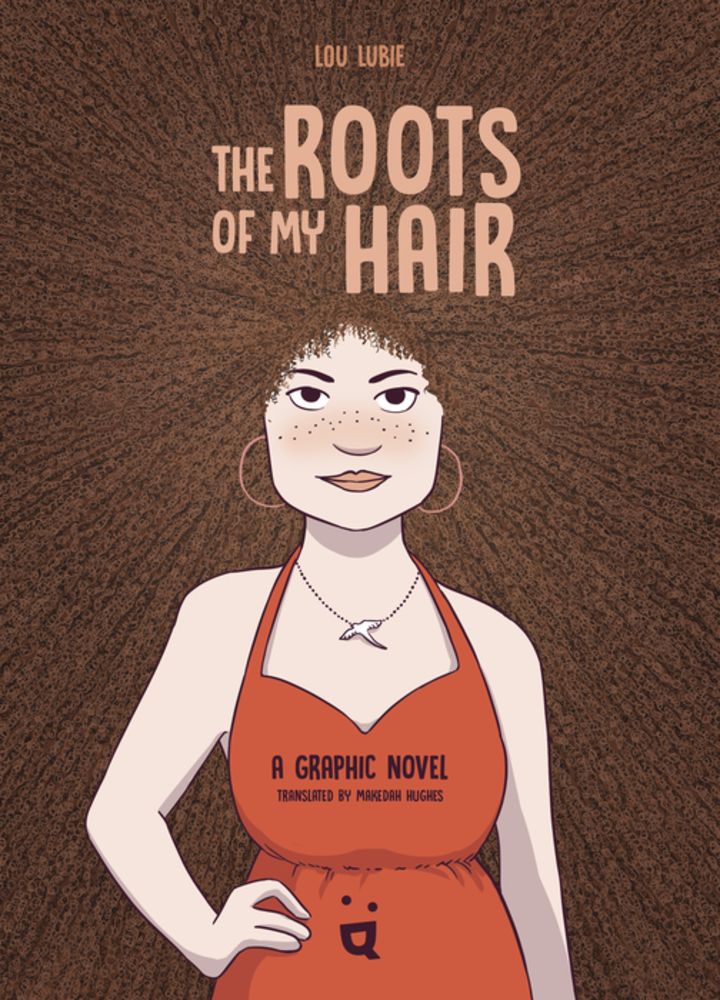
220 pp. May 5, 2026, Helvetiq. Graphic novel/Réunion.
Wash Day currently means for me cursing at tangles and wrestling with wet tresses; also worrying again about ‘product’ and how I’ll find something to replace the discontinued line I like. Wash Day unites women of African descent around the world, as does the fraught and evolving conversation around “Black” hair. The hair of people of African descent has been political for centuries now, from the imposition of headscarves in the Tignon laws, to the apartheid practice of the pencil test to determine how ‘African’ a person was. These are some of the subjects Lubie broaches in this graphic novel.
This is the story of a young woman as she comes of age on Réunion Island, and as she later moves to France for her education. The protagonist comes from a family of multiple ethnic origins: her mother is Cafrine (Black Creole), her father Yab (white Creole). Her brothers are dark-skinned with Afro-textured hair, but she identifies as white Creole because of her skin colour. Her hair, however, doesn’t: it’s ‘konyé’ (kinky)—although she looks “white,” Rose has a full head of curly hair she struggles to manage. She hates her hair on Wash Days, and in the mornings when she’s getting ready for school. She hates her hair particularly when she’s bullied for it at school. She never sees herself as beautiful, growing up, because of her hair.
People with this hair texture will relate to the things Rose goes through—like PE days at school, swimming, and rain being things that ruin her life. Rose finally cuts her hair short to manage it better, but that only increases the bullying at school—now they call her a lesbian and/or unfeminine. She eventually moves to France for university where she feels completely culturally and ethnically dislocated; and no one around her has hair like hers. At first, she tries wearing hats, but under those her hair still grows, leading to her discovering the shocking price of haircuts there. Later, she falls down the hole of African salons: wigs, weaves/sew-ins, and chemical treatment (“Beauty is Pain”).
If a book can be called sassy and fierce, The Roots of My Hair is that. It’s unapologetic on its soapbox, and is both entertaining and illuminating about the challenges women with Afro-textured hair face all over the world. It captures especially well the ambivalence women of Black and African descent feel about (what should be) their “crowning glory”; Rose only ever feels good when her hair is straight, or hidden. This novel is also immensely educational: about the many, many ethnicities living on Réunion and how they perceive or describe themselves, and their languages and cultures; and the history of Afro-textured hair typing—because all of these things have a bearing on how Afro-textured hair is perceived on the island (with corollaries around the world). Lubie delves into the anatomy and physiology of hair, describing the physical differences between textures. Then there’s pink tax: how women’s products, including those for hair—which society puts pressure on women to use by demanding a certain standard for women’s hair—are unfairly priced. This is particularly acute for women of African descent. Lubie also describes the artificial hair industry, the online harassment of celebrities with Afro-textured hair, and the history, politics and health implications of hair straightening.
This is only part of what’s in this extremely well-executed and comprehensively researched graphic novel. It’s particularly interesting for its setting—in Réunion and France—and the implications of French colonialism on racial dynamics. It can be both a conversation-starter and a gift to give to your friends who don’t fully understand the fuss about “Black” hair (when you’re tired of explaining). A truly excellent read, and very highly recommended.
Affiliate link: Support independent bookshops and my writing by ordering it from Bookshop here.
Find out more about The Roots of My Hair from the publisher’s site here.
 Harare Review of Books
Leave a comment