
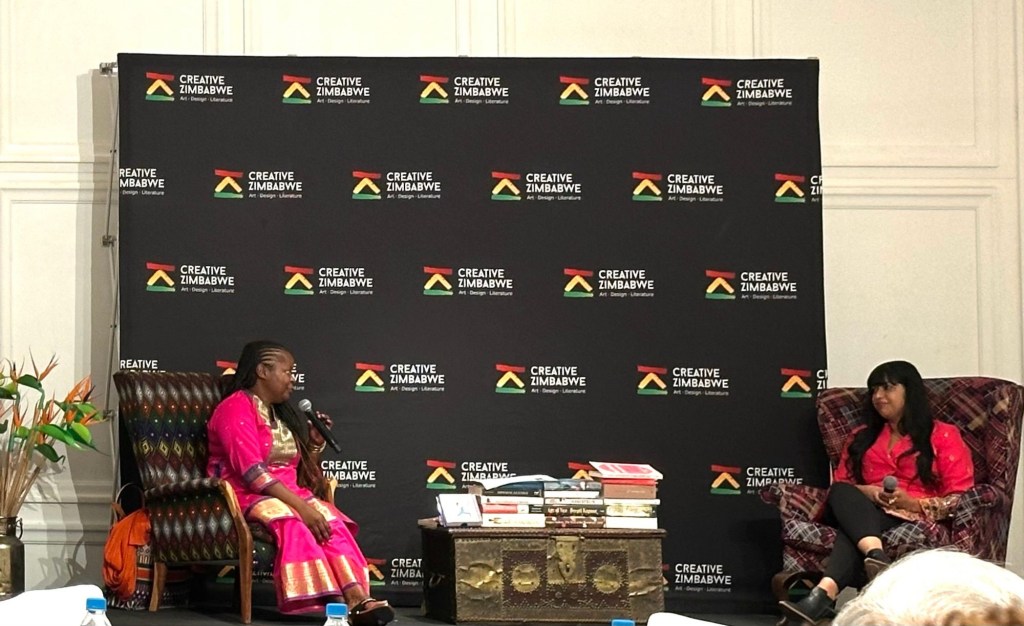
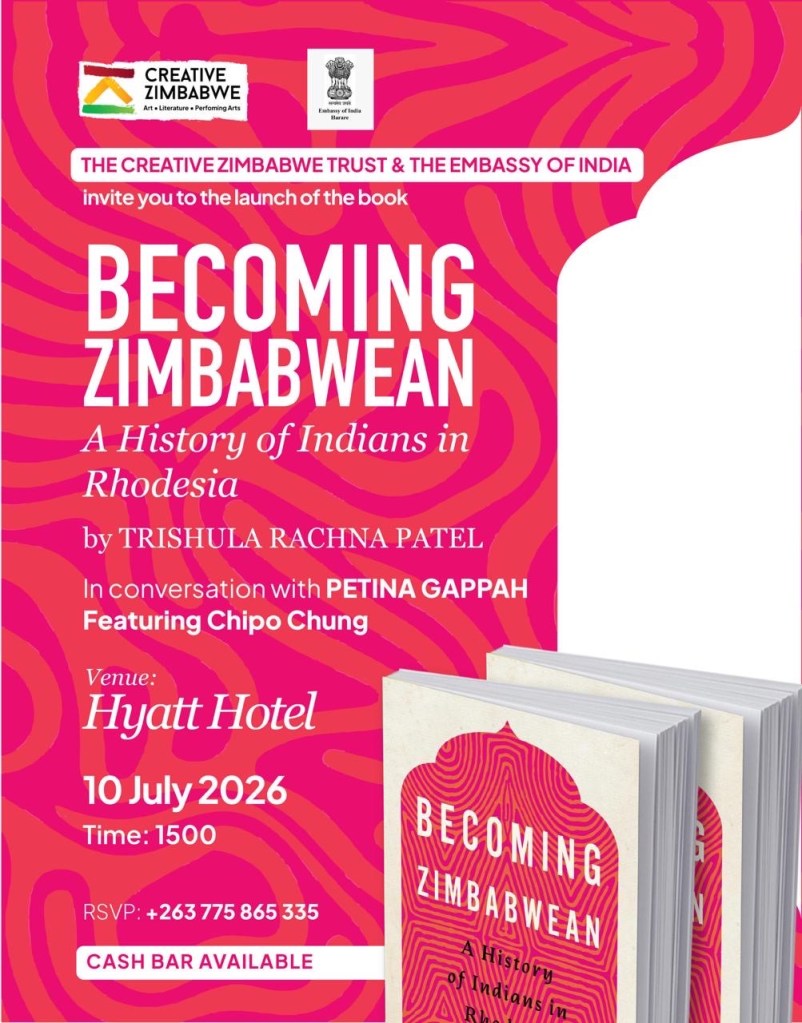
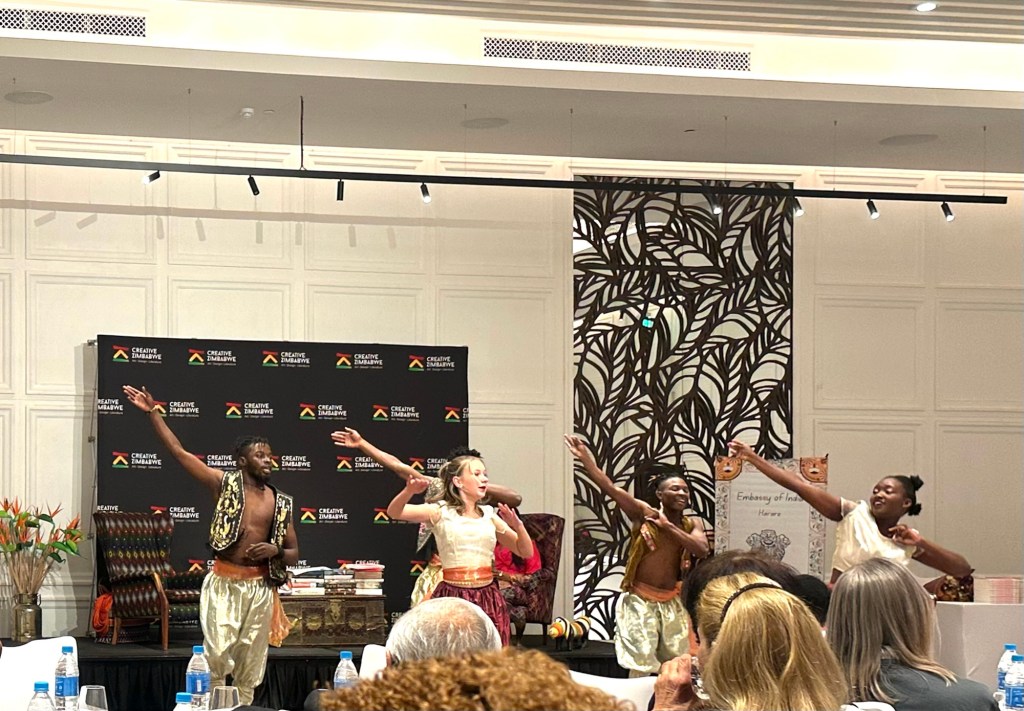
Dr Trishula Rachna Patel’s book launch for Becoming Zimbabwean: A History of Indians in Rhodesia was a glamorous affair held at the Hyatt Regency Hotel in Harare (formerly the Meikles Hotel), on the evening of 10 July 2026, hosted by The Creative Zimbabwe Trust and The Embassy of India. There were readings from Patel’s book and “Aunt Juliana’s Indian” from Petina Gappah’s An Elegy for Easterly, followed by an interesting chat between Patel and Gappah. Chipo Chung was MC for the event.
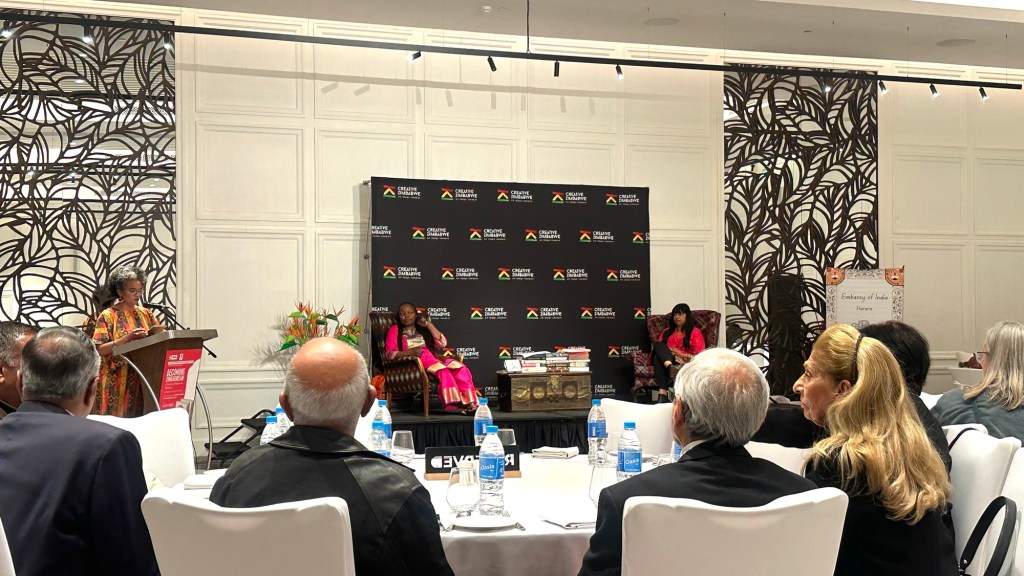
Among the speakers were the Indian Ambassador to Zimbabwe, H. E. Mr Brahma Kumar; Ambassador Hasu H. Patel, Professor Emeritus at the University of Zimbabwe and former Zimbabwean High Commissioner to Australia, New Zealand and Singapore; and Justice Bharat Patel, who is on Zimbabwe’s Constitutional Court.
Ambassador Kumar spoke about how “newly independent countries are struggling still to fully integrate [migrant populations] in their social and political fabrics,” and said the book raises a very important question:
“Why do these Zimbabweans have to be identified as Zimbabweans of Indian origin? Why are they not just Zimbabwean, and broadly, why are they not just African? This is a question that Africa needs to ask itself: What is the meaning of being an African?”
He drew a line from this to the xenophobic violence being experienced by Zimbabweans in South Africa, and entreated the audience to see how those things could be related: “Indians” in Zimbabwe “do not have to be Black to belong,” he said, but “make generational claims to belonging.”
“Members of the Indian community also stood in solidarity with the people of Zimbabwe during the country’s struggle for independence. Many offered moral support, practical assistance, and unwavering belief in the ideas of justice, equality and freedom.”
Amb. Kumar also pointed out the importance of documenting ordinary history: “Books such as this are invaluable because they preserve memories that might otherwise be forgotten. They remind [us] that history is shaped not only by political leaders and major events but also by ordinary families whose determination, sacrifices and dreams leave an extraordinary legacy.”
Ambassador Hasu Patel congratulated Dr Trishula Patel on what he believes is the first book-length work collecting the oral histories of Indian Zimbabweans. He spoke of how in the book Patel concentrates on the “dukhan” around which the life of Indian Rhodesians and Zimbabweans has centred:
“Dukhan is a Gujarati word, which means … the shop. [The shop] became the central focus of the early pioneers. Because of the segregationary policies, they had no other choice. They were also not very well educated. And [most] had no other choice except to go into trading (although some went into market gardening and hawking). The shop represented a unique element of the society. It was a family kinship network. And it became not only an economic space, it also became a social and political space. And [Dr Patel] expands on these different spaces in the book.”
Amb. Patel related how Indians moved out of the dukhan as they became “educated and professionalised,” becoming doctors, lawyers, judges, academics and more; and also out of the “ghetto,” the area between Harare’s railway station and the Kopje, into places like Ridgeview. He recounted the history of the establishment of that suburb, which was originally meant to be a multi-racial area “although it is still predominantly an Indian area.” He also shared other fascinating tidbits from Indian Zimbabwean history—like the activity of the South Rhodesian Youth Organisation, which made “connections” with the editor of the African Daily News, Nathan Shamuyarira, sixty-six years ago. “What is interesting,” Amb. Patel said, “is that they also put an advertisement in the paper, that they were against the 1960 constitution.” As a result of this connection, he added, Shamuyarira was a guest in 1980 when there was a prayer ceremony in the Hindu temple to welcome Zimbabwean independence.
The ambassador ended with this:
“In short, I agree with [Dr Patel], that this is an African story. But this is also, as far as the Indian embassy is concerned, a diaspora story. And so it’s a mixture. It’s an African population, but also a diaspora one. And so those two identities remain, but the belonging is still local.”
Here’s the publisher’s blurb for Becoming Zimbabwean:
The first comprehensive history of Indian migrants and their descendants in Zimbabwe Becoming Zimbabwean tells the long-overdue story of the Indian community in the former British colony of Southern Rhodesia, now Zimbabwe. Centering the stories of individuals and families, and building on a foundation of extensive archival research, Trishula Rachna Patel—a Zimbabwean of Indian origin herself—shows that the history of Indians in Zimbabwe is not of a transient diaspora but one of deliberate permanence. Indians initially played a critical part in the settler colonial process in Southern Rhodesia, but as new generations were born and raised, their politics and social lives evolved to localized forms of citizenship. Eventually, they functioned as part of the resistance to the Rhodesian white minority government, either through participation in the system as non-whites or by joining the Black anticolonial nationalist movement. They did all this through their shops, African-rooted institutions that became social, economic, and political spaces through which Indians became Zimbabwean. In this highly readable and authoritative study, Patel makes clear that Zimbabwe cannot be properly understood without accounting for the substantial Indian community that has woven itself into the fabric of the nation.
About Dr Trishula Patel:
Trishula Patel is an assistant professor of African/African diaspora history at the University of Denver. She has a BA and MA in history from the University of Pennsylvania, an MS in journalism from Columbia University, and received her PhD in African history from Georgetown University in 2021. She teaches courses on precolonial and modern African history, legal history, race and segregation in African contexts, mobility and migration within and beyond Africa, modern South Asian history, and methods of oral history and archival fieldwork in the global south. Her published and upcoming works include the history of cricket in Zimbabwe, Indian diplomats in Central Africa, Mahatma Gandhi’s legacy outside the subcontinent, and xenophobia and nativism in 21st century Africa. Her first book, Becoming Zimbabwean: A History of Indians in Rhodesia (University of Virginia Press, 2026), focuses on the history of the South Asian diaspora in Zimbabwe, where she was born and raised. Her second book project is a history of cricket in Rhodesia/Zimbabwe, and how the sport was intricately entwined with the historical processes of land colonialism and reform in the postcolonial period. (From the University of Denver’s website)
 Harare Review of Books
Leave a comment