
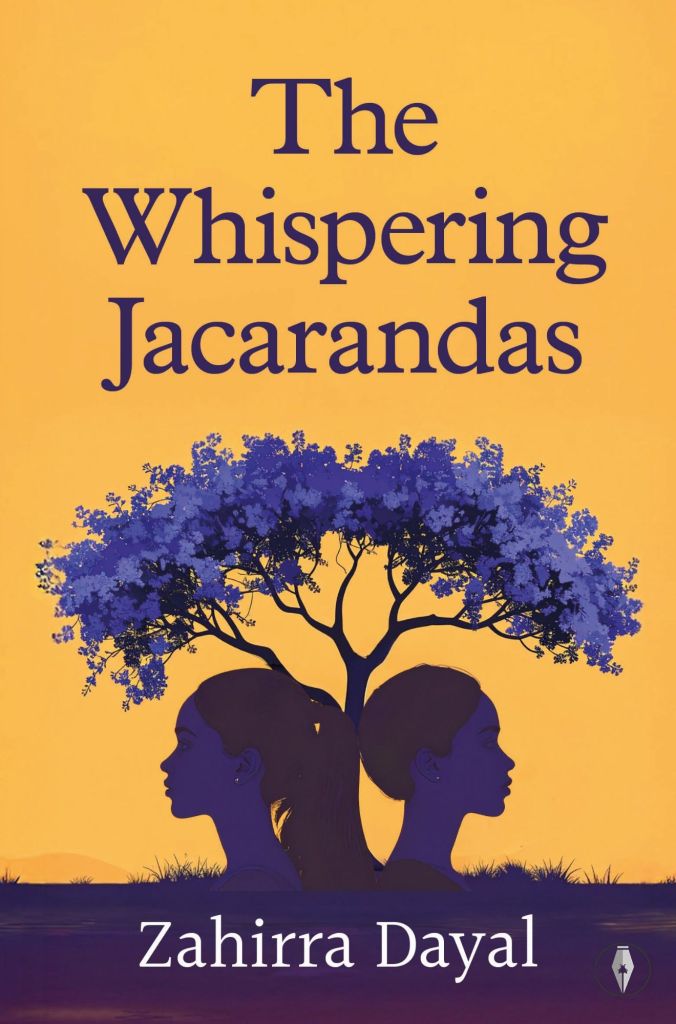
296 pp. August 28, 2026, Fly on the Wall Press. Fiction/Zimbabwe.
Two sisters share a terrible secret. At first it binds them together, but eventually it tears them apart.
Zaynah and Amira spend their days at their grandmother’s house, their refuge from a tumultuous home life. Ma is loving and present, two things their parents are not. But one night during Ramadan—and on subsequent nights after—their childhood innocence is shattered into a million tiny pieces, and a long shadow is cast over their lives that lasts well into their adulthood. Zaynah copes through conformity and academic success, but Amira falls into repetitive cycles of trouble and rebellion. All of this happens in the milieu of their insular Indian community and close family through Zimbabwe’s evolution in the decades since Independence.
The novel’s strength and emotional core is in Dayal’s descriptions of growing up Muslim and Indian in Zimbabwe, of the peculiarities of being in a community within a community. These are people preoccupied with preserving their traditions and identity far from home—even while identifying with the new country. Zaynah’s people are thoroughly Zimbabwean, and everything about her childhood is familiar to any Zimbabwean of that time and place; but religious and cultural observances set the tone of her family’s life, in gatherings, food, and prayer. The closeness of that community and family is a wonderful thing—the extended family pools resources for whomever is in need—but this is also the protectiveness whose dark side devastates the sisters.
Dayal unpacks, too, the prejudices of that community. Zaynah’s mother is Coloured, and therefore not fully accepted in the Indian community or the family—a matter of both class and race, partly rooted in Rhodesia’s segregationist history. Neither are her children—particularly Zaynah, who’s dark in complexion and has curly (Afro-textured) hair. And for this traditional family and in keeping with the pressures of this community, the patriarchy is never far away: although the women of the novel are strong characters, their lives are frequently in service to the men who so often overrule them.
Although The Whispering Jacarandas tackles a difficult subject—child abuse, and a family’s reluctance to face it—Dayal’s reconstruction of a Zimbabwe that has passed into memory is truly beautiful. It’s in small details that will make many Zimbabweans ache with nostalgia: the Dairibord ice cream man and his cart; the slang word “dwinch,” which many people who grew up with curly hair in Zimbabwe will be familiar with; the famed “Purple Panic” of jacaranda season, when public exam candidates know they’ve run out of time to study adequately; the downtown Indian shops that recall colonial segregation, but that remain such a distinctive feature of Zimbabwe’s urban landscape… and so much more. But it’s also in the larger, less pleasant themes, only touched on relatively lightly in this novel: Zimbabwe’s economic descent and political struggles, the overbearing nature of Mugabe’s rule. Zaynah attends university in South Africa, as many Zimbabweans have; even for those who did not, that part of the story will be very familiar through the stories of family and friends.
The Whispering Jacarandas is profoundly tender and evocative. Using jacarandas as the novel’s central motif will be meaningful to Zimbabweans and many southern Africans, for whom this tree is a favourite, well-loved invader, with its stunning seasonal display. The novel shares a legend about how jacarandas came to Zimbabwe, in an example of the emotional potency of Dayal’s writing:
“One of her aunts had told her the story about the jacarandas, whose beauty bewitched everyone. The trees had come from faraway places, crossing oceans and traversing continents, until they reached South Africa, and a couple returned to Zimbabwe from their honeymoon in Durban with six seedlings. The saplings thrived and soon the trees spread their roots further and further, causing an explosion of purple haze every year from September to October in Harare.”
This is a novel that tells of very human failures—of parents and families never truly equipped to deal with difficulty, making mistakes that deepen wounds. It throws a light on how children are too often left to fend for themselves after trauma, and how they must find a way to go on, doing so ineffectually—even in a seemingly close-knit family and community, where support is taken for granted. Difficult as these subjects are, The Whispering Jacarandas, thankfully, ends on a redemptive note.
Find out more about The Whispering Jacarandas from the publisher’s site here.
 Harare Review of Books
Leave a comment