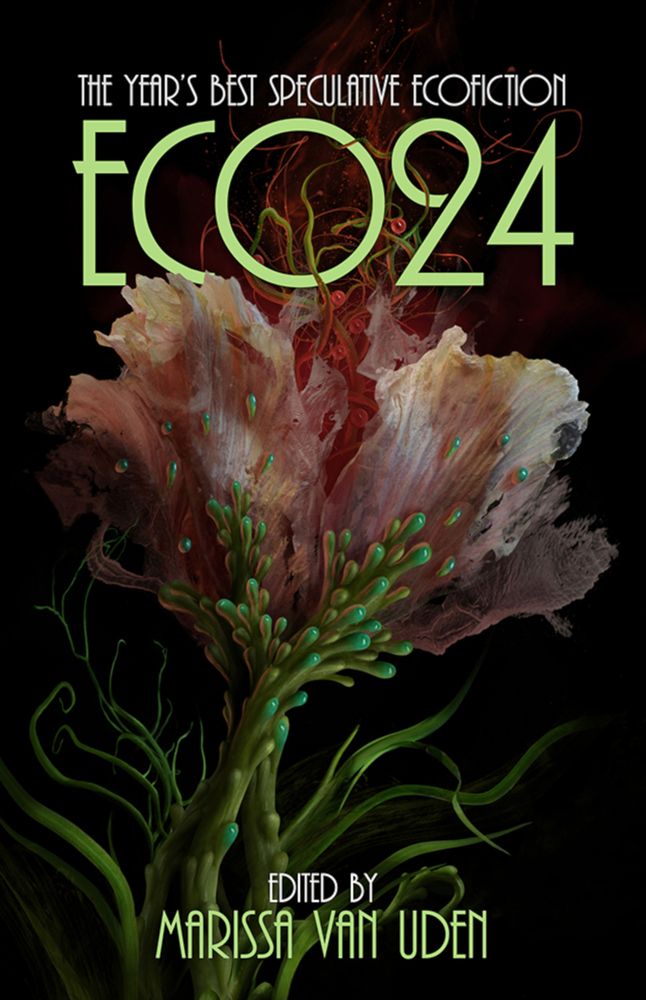
312 pp. November 18, 2025, Violet Lichen Books. Speculative/eco-fiction.
In Marissa Van Uden’s introduction to this collection, billed as one of ‘nature-based speculative fiction,’ readers will learn that John Statler first came up with the name for the genre in 1971, when he published Eco-Fiction, featuring stories by Kurt Vonnegut, Ray Bradbury, John Steinbeck, as well as Daphne du Maurier’s amazing “The Birds” (which has spawned many imitators). Sub-genres of ecofiction, we are told, include eco-weird and eco-horror—in fact, any flavour of speculative fiction that includes nature elements can be classified as ecofiction, including the works of Ursula K Le Guin, Frank Herbert, Algernon Blackwood, Margaret Atwood, Octavia Butler, N.K. Jemisin, Kim Stanley Robinson, J. G. Ballard, and Jeff Vandermeer. Ecofiction may not always be recognised as such, but it’s all around you: “Nature-based stories are everywhere, but it seems we don’t always notice what links together so many of our all-time favorite works,” Van Uden writes.
Shockingly, I haven’t read Rachel Carson’s Silent Spring yet, it being one of the zillion books on my (theoretical, at this point) tottering, tilting TBR—something I’m sure I’ll get around to if I live long enough (plan to, if only to read all those books). Silent Spring is mentioned too in the book’s introduction because Carson attributed her early interest in nature as stemming from two works of ecofiction—Beatrix Potter’s The Tale of Peter Rabbit (which shaped her worldview regarding ‘the inner lives of animals’), and Gene Stratton-Porter’s Freckles. Jane Goodall is said to have been influenced by The Story of Dr. Doolittle by Hugh Lofting and Tarzan of the Apes by William Rice Burroughs; Paul Watson, co-founder of Greenpace, by Edward Abbey’s The Monkey Wrench Gang; and Sir David Attenborough by Wild Animals I Have Known by Ernest Thompson Seton. Van Uden points out that other ecofiction—like Anna Sewell’s Black Beautyand KSR’s The Ministry for the Future—has led to changes in public policy.
This is interesting:
“We are drawn to these stories for their own sake, for the truths they tell about how we exist in this world, but the genre has also had a massive positive impact on the world. Studies on whether people take direct action after reading climate fiction have delivered mixed results, but if you look at some of the world’s most influential conservationists and environmentalists, there is often a treasured piece of ecofiction in their childhood that helped to drive the trajectory of their career and their passion for nature.”
If you were educated in the Western tradition (as I was), early books were mostly stories about animals doing things; but cultures around the world have taught life principles through stories about nature and animals for as long as humans have told stories. You almost certainly read something in the genre as a child: Charlotte’s Web, Watership Down, the above-mentioned The Tale of Peter Rabbit, The Story of Dr. Doolittle, and Tarzan of the Apes are listed as children’s fiction examples. The influence of ecofiction is, of course, hardly limited to just conservationists and environmentalists; certainly, it was very formative for me, a desperately earnest and intent (intense?) nature girl. I’m also a lover of SFF, so I was very keen to read this collection, hoping to find stories about how humans have affected the planet, what we’re doing to fix that, how nature is responding, and what the future might hold—all through a fabulist lens.
Now to the stories. The collection opens with Shelly Jones’s “In the Field,” a grim and moving story from the end of the human world, from the POV of a field research robot that’s the only remaining companion of a professor. The professor’s mostly lost in reminiscences about her life and work, so much so that she believes there’s still work for her to do in the world outside. (Whatever’s ended the world also corrupted her university’s data system, a scholar’s nightmare.) The robot’s tenderness towards the dying professor is very moving, and so is how the question of who we are when our life’s work is at an end hangs over the story: the professor wants the robot to continue her research well past the point when it matters anymore. “There are no humans here,” the robot tells us, no matter what the professor believes.
Eugen Bacon’s “The Water Runner” will be familiar to those who read her 2024 anthology, A Place Between Waking and Forgetting. This, too, the second story of the anthology, is grim: a woman’s daily task is to extract water from the bodies of the dead because it’s so scarce. People “sell” the water in the bodies of their loved ones to water runners for credits to live on. You won’t be able to read about this world without feeling your heart crack in your chest. What happens to the protagonist in the end is unspeakable.
That story’s a striking counterpoint to the lush setting in K-Ming Chang’s eco-horror/eco-weird, feminist “Ama’s Jungle,” which opens with the memorable lines, “We had never seen the color green. We punched each other to produce it.” This is essentially a Pied Piper tale: A bunch of young girls is trapped by an auntie who moves into their bleak neighbourhood. Ama moves in mysterious ways: “Ama had no belongings, and Yina never heard the gas stove ticking or the front door opening. “She only goes out the back,” Yina said. “She leaves the door wide open.” But where we lived, the back door only led to a chain-link fence. … We thought perhaps she left the back door open to let in a breeze, but there never was any breeze.” So when she shows the children the jungle in her back yard, they’re entranced, as all children would be. The jungle’s a living presence, ready to devour them, Ama its malevolent spirit. This is a horrifying and profoundly beautiful story.
In Louis Evans’s “A Seder in Siberia,” the main character is an eco-pheno-geno-biofeedback climate engineer (what a fun name for a profession, and so futuristic), tasked with tweaking and bringing order to the world. But order is a difficult thing to command, both in a biosphere and a family.
The fantastic “Our Best Selves” by Hiron Ennes features a deeply weird family (all families are weird; each weird family is weird in its own way) that’s moved to a ruined house (apropos) in the countryside: “The floors are dirt. Leafy columns of light tumble through the cracks in the roof. A possum hisses in the entryway.” (Delightful.) The furniture is also ruined, and “carved from the same stone as the walls,” even the beds. And the garden here seems to be wildly alive. As the story unfolds, we come to understand that the mom rejects the city life and modernity (probably in an attempt to protect her weird family), and see hints of problems within—but the family finds their way through. If this story veers into body horror—and, ew, it kind of does—this is bearable even for me.
Other authors in this collection: E.M Faulds, winner of the 2026 BSFA Best Short Fiction Award; Nika Murphy, with a luminous and sad story set in Ukraine; F. E. Choe with a lovely story about a dog (?) navigating a post-apocalyptic landscape (the watchers are a wonderful device here); Adeline Wong’s clever short tale about a student working out how one might reverse the damage to a climate-ravaged Earth; and Joshua Jones Lofflin wonderfully imagined sinking library from the vantage point of its last librarian. Cat McMahan, Kay Vaindal, Renan Bernado, Steph Kwiatkowski, Katharine Tyndall, Kelsea Yu, E. Catherine Tobler, Guillermo G. Mendoza, Osahon Ize-Iyamu, Trae Hawkins, Matthew Freeman, Jennifer Hudak, and E. M. Linden complete what is a marvellously deep and wide, well-curated collection.
Eco24 is very much worth adding to your physical library for the pleasure, joy and wonder it will bring you for years to come, when you rediscover the stories in it. You don’t even have to be a tree-hugger—comme moi—to appreciate all the things the stories are doing; you’ll likely love the collection simply at the level of story. It may even recall to you ancestral memories stretching back millennia of storytelling around a fire—or it may not, and you’ll still enjoy it. Very highly recommended.
Thank you to Violet Lichen and Edelweiss for access to a DRC.
Affiliate link: Support independent bookshops and my writing by ordering it from Bookshop here.
Find out more about Eco24 from the publisher’s site here or from Apex Book Company here.


Leave a comment