
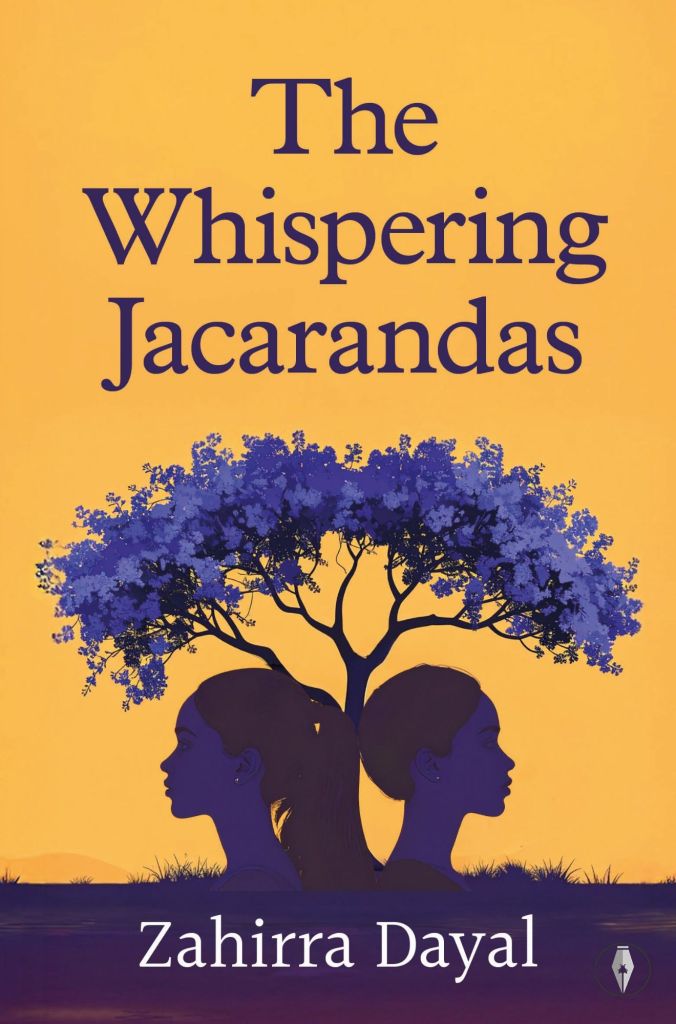
HRB is delighted to share this excerpt from Zahirra Dayal’s The Whispering Jacarandas, expected from Fly On The Wall Press on August 28, 2026. Fly on the Wall kindly provided this excerpt.
Zahirra Dayal was born in Zimbabwe and now lives in London, where she works as a university lecturer. Her writing explores belonging, racial dynamics, and the unspoken tensions of family life.
Her debut novel, The Whispering Jacarandas, grew from a short story inspired by her grandmother, who migrated from Gujarat to Southern Africa, and was developed into a novel through a Jericho Writers Self-Edit bursary.
Zahirra’s work has appeared in The Mechanics’ Institute Review and Tesserae, with a poem forthcoming in Third Space. She has been longlisted for the Deborah Rogers Prize and the SI Leeds Literary Prize, and shortlisted for the Owned Voices Award, receiving mentorship from acclaimed writers including Yvonne Singh.
The Whispering Jacarandas is a haunting debut which unfolds in the charged aftermath of Zimbabwe’s independence, where sisters Zaynah and Amira grew up within the shelter of a close-knit Indian community. When a single night of violence drives a rift between them, one draws inward into secrecy whilst the other seeks escape in rebellion.
As the sisters navigate adolescence under the shadow of silence, their paths diverge. Against a backdrop of political upheaval and simmering racial tensions, they must confront the weight of trauma and the fragility of identity, as they struggle to repair the fractured thread of sisterhood.
Under a purple sky
Maryam. 1993
Maryam’s body filled the bathtub. It had taken four pairs of arms to lower her in. The women washed the right section of her front and back and then the left, covering her awrah with strips of white cloth. With their eyes lowered, the washers’ lips moved in unison as they recited the prayer. The up and down cadence of their voices was hypnotic. Was she dreaming?
Camphor-infused water collected in the creases of her battle-weary body that had birthed eight children. Maryam waited for them to wash her three times: odd numbers were auspicious. Her body was safe here. These women held the secrets and scars of all they had bathed before her.
One of the women wore gold bangles that reflected the light sneaking under the bathroom door, taking Maryam back through all those years…all the way to her childhood. The year she turned twelve. Scrubbing tin plates under the fire-hued flowers of the Gulmohar tree, making patterns with the reflection of her glass bangles on the silver bowl.
‘Stop daydreaming, Maryam!’ came her mother’s tired voice, interrupting her game. ‘Arrrre. Who will marry a girl who is slow with everything?’
The following year, she was married.
The memory tugged at her chest, but the pressure of the hands on her forehead drew her back. The washers combed her silver strands, using them to hide her breasts – what was left of them. She’d never allowed her daughters to cut their hair. How shameful to go with nothing to cover your breasts!
A rose scent floated up her nose as the women wrapped her in the five perfumed garments. Finally, they tied seven evenly spaced knots to keep the white cloth secure. Leaving her face uncovered, they carried her to the living room and laid her down so that she faced Mecca in the East.
Maryam’s granddaughter was lighting the incense sticks in the brass burners on the mantelpiece. Zaynah rubbed the powdery grey residue on her black abaya and knelt beside her. A single tear slid down the girl’s face. Maryam longed to reach out and wipe it away.
Grey smoke swirled from the tips of the sticks and the jasmine scent began a slow journey around the room. Zaynah took a Quran from the pile and sat so close, her warm breath caressed the skin on Maryam’s cheeks as the guttural verses rang out, ‘Bismillahirahmanirahim…’
Zaynah, such a clever girl, but then a dark thought squeezed through a crevice in her mind. After her son’s wedding, someone with a dirty heart had cast a long spell of silence on 8-year-old Zaynah. Even a taweez was limited in the miracles it could perform, because there was a part of her granddaughter that was lost forever; a part so elusive, Maryam could only ever sense its absence. Too many girls and women swallowed the words they needed to spit out. Words fermented and rotted inside the body, killing it off slowly.
Her living room was naked without the sofas. Hadn’t she told her sons a thousand times to reupholster the brown ones – creaking with all the years of little jumping feet? Someone had covered the red carpet with sheets from her linen cupboard. Crisp white sheets her housemaid had washed and ironed by hand. Gift would be washing up dishes now, or on her knees scrubbing the floor. Hot shame rose inside her. If only she’d treated Gift better. It was one of the many sins she would answer for soon.
The sound of car doors slamming shut in the driveway, followed by hushed voices, interrupted her train of thoughts. She floated to the front door where women slipped out of their shoes. Her doorway was like a second-hand shoe shop, with rows of tattered sandals, slippers and high heels. Eyes protruded when they faced her supine body. Some came up to get a closer look; morbid curiosity danced across their faces. Others stole sly glances when they thought nobody was watching.
Four eyes pierced her, belonging to the twins with scissor-tongues, who carried all their grudges and hatred on their backs. They terrorised her granddaughters – calling them ‘half-castes’ any chance they got.
‘Sorrreee about your grandmother. So sad,’ said one of them, her lips mangled into a knot, ‘there’s no noor on her face.’
‘Yes. Such a pittteee.’ The other nodded back. ‘Only the good shine with the divine light of noor when they leave.’
Zaynah’s younger sister, Amira, sucked her teeth at the twins. ‘Show some respect!’
Amira was like fire wrapped in skin, her sharpened claws ready to scratch. This wasn’t a bad thing. A girl’s life was littered with wars. But an anger as boundless as hers was dangerous. Instead of sadness, her face simmered with a rage even greater than the day she’d ripped hair out of a girl’s scalp. Amira glowered at Zaynah, who shifted, bending lower into the pages of the Quran. Whatever had happened between them oozed like an open wound.
Maryam didn’t have time to dwell on the silent thread of tension that stretched between the sisters, because her neighbour, Shakila, limped in with her bad hip. The woman launched herself on the other mourners, squeezing them in a thick embrace. When Shakila’s gaze fell on Maryam’s third granddaughter, Nadiya, her syrupy voice dripped through the air. ‘So fair, fair, mashallah.’ She gripped a chunk of flesh from Nadiya’s cheeks, turning the girl’s face tomato red. ‘This one will marry well, inshallah, inshallah.’
As proof of her piety, Shakila sprinkled mashallahs and inshallahs into her sentences as liberally as chilli powder in her food. Nadiya’s mother, Sour Milk, scowled. Maryam chuckled at the nickname they’d coined for her daughter-in-law, who talked with tight lips too indifferent to stretch for her in-laws.
Shakila planted her heavy frame cross-legged on an empty patch of sheet, enveloping everyone in a pungent cloud of asafoetida that rose from her clothes and coated the air.
There was a glass container filled with tasbihs near the fireplace and the women who came in chose a string of beads, before finding a spot to perch, ensuring their backs and feet never faced Maryam. Fingers clutched each bead as they worked around the circle, whispering the names of Allah. When they had completed multiples of ten, they signalled with their fingers to one of her granddaughters. They dropped one kidney bean for every ten tasbihs into a plastic cup, which made a loud clatter each time.
Find out more about The Whispering Jacarandas on the publisher’s site here.


Leave a comment