
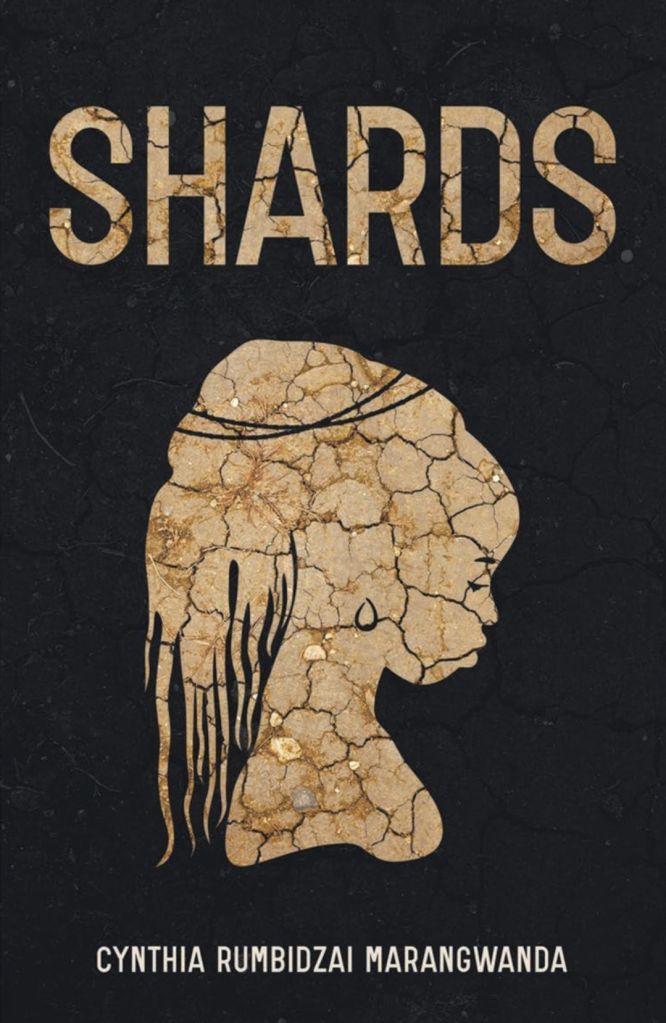
HRB is delighted to bring you an excerpt from Shards by Cynthia Rumbidzai Marangwanda (Carnelian Heart Publishing, 2023). Carnelian Heart kindly provided the excerpt below.
Cynthia Marangwanda is a Zimbabwean writer, poet, and spoken-word artist. She has shared her work locally and abroad, in places such as Namibia, Lesotho, the Netherlands, and the US. Her poetry and writing mainly deal with themes of identity, African spirituality, cultural heritage, Afrocentric womanhood, and revolutionary ideology. She holds an honors degree in women’s and gender studies from Women’s University in Africa. (From World Literature Today)
About Shards:
Shards explores themes of life in post-Independence Zimbabwe. In particular, it explores the practices of African spirituality and traditional religious beliefs, juxtaposed against the relentless march of African nations into modernity. Marangwanda won a National Arts Merit Award for Shards in 2015 for Outstanding First Creative Published Work.
You can see what HRB thought of Shards here.
And you can read an interview with Cynthia Rumbidzai Marangwanda here.
An image of my deceased paternal grandmother emerges out of the still air. Her eyes are fixated on my rottenness and I feel the irresistible pull of uprooted family trees. She is calling me without uttering a word and I feel powerless to resist her forces. She is dressed in her svikiro robes. Billowing black fabric shrouds her body like mist over Mount Nyangani. I tell Pan that my grandmother has visited again and he tells me to keep quiet, he is engrossed in a very engaging conversation with his dead father and I’m disturbing them. I greet my grandmother softly and respectfully with eyes cast down, but she shakes her head disapprovingly. I have disappointed her by consistently refusing to answer when I am summoned. I ask for forgiveness for what seems like the thousandth time, but she does not respond. Her obstinacy is an indictment I cannot bear and I begin to whimper despairingly. Pan laughs heartily at something his father has just said, and my grandmother inches forward, a subterranean look in her eyes.
My grandmother died when I was fifteen. I remember a bespectacled teacher from the boarding school I attended pulling me aside and gravely relaying the news to me. I recall him watching me closely as the words sank in, probably waiting for an anticipated outburst of violent grief but it was not forthcoming. I had not known my paternal grandmother well enough to feel anything but a curious rocking motion inside my head when I heard she was no more. The news destabilised me for, at most, a minute before my normal state of numbness resumed.
What I knew of her was that she was a Head Nurse at a rural district clinic, she possessed remarkably long and thick natural hair, and she was a svikiro, a spirit medium, in her spare time. The one time we spoke for longer than the customary greetings, she swiftly launched into a lengthy explanation about the parallels between Shona spirituality and Christian theology, as well as those between the sacrificial martyr deaths of the messianic figures of Nehanda Nyakasikana and Jesus Christ.
Growing up, I heard unsavoury rumours that she had deserted her children, my father included, when they were still young, only to reappear when they were fully functional adults, and such talk always made me survey her with a wary eye. Her marriage to my paternal grandfather had not lasted many years and she had never sought to remarry after that. I remember her being a very inward, taciturn woman who seemed to take great pains to insulate herself from the emotional level of human contact. I think I am certainly her granddaughter in this regard. I did not attend her funeral, I spent that day playing truant from my Mathematics and Accounting classes. A sociopathic gift for erasure soon rubbed all thought of my extinguished grandmother from my consciousness and life lumbered on, wooden as ever. Now whenever I used the term Gogo or Grandma, I referred to the industrious and admirably self-sufficient mother of my mother who still roamed the earth, albeit on incurably arthritic legs. And so with time, my paternal grandmother’s significance diminished further and further, until she had shrunk to the size of a subatomic particle in my memory. And life crawled on, slimy as ever.
And then four years to the day when she went to become an ancestor, she appeared again. So unexpectedly, after such a chasm of time. It was a day when I had forfeited all pretence of meaningful activity and elected to spend my time getting my hair braided by the family hairdresser in the comfort of my parents’ upstairs living room. The extensions I was using were imported from Dubai, courtesy of my mother. Appearance was ultimate, of course. The hairdresser was a talkative, gossipy woman a few years older than me, with three children all below the age of six. Although she was a generally amiable person who was skilled at her craft, she also had something of the nymphomaniac about her. She loved to talk about men, all things masculine seemed to thrill and enthral her to no end. Her voice would get husky and uncomfortably moist as she talked about the litany of males she had bedded, and the unattainable ones she nonetheless still heavily lusted after. The three fathers of her children had all left her for other women, but she seemed not to mind. She was perpetually on the prowl for the next penis to conquer and seemed to revel in this predatory pursuit.
On the day in question she was rambling on as usual about this and that fellow while she dealt with my hair. I couldn’t stop yawning. Midway through the braiding process, she started lamenting about how shocking it was that she had somehow managed to reach her age without tasting a white man. That was an abomination in her opinion and certainly needed to be rectified. Not sure how to console her, I simply listened to her chattering voice droning on. Soon my eyelids gave up and started to droop, and my head began to lose balance. I was dozing off. I tried to struggle against the tranquilising seduction of sleep, and in my attempt to pull back its heavy curtains I forced my eyes to open wide. That is the moment I saw my buried grandmother standing slightly to the side, in front of me.
I was so startled, my body jerked with such ferocity the hairdresser was momentarily silenced. She asked me if I was alright, had she twisted my hair too tightly? I shook my head and croaked that I had been bitten by an insect and was startled by the bite’s sting. She seemed to find my response satisfactory and started to tell me about the day she was stung by a wasp, back in her primary school days.
“Oooh, the pain was so sharp, I’ll never forget it,” I heard her say, as though through static.
My eyes were riveted on Grandmother looming there, her hair soaring in that brazen way I remembered from childhood. For some reason I suddenly felt acutely nostalgic, but for what, I could not pinpoint. Grandmother was holding out an ochre-coloured wrap cloth, her branchlike arms stretched almost to the tip of my nose. Her eyes were a silent plea for me to receive it, but my hands had turned to granite. She stood there for a resilient length of time waiting for me to accept what was offered, before cool saltless tears gradually began to stain her archaeological features. I wanted to look away, to redirect my sight elsewhere but I couldn’t. The empty space where her heart used to pump when she lived was breaking, fracturing, irreversibly, excruciatingly, and I was the culprit. Her lips were moving, and in the silences they produced, I could hear the wailing of distant worlds. Her skin rose in a whirlwind like drunken dust, ascending ever higher until it disappeared into the nightly heights beyond. I watched her tremble with uncompressed fury and I knew I had trespassed into a Hades of sorts. Her wrath burst into a multiplication of dark crow wings that flapped maniacally out of the window with the promise of vengeful returns.
All was calmness and solid reality again. Relief flooded me in streams of sanity that I drank from thirstily. I could not fathom what I had just witnessed, but I was glad it had died as quickly as it had been born. I was convinced nothing of the sort would ever occur again, it had just been a schizophrenic ripple on an otherwise serene surface, certainly never to be repeated. I was wrong. Grandmother returned three days later. I was lazing in my bedroom at nightfall, surfing the internet in hopes of stumbling upon some much-needed stimulus. There was none. I felt an iron breeze strike my skin and looked up. It was Grandmother. She was dressed in a straw ensemble I could not quite understand. She was holding out a wounded white lion cub, but again I refused to accept her gift. When Grandmother realised she had again been rejected, she bared her decayed fangs and her eyes began to flash in a manner better suited to lightning. She started to utter words like rusty nails in human flesh, as she slowly advanced towards my immobilised frame.
I was brimming with fear and soon a shattering cry spilled from my throat. The first person to come bounding into my room was my younger sister; she took one look at my petrified face and screamed for my parents to come. At the arrival of my sister, Grandmother promptly crumbled into a heap of ashes that seemed to blink at me with malicious eyes. When my parents appeared, followed closely by the housekeeper clutching a Bible, I told them I had had a bad vision but it was gone now. I was too terrified to reveal it was Grandmother. My parents stood around helplessly, unsure of what could be done. My mother’s expensive face looked its poorest, and my father decided I should take sleeping pills that night. My sister had her arms around my shoulders, attempting to comfort me. Eventually the housekeeper offered to say a prayer, and everyone except me bowed their heads and shut their eyelids. The housekeeper proceeded to unleash a most theatrical prayer of pentecostal proportions that I found quite entertaining. I giggled throughout her godly exhortations and Christly incantations, and when she said the final amen – there were quite a number prior, mind you – I clapped delightedly. They all looked at me with eyes that told of an uneasy shock creeping in. My father instructed my sister to go fetch a bottle of sleeping pills from my parents’ medicine cabinet, and after swallowing two, I fell into a graveyard sleep. But Grandmother did not go away.
Her visits became more frequent as the days and weeks trundled on, and the nature of these appearances became ever more insistent and urgent. She usually showed up when the sun had gone to sleep for the day, at the time when a crisp stillness sharpened the air. She always arrived when I was home unwinding, and she always caught me at my most unguarded. I started trying to anticipate or pre-empt when she would come, but this was always in vain. Grandmother had a way of deeply unnerving me with her sudden arrivals, a way that caused an uncontrolled anxiety to sprout and grow out of the cracked mirror of my being. Soon, I began to both expect and dread Grandmother’s familiar deadness bearing down on me in the most relentless of manners. I could not wipe her off, she was the stubborn stain no decorated detergent could clear. Her spectre was a shape-shifting array of alarming guises meant to contort my limits to their snapping point.
At times she would hold out piles of rotting dead fish whose unearthly odour and glassy staring eyes would drive me to the point of nausea. There was the day she came riding on a salivating lioness that gazed at me with such entrenched starvation I screamed so sharply my vocal cords complained. Sometimes she took on a serpentine form that chilled me with its cunning deviance, other times she sat cross-legged on the floor and performed heavy rituals I could not pretend to comprehend. On some occasions, she would carefully write her indecipherable thoughts in the air using her finger. She would write in the most aesthetically perfect calligraphy imaginable. She would offer me strings upon strings of beads in multiple colours while instructing me to abstain from the plastic fashions of the day. And there were the dozens of papyrus scrolls she started to bring me every time she visited. She strongly urged me to read these scrolls, despite the fact that they were written in an ancient language from beneath, a language too complex for me to decode. I remember Grandmother draped in blankets intently stoking the waning fire dying inside me. She offered me a compass once, it pointed nowhere existent but somehow showed the way.
In the beginning, I would resolutely ignore Grandmother’s overtures and her gibberish talk, but as her visits became more sustained and predictable, my resolve softened, and I gradually began to unlock my padlocked doors to allow her a measure of entry. I started thanking her graciously for all the varying gifts she unfailingly brought every time she came. I also noticed that her speech was not as nonsensical as I had earlier dismissed it to be, and soon began engaging in rich insightful discussions with her about everything from metaphysics to the science of rainmaking. She had such an expansive mind and I was slowly lured into an irresistible alliance governed by her invisible intellect and abilities.
I did not much care that the people I lived with would cast furtive anxious glances my way and shift their bodies unhappily whenever I spoke to Grandmother. I had explained the whole situation to my parents after her third visit and now whenever I conversed with her in the presence of my family members, other relatives, or the domestic staff, they would all maintain a stiff sober silence until my conversation with Grandmother was over. I took this as a sign of respectful honour for the depth of our discourses. The more absorbed I became in Grandmother, the less interest I had in those around me. The common cord that supposedly connected me to them began to seem less authentic and more contrived with each new sunrise. They all appeared so mundane and routine compared to the colossus I was now regularly confronting in the spectacle of my reawakened foremother. They were fading in relevance in a very rapid fashion.
Sometimes I would glimpse my mother or sister, their faces ravaged with unmasked horror and their cheeks sparkling with shimmering tears as they watched me from a distance. Other times I would notice my father, his accomplished features knotted in bundles of tension and despondency so severe I longed to untie them for him, although I lacked the knowledge of how to do so. The housekeeper would study me with a disgusted disdain that prickled my skin. She took to keeping a bottle of church-purchased holy water near enough to sprinkle herself and her surroundings whenever she encountered me in the house or in the yard. I ignored her antics. The gardener would simply stare at me with such a look of confused curiosity that I would find myself feeling slightly embarrassed, but only slightly.
My mother soon got into the habit of ushering me into my bedroom and locking the door from outside when family friends or relatives visited. But I wasn’t offended. In fact, it was quite alright because Grandmother hated guests. I would occasionally pick up snatches of talk between my parents and some other people who paid too many courtesy calls for it to still be courteous. Phrases such as “we should take her to this-and-that faith healer or traditional healer” and “no, what she needs is thorough medical treatment” would bubble down to me as I swam with Grandmother. Grandmother loved the water, she said it was her shrine. It was also her source of replenishment, the place where she stocked up on her mysterious supplies. Grandmother would bring me the river, its precious waters contained within her amorphous hands, and I would wade in enthusiastically, ready to soak up its secrets. I soon discovered the river was a friend. It housed amphibious entities that greatly enjoyed unfurling their vast landscapes of waterborne wisdom for the feeding of my famine. I drank in their knowledge with a thirst that remained perennially parched. Some days Grandmother would come clothed in the electrifying neon-blue waters of the caves of Chinhoyi and I would not hesitate to delve into their haunted pools, mermaid-like.
As Grandmother intensified into an ever-evolving necessity in the corridors of my consciousness, the naturally fragile link I had always maintained with my environment began to loosen and slacken further until I felt myself almost entirely dissociated. Then came the day I was seated awkwardly in a large claustrophobic room in a (mental) institution of higher learning. It was my first – and excruciatingly dismal – attempt at acquiring a university education. I was valiantly fighting to focus my concentration on what the female lecturer with a hideous perm was preaching, but I was of course failing fantastically. In the process of this quiet struggle, I felt a thing stir within the recesses of my inner ear. It was a faint pounding sound, a dull ache too subtle to be medicated. My body tensed as I waited and listened. Something was afoot.
Find out more about Shards on the publisher’s site here.
Affiliate link: Support independent bookshops and my writing by ordering it from Bookshop here.


Leave a Reply