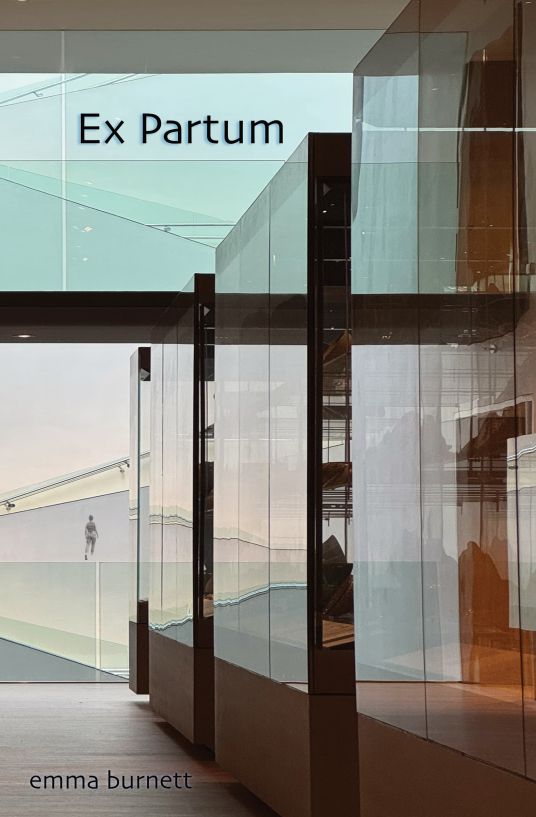
118 pp. June 2, 2026, Atthis Arts. SF.
Us vs Them. Most dystopian imaginings feature a variant of this: division by class, by appearance, by some arcane ability. burnett’s book asks a more than usually interesting question: What if that division was by how people eat?
In Ex Partum, a bunch of people have signed up for a controlled life where what they ‘eat’ (consume is a better word) is tailored to them, in the form of nutrition ‘bulbs’ (essentially, Soylent). For this to be effective, they must create a society where they live apart, where their environment is also controlled—and so they’re housed in separate apartment blocks across this unnamed city. And indeed they’re so committed to their lifestyle that they’ve accepted anatomical changes for adaptation to liquid food (they look down on chewing as base), so their teeth are smaller than normal. They’ve also, of course, created a whole philosophy around how and why their way of life is superior.
And if Block residents are the in-group, there must necessarily be an out-group—those who’ve opted out. For most of the novella, readers are co-opted by the narrative and only see these outsiders, or “excoms,” from the viewpoint of Block residents. But snippets of information about them, like rumours, raise suspicion that perhaps Panya, the protagonist, and her pals have received beliefs that are upside down.
Readers will gather early on that there’s an overarching entity, probably a corporation, that drives all of this, and profits from it. So this is a book about societal divisions, those made additionally nonsensical by capitalism—which tends to hide its hand, as history will always show. But it’s also about the difficulty of mothering in a controlling society—which is most societies under the patriarchy—when you don’t have the help and support you need. Panya is oppressed by Capital, by her gender, her choice to have a child, and by the enforcers of this complex system; and she’s a sympathetic figure because she’s so naïve. But Panya is also ridiculous in her prejudices, and even when she needs help, she struggles to get over them. She’s a fascinating figure that way: both a victim and a product of her society, mentally agreeing with her beliefs even as she suffers from them.
burnett’s world is very carefully constructed, and so well done in these few pages. Particularly effective is Panya’s development, from her realisation that she’s in crisis to her grudging acceptance that she may be wrong in all she thought (and it is grudging). If burnett doesn’t paint a full picture of this world Panya inhabits, it’s easy enough to imagine, simply from extrapolating what life might be like if the corps we know today became all-powerful—which is something many other SF writers have explored. What sets Ex Partum apart from the majority of those stories is the chilling exploration of dystopia from a new mother’s perspective.
An excellent novella, well worth your time and pondering. Many thanks to Atthis Arts and NetGalley for DRC access.
Note: Please read emma’s essay on her experience of publishing this book.
More about Ex Partum on emma’s site here. And here’s her Patreon.
Affiliate link: Support independent bookshops and my writing by ordering it from Bookshop here.


Leave a comment