
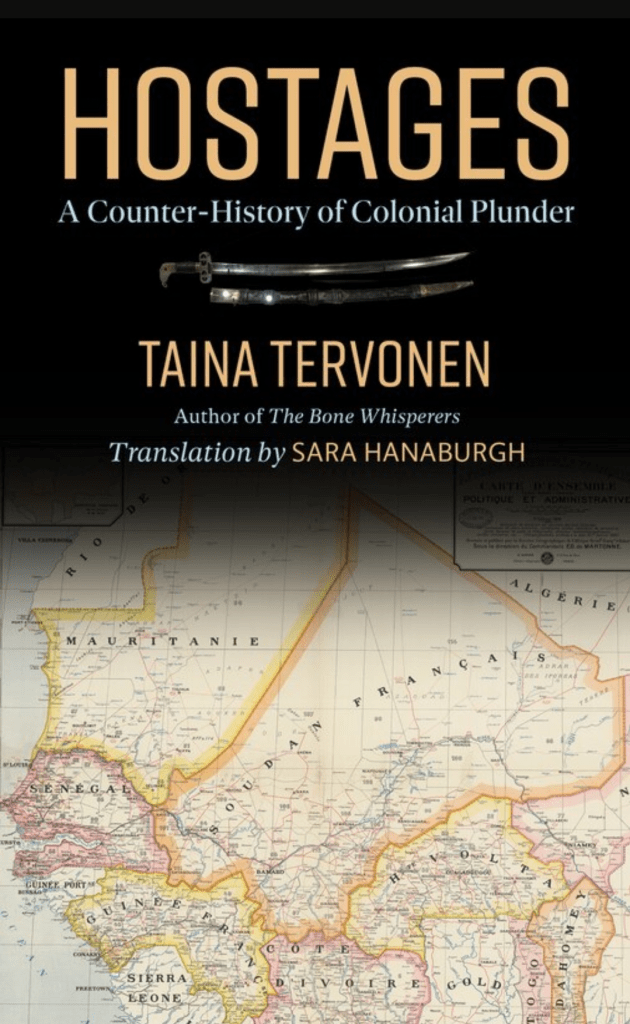
240 pp. February 2, 2026, Schaffner Press. Non-fiction/African History
One April morning in the late nineteenth century, a French army officer, Louis Archinard, with his troops, raided the city of Ségou, the capital of the Toucouleur Empire, located in present-day Mali on the Niger River. Ahmadou Tall, its ruler, was not home; so Archinard proceeded to ransack and loot, coming away with “weapons, gold and silver jewellery,” and five hundred and eighteen manuscripts. Archinard also took people, including the emperor’s ten-year-old son, Abdoulaye. All of the treasure—and that son—ended up in France.
Taina Tervonen has gone back and forth between France and Senegal to retrace the movement of Archinard’s “treasure,” and to find its current location. This is no mean task; as we have come to see during restitution claims, looted artifacts languish in museum basements, forgotten or mislabelled; are lost because no one tracks their movement from place to place, or documents get misplaced; and sometimes these artefacts are stolen again for at least a second time. Museum curators may be (or say they are) very careful about looking after these treasures, but they have often misunderstood their significance as they have. neglected to consult the community these objects were stolen from. Then, too, original looters sometimes lumped different objects together by category (drums, garments, daggers, swords and knives) without knowledge so that their original function was not recorded, nor was their provenance. It is, in short, a mess, and hunting down specific artefacts, as Tervonen tried to, is frequently unfruitful—unless that object is famous; but that only applies to a small fraction of the material heritage in Western museums.
One object Tervonen traces is a sabre alleged to have belonged to El Hadj Oumar Tall, the great general and scholar who founded the Toucouleur Empire. The sabre was said to have been used by his grandson, Abdoulaye, to defend his mother from the invaders on that fateful day in 1890. It’s easy enough for Tervonen to locate what museums claim is the sabre in question: she finds it at the Army Museum in Paris, France. In 2019, that sabre was “restored” to Senegal, although not according to French law: it still belongs to France and was loaned to Senegal. It has been on display ever since at the Museum of Black Civilisations in Dakar. Whether this sabre indeed belonged to El Hadj Oumar Tall is in question, as we find out by the end of Tervonen’s quest. However, readers will come to wonder if that matters at all, when the value of cultural objects is decided and defended by that culture’s elders and history.
Tervonen’s fascinating mission ends on a poignant note: ultimately, Archinard’s treasure is only things, even if culturally and religiously valuable things, that are the source of some friction and a tug of war between France and Senegal. A far more terrible story unfolds in Archinard’s archives, in letters Tervonen finds that Abdoulaye, the abducted child, wrote to his French “patron.” Archinard, likely plotting a political future for him, had given Abdoulaye into the care of a couple in France. Abdoulaye was educated and no doubt socialised to become an upright young Frenchman, a credit to his “rescuers.” The idea was that he would eventually join the military and return to Senegal to serve France there and perhaps challenge or weaken his uncle’s rule over his people (a strategy that will feel strikingly similar to that of former colonisers today, who hope that those they show the grandeur of the (former) metropole will return to evangelise about it). Abdoulaye came to a sad end: not only did he become extremely disillusioned with his adoptive country and compatriots, but he also died tragically early, at twenty, of tuberculosis.
Tervonen’s book is an engaging and incisive account that invites readers to interrogate colonial practices: the brutality and violence, looting, breaking up of families through wars and abduction, and a terrible callousness towards colonial subjects. It’s interesting, too, for the questions it raises about who gets to tell history; as in the proverb Achebe made famous, the historians have always been the hunters, rather than the lions. Tervonen’s book, however, cannot then fully escape protestations about the colonial gaze and questions about access (both to European historical sources sources and archives and to publishers): as one interlocutor asks of its author, “a white woman, a descendant of the colonizers,” what her interest even is in these objects. Tervonen’s response is that she is not, like the erstwhile colonisers, French (being, rather, Finnish); that colonialism is a shared history, and interrogating that shared history is important because not talking about it “ends up creating problems elsewhere”—a perhaps quite simplistic answer. Her true interest may be both intellectual as well as nostalgic: she grew up in Senegal as the child of missionaries, and learnt some of this history in school.
Finally, as Tervonen says: “Domination requires controlling the other’s gaze and limiting its scope, whether it involves objects from elsewhere placed in museums to tell a story of natural superiority or a member of their youth who has been educated to a certain point, but who is only allowed to see what is admirable. […] Both the dominant and the dominated need to see each other as such until that gaze becomes so natural and integrated that we no longer notice it, and then even when everything around the visible shackles of domination shatters, the gaze remains, because it is part of us now. The other remains locked up inside, in an identity that has been assigned: the Black man is like this; the Toubab is like that.”
Thank you to Lauren Cerand for the review copy.
Affiliate link: Support independent bookshops and my writing by ordering it from Bookshop here.
 Harare Review of Books
Leave a comment