
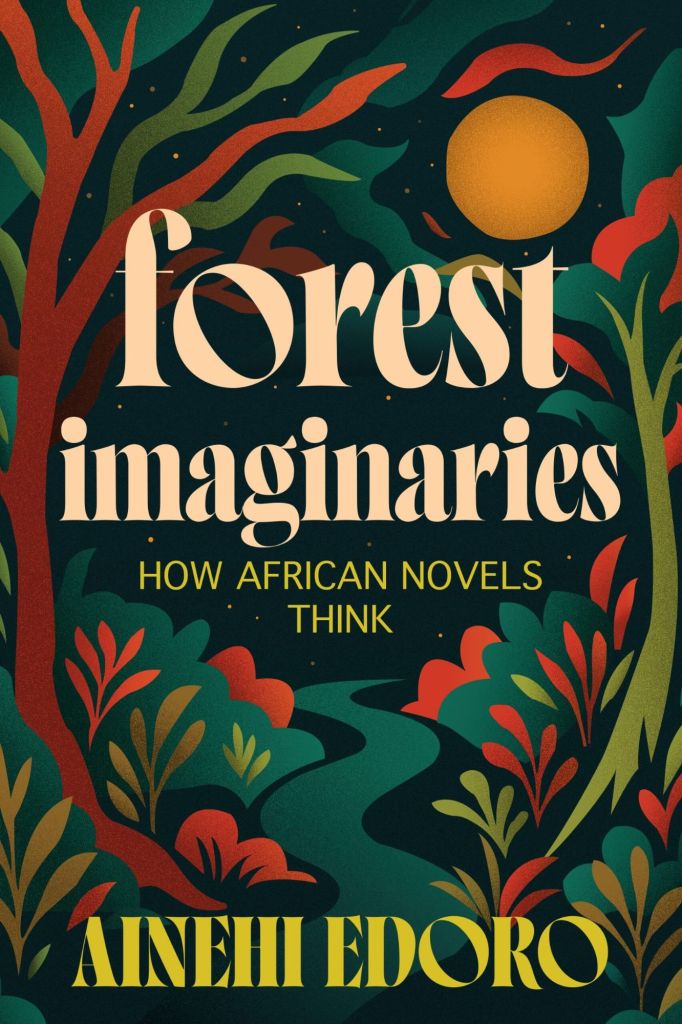
290 pp. January 20, 2026, Columbia University Press. Non-fiction.
All quotes below are from an advance copy of the book.
Zimbabwean folklore has the general concept of “bush” (sango in ChiShona, iganga in isiNdebele) rather than forest proper, but it was easy to locate it in Professor Ainehi Edoro’s Forest Imaginaries: How African Novels Think. It represents the ‘outside’: of village or community life; of normal or regular, ordered spaces; of day-to-day reality. When invoked, you know unusual or magical things are about to happen. It’s where dead things walk, where talking animals live. It’s where people exiled by society flee, a refugee for those fleeing trouble. Forests are a distinct and distinctive space, and also thresholds or portals. And in Edoro’s treatise, a forest is “a conceptual tool for rethinking the forms, histories, aesthetics, and critical methods of African literature.” Forests act as “indigenous archives,” places in African narratives where “knowledge and power” are kept.
“There is something about the forest that suspends law, lets imagination run wild, transforms bodies, and collapses time as well as the human and the nonhuman.”
The book’s prologue is illuminating, helping readers understand how Edoro came about her ‘forest theory.’ She grew up, as so many of us did, amidst stories “where hunters encountered strange creatures and barely lived to tell the tale,” stories where “the forest was a space that was both feared and desired.” She also grew up in what she calls “the remains of the Benin Empire, one of West Africa’s greatest forest kingdoms.” It’s easy to see how forests loomed large in her childhood imagination, and how the seeds of future scholarly enquiry were sown.
But, again like many of us, Edoro’s schooling displaced many of these ideas, at least for a while: she was educated in the Western tradition, reading Victorian children’s classics (although she also read Nigerian novels). By the time she became a literary scholar, Edoro says, “the forest [had] receded to the background as mere setting.”
Fortunately for us, the forest found its revival for Edoro in her late twenties, when she “rather fortuitously” read Chinua Achebe’s Things Fall Apart and Giorgio Agamben’s Homo Sacer at the same time:
“[I] couldn’t get the image of a sickly Unoka being left to die in the forest out of my mind. Both books ignited something that had lain dormant in my mind: the idea that forest stories captivate us because they ask very difficult questions about the world but through images we can grasp.”
This is the essence of Edoro’s theory about forests in African fiction:
“They are spaces for worldmaking—a kind of cosmogonic laboratory where storytellers try out different ways of reconfiguring the laws that govern our worlds so that they can offer us the knowledge of how to build a better world.”
The rest of the book sets out arguments to prove this.
In the introduction, Rethinking African Fiction from the Forest, Edoro lays out her theory of forest in more detail. She explains the theoretical basis of novels ‘thinking,’ of the forest as a unique and intelligent (thinking) space as well as a narrative device, and of its function as a protagonist. One of the main things troubling Edoro is how African fiction is thought about as being divided across the colonial encounter, pre-, and post-, rather than considered as a continuity from folklore and oral tradition—from, for example, Mofolo, to Achebe and Soyinka, through to today’s vibrant speculative fiction futures in Okorafor. It’s a pleasing theory, and Edoro clarifies why I dislike post-colonial framing: the tendency to see African history as dark and unformed before the colonial encounter, and as completely defined by it thereafter. So Edoro in this book demonstrates genealogy and creates a map of the development of fiction(s) on the continent, moving away from a Western analysis, and providing a useful framework for ongoing and future analysis.
She argues for a literary tradition that considers African literature and locates the early African novel not as in opposition or as inferior to the European. African fiction is not concerned with European preoccupations; therefore, it asks different questions, and theorises differently—easy to see when its history is considered in a linear, rather than discontinuous way. Edoro shows the European novel is concerned with the individual, while the African novel thinks about the world: how it’s made, how it works, where power comes from.
Forests proliferate across both time and the space of the continent in African fiction. Examples in the book from adult fiction: Joseph Jeffrey Walters’s Guanya Pau (1894), Thomas Mofolo’s Chaka (1925), Pita Nwana’s Omenuko (1933), D. O. Fágúnwà’s Forest of a Thousand Daemons (1938), Camara Laye’s The Radiance of the King (1954), Mongo Beti’s The Poor Christ of Bomba (1956), Chinua Achebe’s Things Fall Apart (1958), Ngũgĩ wa Thiong’o’s Weep Not, Child, Elechi Amadi’s The Concubine (1966), J. M. Coetzee’s Dusklands (1974), Ama Ata Aidoo’s Our Sister Killjoy (1977), Sony Labou Tansi’s Life and a Half (1979), Pepetela’s Mayombe (1980), Ben Okri’s The Famished Road (1991), Alain Mabanckou’s Memoirs of a Porcupine (2006), Lauren Beukes’s Zoo City (2010), Nnedi Okorafor’s Lagoon (2014), Trifonia Obono’s La Bastarda (2016), Véronique Tadjo’s In the Company of Men (2017). Some from recent children’s and YA fiction: Efua Traoré’s Children of the Quicksand (2022), Chikodili Emelumadu’s Dazzling (2023), and Craig Kofi Farmer’s Kwame Crashes the Underworld (2024). Readers will be able to list many more. And of course forests are important in African oral traditions; the book lists The Mwindo Epic of the Nyanga people in the Democratic Republic of Congo, The Ozidi Saga from the Ijaw of Nigeria, and the Epic of Sundiata from Mali.
Edoro posits her theory of forest in the book’s five chapters. The first, Thinking Like a Forest: Fragmentation In African Storytelling, explains that Wọlé Ṣóyínká “became the first to grapple with the forest as a formal and aesthetic problem in African literature.” Here, Edoro shows a theory of forest based on concepts in Yorùbá and Igbo cosmology, conceptualising the forest as a liminal space where “heaven” and “earth” meet—a place both physical and spiritual, neither and both.
Edoro also furthers her argument about how African literature scholars approach their analysis through a “historicist model of progress” (recalling the consequences of Western thinking about time as an arrow[1]); therefore, “[early] modern Ethiopian hagiographic writing, folktales, divination stories, hunter epics, praise poems” and other “indigenous narratives,” not fitting neatly into these models, are ignored. Edoro makes crucial points here about the degrading of Africa’s orally transmitted, indigenous narratives to something primitive, and motivates their inclusion in a zoomed-out, decolonial view of African literature that acknowledges its genealogy.
Edoro also introduces here an idea that’s important to the book: that the forest is a place of fragmentation and experimentation, “where everything is always changing, breaking apart, and coming together again.” The forest is therefore a place of repetition, continual renewal and remaking, a concept similar to Ṣóyínká’s “re-creative intelligence.” Edoro supports this through an analysis of Ṣóyínká’s writing (particularly his 1963 play, A Dance of the Forests), as well as a brief foray into Amos Tutuola’s My Life in the Bush of Ghosts. The point is that the forest is not a place of chaos, destruction and disorder, but rather one of [re]creation, possibility and worldmaking. Edoro explores this further through linking ideas about fragmentation and (African concepts of) fractals, and a consideration of fractals as both iterative and generative. (See: The fractals at the heart of African designs)
“Rather than viewing fragmentation as the binary opposite of wholeness, African fractal thought presents it as a means of structuring complexity and enabling continuous creativity.”
This allows Edoro to introduce a discussion of fragmentation in African epics (specifically, here, in The Mwindo Epic), which the reader will gather has been a hot topic of discussion for a long time in African literary scholarship. Again, it becomes clear how inadequate Western literary analyses are for understanding African narrative output. For African epics, with their iterative form, a ‘fractal’ consideration of story becomes useful: “[Certain] stories are simply meant to endlessly generate more stories.”
“Anansi stories, Ifa verses, and epics like Mwindo are more than narratives; they are knowledge systems that function much like Ṣóyínká’s transitional memory. The fragmentation inherent in these literary texts enables the accumulation and recall of knowledge in a way that is both flexible and enduring.”
The second chapter of the book, A Fairy Tale Of Blood (which would make a fantastic title for a fantasy novel), interrogates concepts of power—particularly colonial and imperial power—in African fiction. Provocatively, the subheading of this section is “Or Why Imperialism Is Always About Death.” Here, Edoro begins by exploring (a fictional interpretation of) Shaka’s rise to power in Thomas Mofolo’s Chaka. She describes the novel as a critique of modern power which can help us think about imperial power across the world—how, in her words, imperial power “does not abolish violence” but “sustains itself through the relentless proliferation of violence.” Edoro is aware that her choice of Mofolo is a political act: “By centering an early twentieth-century African novel in an examination of modern power, I also challenge the prevailing assumption in African literary studies that early African novels were only precursors to the politically mature novels of the independence era.” Again, in this chapter Edoro revisits the “archival erasure” of early African literature.
In Mofolo’s novel, Chaka is exiled to the forest as a child because he is ‘illegitimate.’ Edoro illustrates this as a symbol: Chaka is then “a figure of the forest, and that places him within the community but as what can never truly belong.” By simply existing, he threatens the existence and coherence of the community. In addition, strengthening the idea of his being a figure of the forest, Chaka’s power is forged in the forest, both through rituals and battle.
Edoro explores the ‘Evil Forest’ in Chinua Achebe’s Things Fall Apart in the book’s outstanding third chapter, appropriately titled Chinua Achebe’s Evil Forest. This section explains and explores the possibilities in the fascinating Igbo concept of ajöfia, defined as “a forest space set apart for things and bodies banned from collective life,” and reinvented or reinterpreted by Achebe as the Evil Forest. Edoro quotes Ikem Stanley Okoye: “[Ajöfia] is the [repository] for any objects that the society wanted to commit to oblivion.” The Evil Forest as explained this way is a place that exists so that order can be created in a community: it absorbs evil on behalf of the collective, what Edoro calls its juridical function. She demonstrates how this works in Things Fall Apart, and how this juridical function of a forest can be found in other African stories, Chaka included.
Also noteworthy is that evil forests can “stop working … or working properly” (an intriguingly mechanistic idea), “multiplying … emergencies and threats.” Edoro takes this in interesting directions when she explains how the Evil Forest fails to save the clan in Things Fall Apart from the white man and the empire he represents. The forest fails the clan again when the church mission they have consigned to it is not destroyed. It’s a juridical crisis: “By losing the evil forest and, by extension, the battle over death, the clan loses the capacity to decide what is within or outside the law, what is threatening or nonthreatening violence, what is legitimate or illegitimate violence, who is a spirit of the wild and who is not, where the wild ends and where it begins.” The clan has lost, Edoro says, and the Empire has gained “the power to give meaning to violence.”
This is a furthering of the ideas in the second chapter about how imperial power is able to sustain itself by proliferating violence. Here, the concept is more abstract: by conquering the Evil Forest, the Empire gains the power to dictate right and wrong, and what the clan had agreed as ordering their collective life is now determined by the Empire to be wrong and prosecutable in whatever way the Empire chooses. The management of violence, Edoro says, has passed from the clan to the Empire, and what was good and orderly for the clan is now bad. And because the clan’s desires were modest—simply to keep order in their world—their use of violence was limited. The Empire, however, is driven by a ravenous desire that will produce abstracted, unlimited, unspeakable violence; that’s perhaps the Empire’s real power. Furthering this thought, it’s a small step from there to imagining areas far from the metropole being defined as evil forests too and operating as such on behalf of the Empire.
In contrast, Amos Tutuola’s ‘Endless Forest’ in the book’s fourth chapter, The Endless Forest In Amos Tutuola’s Spectacular Fiction, is not about power but mainly about “[celebrating] the wild, unappeasable, ineffaceable power of a radically alien world.” Importantly, this playful world is where characters go to seek knowledge. Edoro takes readers on an adventure through the improbable forest of The Palm-Wine Drinkard and returns to the idea of fragmentation. The treatment of Tutuola’s work by scholars has been contentious; Edoro is firmly in the camp of those who think he was a genius. “Tutuola’s writing sits uneasily in African literary discourse,” she writes. “His work has been grudgingly admitted into the canon. Discourse on his work runs the gamut of insult to condescension to flattery.” Tutuola, however, is a genius to Edoro for his fantastical fiction; anyone can write realist fiction, she believes, which is simply about what we all see around us. If we seek “visionary knowledge,” it is “always something that emerges in the entanglements between the world of the living and other worlds,” in the liminal and numinous—like in Tutuola’s work. Somewhere in that irreality lies truth. (And I imagine Tutuola’s work is therefore possibly a forest too?) A fascinating analysis follows of The Palm-Wine Drinkard using game theory.
“Tutuola’s creatures are different. They’re not degraded versions of the human but fully formed beings with their own powers, logics, and strange beauty. Even when violent or grotesque, they don’t exist to make the human look better.”
Finally, in the book’s last chapter, Nnedi Okorafor’s Aquatic Forest, Edoro explores an usual presentation of a forest in African fiction, the aquatic coralline forest in Nnedi Okorafor’s Lagoon. Edoro formalises the term “forest thinking”, defining it as “reimagining worlds in ways that address urgent issues of our time,” something she sees Okorafor doing in Lagoon. She says, “One of the key arguments of [Lagoon] is that the survival of the planet rests on a radical reimagining of humanity’s relationship with the earth and its nonhuman life forms.” Okorafor does this through Lagoon‘s undersea forest.
The forest in Lagoon does all of the work forests do as explained before, but it must be important that Okorafor has located it in the ocean. Edoro interprets this as both “testing the limits of forest function” and expanding the possibilities of forest mechanisms (as described before, in the book). She uses Frederic Jameson’s theory of utopia to help frame Okorafor’s forest as a multispecies utopia at the end of the human world—not idyllic, but rather illuminating the “underlying injustices of the present.” In Lagoon, the aliens “establish a world in which crude oil is obsolete, but more importantly, they bring about a world” where humans can no longer “decide which life forms can live or … die.” This new world is one where all species coexist in entangled ways. Edoro muses that Okorafor has perhaps chosen to make her aquatic forest coralline, rather than kelp, because of the appeal of the mental picture of “myriad organisms clustering around the corals to form what feels like a pulsating, dynamic community.” Corals are also hybrid creatures—which fits in well with Okorafor’s utopian multispecies imagining.
Okorafor’s Lagoon is not only utopian but feminist and queer, which Edoro also explains in this chapter. Lagoon is about the future because it imagines the repair of multispecies relations as the only cure for what ails us, “the unreason of ecological violence” in the Anthropocene.
Edoro concludes the book with thoughts about the place of recent speculative fiction in African literature. “Scholars,” she says, “have effectively divided the African literary archive along the lines of a realist past and a speculative present, a past centered on recounting history and the present centered on imagining the future.” She sees in Okorafor and other contemporary African writers an embracing of the utopian possibilities of SFF (see more about this at the end of her chat with Bhakti Shringarpure of Warscapes, linked below). t’s important to Edoro that this book serve as a corrective for perceptions of African literature as separated by the colonial encounter. She considers this ahistorical, and lays out a persuasive case for linking African fiction from its early forms in oral narratives through to its speculative future; the success of this book is in how it all seems obvious in retrospect, like it was all waiting there for someone to see it.
Edoro’s study is extremely helpful for its elucidation of ways to think about African stories, for why forests recur in these narratives, and what they may mean. It should change how we read (and listen to, and watch) African fiction and, more than anything, how we link its history and genealogy, recent past, and its futures. The book has then achieved what one hopes for any scholarly work: it opens up new directions.
Thank you to Prof Edoro for a review copy.
If you’d like to hear more about this book, check out Prof Edoro in conversation about it:
- Book Club: How African Novels Think with Ainehi Edoro – Warscapes | YouTube
- Ainehi Edoro, “Forest Imaginaries: How African Novels Think” — New Books Network
Further watching:
- See lots of thoughts about time in this essay I wrote for Strange Horizons: Strange Horizons – Collective Dreaming: The Schrödinger’s Cat Approach to Framing Futures By Jacqueline Nyathi↩︎
Where you can find Forest Imaginaries:
- On the publisher’s website, Columbia University Press
- Affiliate link: You can support independent bookshops and my writing by ordering it from Bookshop here.


Leave a comment