
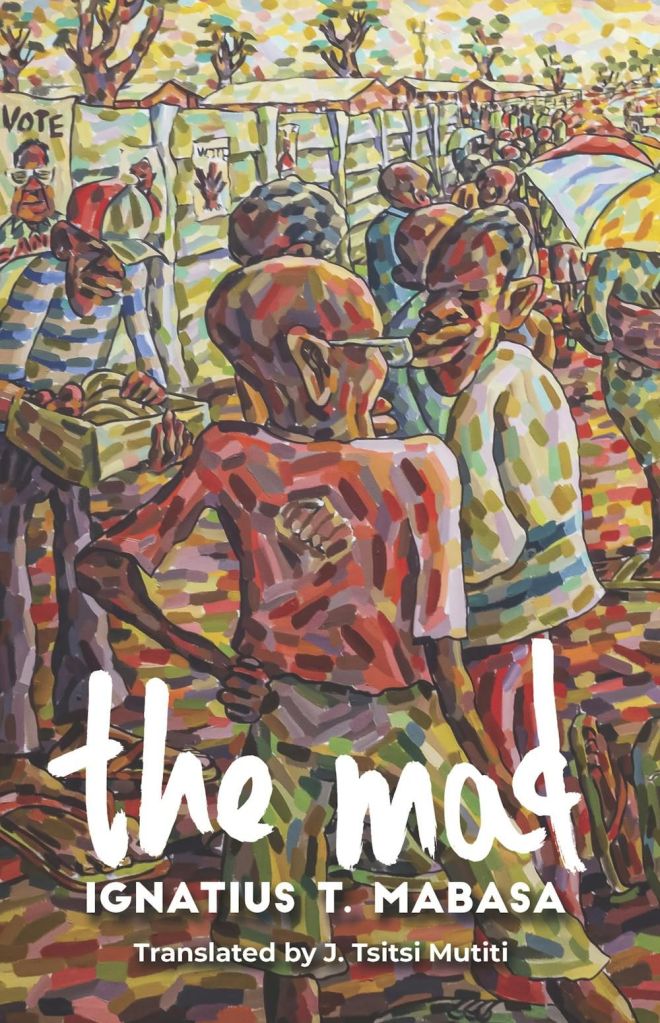
HRB is delighted to share an excerpt from The Mad by renowned Zimbabwean author Ignatius T. Mabasa, translated from the original in chiShona, Mapenzi (Harare: College Press, 1999) by J. Tsitsi Mutiti. The Mad was co-published by Carnelian Heart Publishing and amaBooks on July 29, 2025, and they’ve kindly provided the excerpt below.
See end for PDF download.
The Mad is a satirical novel that paints a vivid portrait of poverty, violence, dehumanisation, and postcolonial dislocation. The novel doesn’t shy away from painful truths, laying bare the realities of marginalised communities in Zimbabwe. The Mad is structured in a way that echoes oral performance, with dramatic monologues, dialogue-driven exposition, and moral ambiguity that swim in a pool of decolonial language politics. It is not only a milestone in Zimbabwean literature but a powerful African literary work that redefines what the modern African novel can be. It uniquely contributes to the broader conversation around how African societies manage cultural continuity and rupture in the face of colonial legacies, poverty, and globalisation.
Teacher
An oldish man was eating boiled maize and drinking beer. He bit into the maize and chewed as if chewing on a piece of bark to make string. His temples bobbed in rhythm with his jaws, as do two pestles in the same mortar being wielded alternately by two women. After chewing for a while, he took a sip of his beer and swallowed. His eyes were small and sunken, and he appeared very alert because they never remained long in one place; he was akin to the sentinel baboon that watches to ensure that its fellows are not caught in the act of stealing from the fields. He wore a moderately smart suit, in a lovely shade, though it was slightly soiled. You needed to look at it closely though to realise that it needed dry cleaning.
With the beer bottle on the floor between his feet, he read The Sunday Mail, tracking the words with his index finger and smiling to himself. People glanced at him and walked on by. He took a pen out of his pocket and underlined some words, then gently nodded his head. After checking his watch, he got up abruptly as if suffering from a sudden attack of diarrhoea. He snatched up his beer bottle and made his way to the station for kombis to Harare. On arriving there he saluted and stood to attention like a policeman or a soldier. He said to a woman with a baby strapped to her back, “Eee . . . Mai Kambeu . . . Is it Kambeu or Kamunhikwi? I forget, I have taught so many kids. Never mind, mother of Kagaka. But do you know I was once a teacher?”
He was silent for a while, watching the kombis arriving and departing, then he resumed, “What the hell are all you people doing? Oh my, just what are you doing? How do you expect these vehicles to move? Take cover, you’ll be hit by the enemy bullets. Hey! I said what are you doing? Hmm, I’d better keep quiet, else they’ll say I’m mad.” He lifted the bottle to his lips and gulped, eyes squeezed tightly as if drinking bitter medicine. He sighed “Aahh” as he took the bottle away from his lips. He looked towards the kombis again. “Uh uh, they just don’t stop, do they? Stubborn, exactly like a beard. Shave it today and tomorrow it’s sprouting again until you get tired of that shaving game.”
“What are they doing, baba?” the woman with her baby strapped to her back asked, perplexed by the old man’s behaviour.
“A-aa, Mai Kampira, don’t you see it? Look and see. They are leaping all over the place and then diving into the kombis, both the stationary ones and the moving ones. Then they suddenly stop! I’m just surprised; aren’t they scared of dying? Did you see the red kombi with tyres like Maud’s cheeks that is going to Harare? Never mind. Did you say something?”
There was a brief silence before he remarked, “Hoo ya-a, I was once a teacher, actually. A real teacher, writing on the board with chalk and teaching your kids, but they fired me. They say I am crazy. Would you accept that – me mad, amai? Do I look as if I might be raving, do you think? Someone who taught kids this past year and even had some getting fifteen points to go to varsity. Do you know what fifteen points mean, amai? Very hard to achieve; it takes a dedicated pupil and an expert teacher. Nuts! I don’t know who can diagnose this kind of crazy. Me, crazy? Now that’s really nuts. No one likes a profound thinker who speaks his mind. That’s me, wide awake and always on the ball. I’m a genius but they call me mad. Do they even recognise madness when they see it? Amai, do you know madness? Of the sort in which people have to be kept bound in heavy chains? People make jokes out of madness, honestly. By God, they are all nuts.” He paused, adjusting his trousers and watching the people at the kombis. He turned to look at the woman with a baby strapped to her back as if he expected her to say something.
The woman simply tittered, eyes downcast as if he were flirting with her. She said nothing.
“Oh, so everyone thinks I’m mad, do they? You are laughing at me, aren’t you, Mai Kampira? Why do you laugh at me? I bet you are nuts as well. Apart from myself, only one teacher in the whole school, Mr Shamuyarira, realises that I am perfectly sane. I showed my students how to critique literature; to think deeply, analyse and sift through the concepts. I taught them to see the grains of sugar at the bottom of a cup full of tea, to sort out the rocks from ruins and rebuild them into a mighty fortress in the mind. This needs a free mind, a fearless mind, flowing intrepidly like the white waters of the mighty Zambezi over Victoria Falls. Who does it fear, for what? It simply flows quietly without coughing or quaking. Foaming ideas and thoughts should never be repressed. A mind bubbling with ideas is what is needed. That’s all!”
The man looked up at the sky and started declaiming, gesturing with the maize cob.
“Hear me, hear me, I say!
Hear me, the voice of a mad one,
A voice hated as a debt is hated.
You may look away, but still you hear me,
I’ll vex you like a vagabond’s avenging spirit.
Go your way saying it is madness
But it will cook you slowly like trotters
And leave you pulpy like paper in the rain.
Hear that voice, hear it,
It will be like a hook stuck
In the mouth of the one fish
That got away,
Constant reminder of its brush
With a fisherman.
Hear me, oh hear!
Feel me like a punch in the eye!
Hear me, the mighty voice that wakes a baby,
Me, the voice you would wish silent like the
rocks.
The voice you would wish cold like a corpse.
The voice that speaks what you would rather not hear.
I’m not a lion drawn on a page in a book,
Whose mouth you may let the children
touch.
I’m not a deserted house in a ghost town
Home to lizards and rats, oh no!
The militant within me is an avenging spirit
That causes one to be a shabby vagabond.
His words kill and eat your sleep at night,
He is a small, loose stone in your shoe
Nibbling at your sole with each step,
Yet you cannot stop to remove it
Because your sock has gaping holes.
He is like dregs left behind in your gums
Burdening your tongue which continually
probes
The caves inside your cheeks.
He wrecks the head like a spade shovelling manure.
He eats up your ideas as the mechanic’s
greasy overalls consume soap,
Beware, he will hit you where you cannot rub
with your hand,
Where you can’t show your mother that
you’ve been beaten.
That voice is a subtle but frightening little
flame,
Later on, burning forests.
So listen well, like a woman of fellowship
receiving the gospel.
Is this decent, I ask you, is it pleasing? Answer me this tricky riddle then:
The pot was burnt cooking sadza on the fire But only the plates from the shelf
Went to grace the table?”
He became silent, then strolled to a large muhacha tree and proceeded to irrigate it with urine. Some people merely laughed, but others, bemused, shook their heads and asked what he was talking about. He came back, zip gaping carelessly, and boarded a kombi that was calling for passengers to Harare.


Leave a comment