
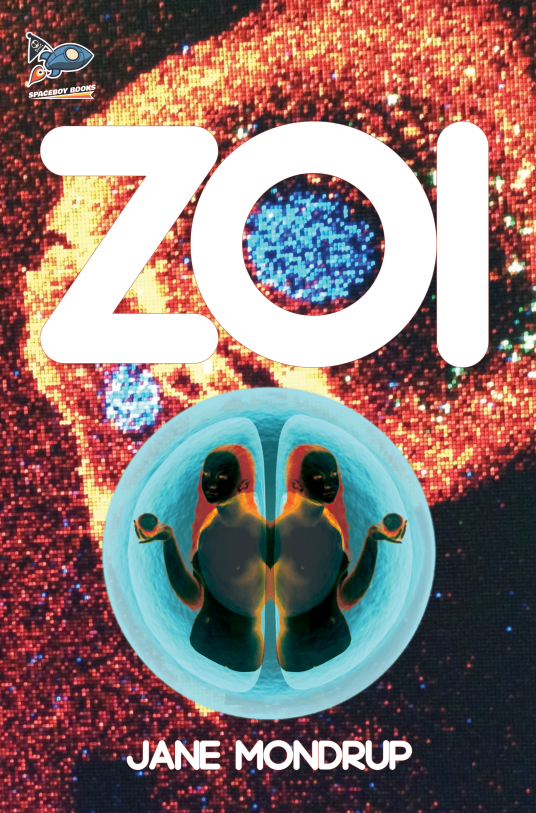
201 pp. June 20, 2025, Spaceboy Books. SF.
Weird, dreamy, and breathtakingly beautiful, this was an easy one to add to my favourite reads of the year.
Amira always wanted to be an astronaut after the mysterious star-faring (ok, space-faring is the more regular term) zoi were first spotted travelling through the solar system. She’s always had an ally in her uncle Karim, and he supports her through the difficult training. He also stands up for her when she elects to join a one-way trip with other astronauts inside a zoi to wherever it may take them. It’s not an easy decision to leave everything and everyone she knew behind, but Amira wants to do this once-in-a-lifetime thing, and to advance human knowledge—true to her scientist’s heart.
I know I loved this book because biology’s been my favourite thing since high school (apart from all of the other things I call favourite). And that’s what I nerded out on in this fantastically imaginative novel: It’s all about cells! Their physiology, replication/reproduction, organelles, all of that. It’s central to the conceit and plot of Zoi. It’s also great how Mondrup imagines the zoi: They’re seemingly not sentient, but continuously respond to their human cargo by making sure the astronauts have everything they need to survive. In turn and not unexpectedly, the zoi exert an influence—chemical, fittingly—on the humans, altering them at first in very subtle and confusing ways… and then, as time goes on, more extensively.
So this is a first contact novel, but also a thought experiment: What if the aliens we met were not laser-shooting lizards or hard-to-see fifth-dimensional superintelligent beings, but giant and fairly basic cells floating through space? What would interaction between us and them look and feel like? If we had to be altered to be able to interact with them, would that change who we are? Are these astronauts even still human by the time they‘ve achieved a kind of immortality?
Zoi is an interesting and refreshing exploration, too, of non-mechanical ways of adapting humans to space—countering most SF tropes which employ transhumanistic methods or involve incorporating cyborg elements. In this novel, the mechanism employed is external, through the influence of the zoi on human bodies; but it’s a fascinating idea: What if future science found biological means to achieve this?
I don’t think only biology nerds will enjoy Zoi; it’s a thoughtful read for the reasons above. Many of its concepts will be things I know I’ll come back to.
Thanks to Spaceboy Books and NetGalley for early DRC access.
Affiliate link: Support independent bookshops and my writing by ordering it from Bookshop here. Paperback | ebook
 Harare Review of Books
Leave a reply to Jacqueline Cancel reply