
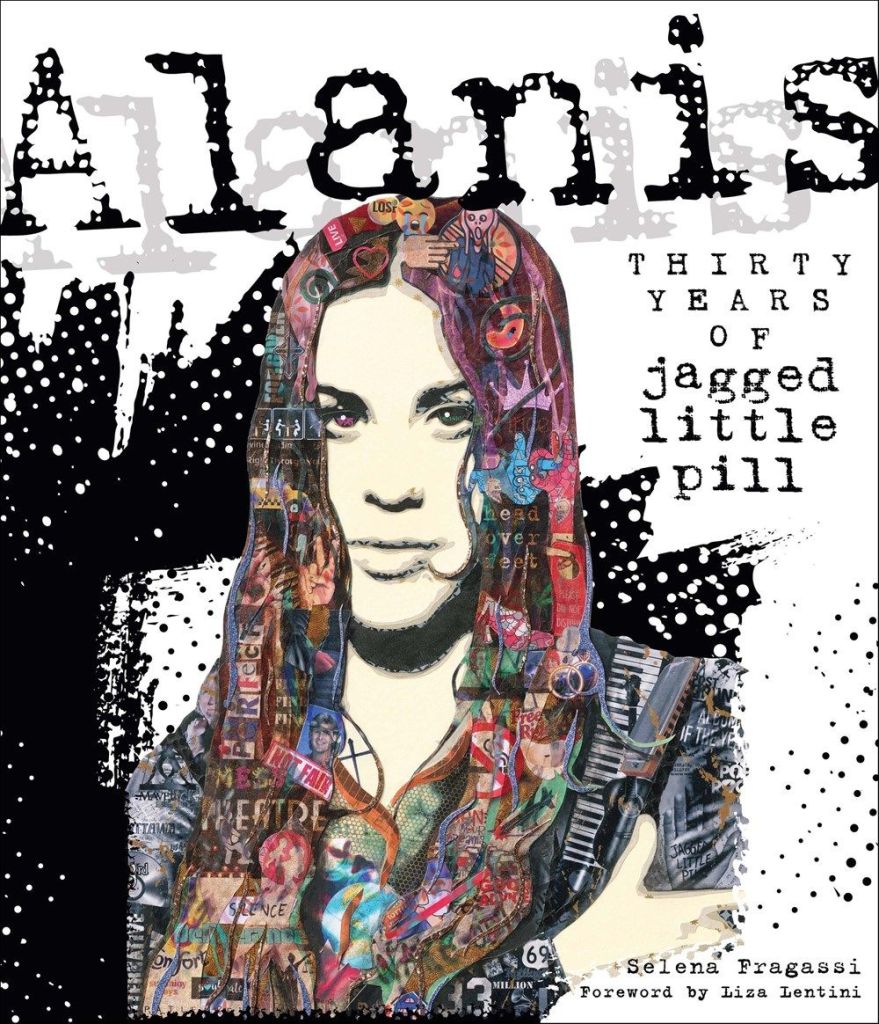
224 pp. Published June 10, 2025 by Epic Ink Books. Non-fiction.
Here’s one for those of us of a certain age: It’s thirty years this month since the release of Alanis Morissette’s album, Jagged Little Pill. Although not her first album (it was her third), its success worldwide is what brought her to our attention.
Back when I was just starting uni, my bestie and housemate introduced me to an angry and angsty album from some Canadian woman. That album became constant company for the next two years and beyond. I turned to it as so many young adults of the time did to assuage or express (or something in-between) all the grief of childhood pains, so much of the rage of bad relationships (including imagined ones), and also as an expression of the zeitgeist of that time. It was catharsis. Singing (mostly shouting) along to it in my flat gave me a voice for my depression. I found Alanis edgy, cool, kind of folksy and alternative—all of the things I thought I was, or was hoping to be. That Alanis’s music spoke to a young Zimbabwean woman that way is testimony to how universal Jagged Little Pill’s themes were, and how necessary it was to have a female voice singing them outside of pop.
This book is a(n unauthorised) biography of Alanis’s life, centred around that iconic album and its impact over the last three decades. Alanis initiated a new raw honesty in female songwriting in mainstream music. There are few fresh details in Fragassi’s book, but she gathers facts from different sources to paint a picture of that time in Alanis’s life, how she (and Glen Ballard) wrote songs on the album, who was around her at that time, who was in her band (including snippets about Taylor Hawkins), and how JLP launched the second part of her career. Alanis has not stopped touring since the release of JLP, and has had many successful albums subsequently—but arguably none quite as phenomenal. There’s been, too, a well-received musical stage production, based on JLP and featuring its songs, with Alanis’s involvement.
It’s not an understatement to say that Alanis and JLP have influenced my music taste to this day. Nor that I can still recognise parts of me that I modelled on an idea of what I thought she represented. And I still play songs off the album every so often, as if they connect me to the young woman I was then (although most of the angst is gone). This book, with its pictures and backstory, while imperfect, fills out the history behind an album that helped make me, and that remains a musical touchstone.
Thanks to Epic Ink Books and Edelweiss for an early DRC.
Affiliate link: Support independent bookshops and my writing by ordering it from Bookshop here.
 Harare Review of Books
Leave a reply to June 2025 reads – Harare Review of Books Cancel reply