
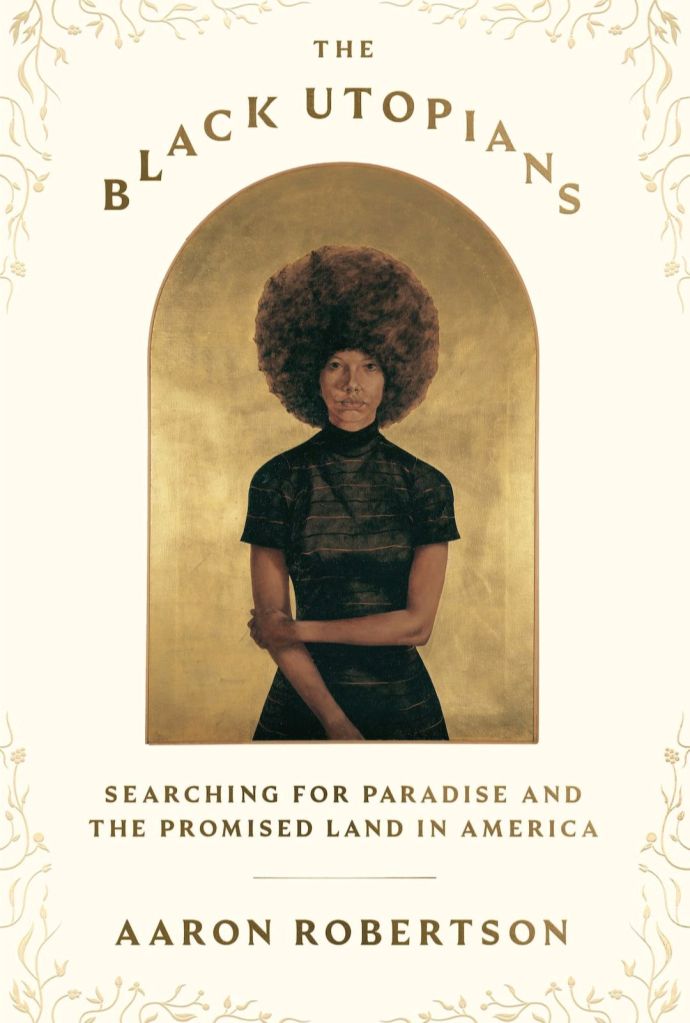
400 pp. Published October 1, 2024 by Farrar, Straus and Giroux. Non-fiction.
I’ve been preoccupied with thinking through future dreaming and conceptions of utopia for a while now. All the ways we imagine other ways of being … Ways that we try or fail to imagine the future … Alternative futurisms. It’s a broad subject. This book is my first encounter with Black (US, African American) utopian visions in the context of Black Christian Nationalism.
The Black Utopians is about two things: the history of Detroit’s Shrine of the Black Madonna and the movement that formed around it, as well as Aaron Robertson’s father’s utopian visions for himself and his family. (Robertson’s father was imprisoned for ten years. After his release, he wrote letters to his son about those dreams.) Founded by Albert Cleage Jr., a man who came from privilege (Detroit’s high society—his father was Detroit’s first Black city doctor), and changing names over the course of its history (as did the founder himself and many of the Shrine’s members), the Shrine bought a building in Detroit and built a community there, founded a school for its children—Mtoto House—where they taught their life principles, raised their children communally, and eventually bought a farm they named Beulah Land, 4,000 acres in South Carolina. Their aim was independence, socially and economically, from a world and country that didn’t want them.
Says Robertson:
“Here, in the mirror of my father’s life and the lives of many others that, in some ways, resembled mine, I sought variations on a theme. Who were the dreamers who always wanted more than they had? How did the disillusioned, the betrayed, the confined, the forgotten, and the persecuted not merely hold on to life but expand its possibilities and preserve its beauty?”
“How much can be repaired in the aftermath of damage? What if all our spiritual, emotional, and physical injuries were mended, our familial land and relationships restored? What if time’s rifts could be sewn back together?
Above all, what would it mean to live as though all of this were possible even if we suspect it is not?”
Black fugitivity: All the ways that Black people make a life outside of the placed on them. It’s something that Robertson says he discussed with his father during the pandemic and in the aftermath of the killings of George Floyd, Breonna Taylor, Ahmaud Arbery … : Flight, like so many Black Americans to Europe and Africa throughout the 20th century. Places of refuge. Places they made in the US too, from marronage in the Great Dismal Swamp, and “blacktowns” (Negro or freedom colonies, freedmen’s villages) like Promise Land and Promised Land (there’s a Biblical theme to the naming), to communities like this one, the Shrine of the Black Madonna, and the farm they bought.
“I couldn’t imagine a reality in which people like Floyd, Breonna Taylor, and Ahmaud Arbery wouldn’t be killed …
The world, no matter how beautiful, would have certain brutal constants. … The apparent persistence of abysmal realities for black people, and the certainty that there exists much more besides, is the soil from which black utopianism emerges.”
Roberston also tells us in the book about other Black utopian communities—like Promise Land, his own ancestral one where his grandparents had land, formed in 1870; Soul City; MOVE, in Philadelphia; and the Nation of Islam’s Salaam Agricultural System.
Cleage did not apparently like the term utopian, considering himself a realist—which he arguable wasn’t. In the aftermath of the ructions of the 1960s and Detroit’s hot summer of 1967, this is what Cleage thought would happen:
“Cleage described Black Christian Nationalism as an apocalyptic movement; he vaguely outlined a coming “Pan-African revolt,” which, if successful, could bring about universal justice on earth.”
The Shrine of the Black Madonna was a place of “strange” ideas—ideas like how Jesus was Black, and a syncretic belief system called KUA. Cleage, now renamed Jaramogi, would say things like this:
“Out of a mystical explosion of divine energy, the cosmos and everything in it was created. This act of creation provided an orderly unification of the four fundamental forces of nature in a Unified Field controlling the functions and interactions of all things.”
But maybe that’s what utopian thinking is about: reaching far beyond what’s known and understood to find ideas for new ways of being.
Utopia is future dreaming, wanting an alternative to the society that has created the painful now. It’s about survival. It’s an imagining of a more just and more equal world. For some who dream, action follows imagination: the members of the Shrine of the Black Madonna strove to create a pocket of heaven (or paradise) in a hostile United States. Maybe it doesn’t matter whether they failed or not: what matters is the attempt, the reaching towards, and how they dared to believe.
The dreams didn’t end: The Shrine established outposts, three of which still exist today in the US.
“[The Shrine] has provided disaster relief for every major hurricane that has affected the Southwest since Hurricane Katrina. The Shrines in each of the three regions host frequent food giveaways, a custom the church has been engaged in for the last fifty years.”
Thank you to Farrar, Straus and Giroux for early access.
Affiliate link: Support independent bookshops and my writing by ordering it from Bookshop here. (e-book)
 Harare Review of Books
Leave a reply to Kindred Creation: Parables and Paradigms for Freedom x Aida Mariam Davis – Harare Review of Books Cancel reply