
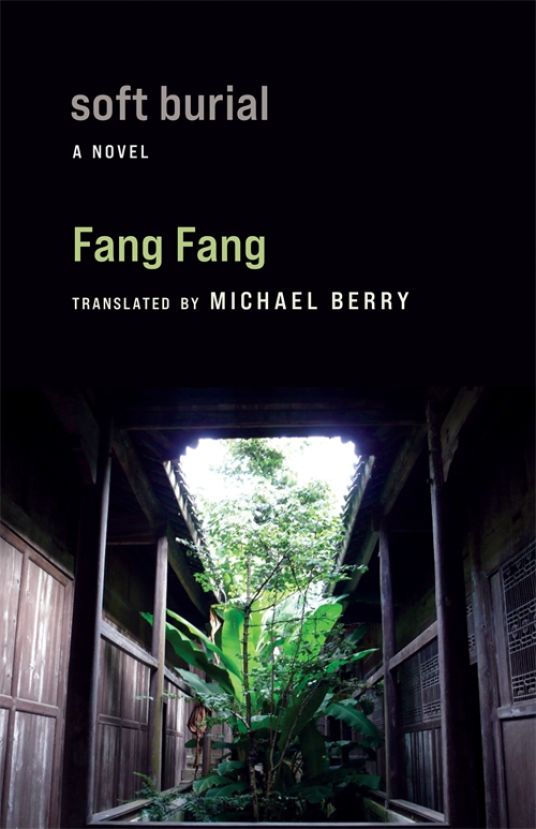
384 pp. Published March 18, 2025 by Columbia University Press. Fiction/historical.
According to this novel, a soft burial is when a person is buried without a coffin, directly in the ground. There are implications: their soul never really rests, and they cannot be reincarnated. The translator’s introduction also introduces readers to the concept of mingzhe baoshen: “Put your own safety before matters of principle,” also understood as “Keep your mouth shut and stay out of trouble.”
Soft Burial probes the absences and silences that are part of traumatic memories. It deals with the period of Land Reform in China—after the Second Sino-Japanese War, and before the Cultural Revolution. In a coda, Fang Fang explains that although this is fiction, it is based in large part on the experiences of one woman—her friend’s mother—but also on the experiences of the generation of Fang Fang’s grandparents: people who were accused of being “evil landowners” in denunciation meetings and “struggled against,” or punished for it. The translator’s introduction also reveals that Soft Burial has itself suffered one, being removed from shelves in China and denunciated—for its inquiry into what must remain undiscussed and forgotten.
The structure of Soft Burial is intriguing: it unspools backwards through time as it reveals what happened to Ding Zitao, the main character of the novel. Ding Zitao is approaching the end of her long and complicated life that has been separated into two distinct parts by repressed trauma from terrible violence, the trauma that led to her profound amnesia. That amnesia can be considered a form of mingzhe baoshen, something that many other characters in the novel choose—including Din Zitao’s son, Qinglin.
Soft Burial is a moving and searing portrayal of the terrible costs of the Land Reform Campaign and its ripple effects in the lives of these characters—Ding Zitao, her families past and present, landowners and villagers in Eastern Sichuan, as well as party officials. Fang Fang is subtle, not making accusations, but the outcome for all of the people involved speaks for itself.
“History is not the past,” Baldwin said. “It is the present.” This is true of this novel. Although Fang Fang has used fiction to talk about the events of the Land Reform Campaign, the soft banning of her novel shows how sensitive those in power still are to the implications of those events, and how they may reflect on the image of the ruling party.
To be put into the earth without a coffin and have your body placed directly into the dirt is one kind of soft burial; but when the living insist on consciously or unconsciously cutting themselves off from what happened, covering up the past, abandoning history, and refusing to remember, this is another form of soft burial committed over the passage of time. And once the past has been committed to a soft burial, it will likely lie there generation after generation, forgotten for all eternity. —Fang Fang
A beautiful, if difficult read. Highly recommended for its portrayal of the silenced history. Many thanks to Columbia University Press and NetGalley for early access to a DRC.
Affiliate link: Support independent bookshops and my writing by ordering it from Bookshop here.
 Harare Review of Books
Leave a comment