
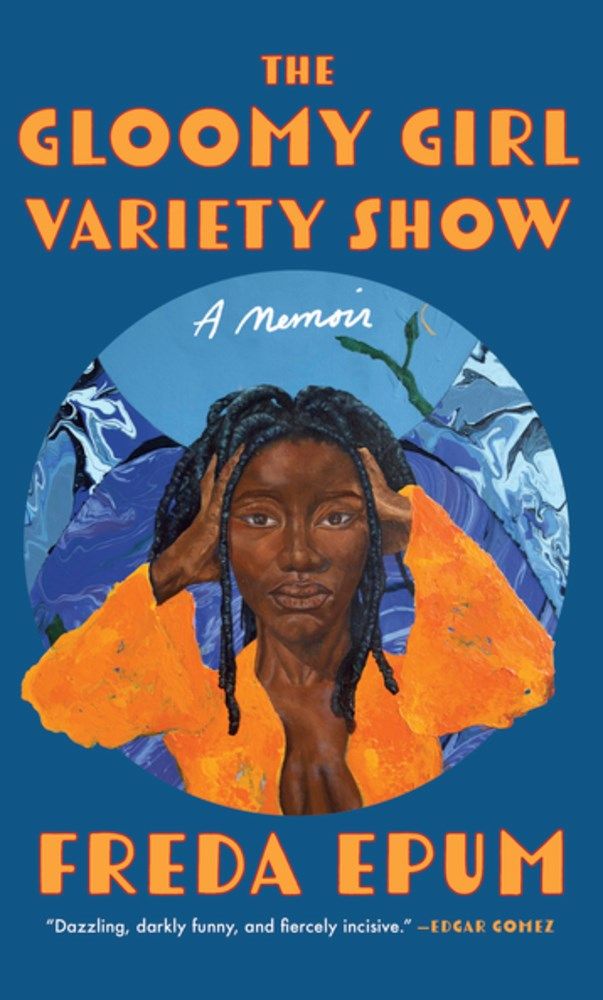
224 pages. Published January 14, 2025 by The Feminist Press at CUNY. Memoir.
Freda Epum’s honest, fizzy, and sparkling memoir deals with messy life; she’s not afraid to dive into its gory intestines. She describes the great highs and lows of grappling with growing up Black in a majority white area (in the US, in Tucson, Arizona), with coming of age, mental illness, unemployment and underemployment, and then finally, happily, making a life of her own. Among her musings, switching between first- and third-person (and occasionally second-): her relationship with her parents, and also with food; longing for home, that loaded idea and freighted concept (“I am without my own definition of home,” she says); identity, and her pain from the sense of dislocation as a third culture kid (learning to mispronounce her surname for the comfort of those around her, and: “I resented my parents, grateful for their sacrifice but bitter about what I’d been deprived of: a sense of self”).
She considers language:
”During one of my literature classes in graduate school, we read Nnedi Okorafor’s Who Fears Death. I sit across from a friend who speed-reads the first twenty chapters in two hours. Meanwhile I’ve only reached chapter ten or so. I don’t tell my friend that I struggle to read the names of the Nigerian characters. I go syllable by syllable, making sure to pronounce them the way my dad would in his thick accent—though it’s waned after thirty years spent in the United States. I often tell people how I wish I, too, had an accent where I call for my “bruddah” to bring up a bowl of nsala soup from downstairs.”
She remembers and relates admissions to hospital for mental healthcare, and sessions with therapists and psychiatrists. She ponders expectations of motherhood (“Will they, too, suffer from mental illness?”). She talks about the burden of capitalism, and about art; includes a stellar essay on “Corpsing,” performance, social death, and “terminal Blackness”; and, finally, she tells us about how she finds love.
The central idea in The Gloomy Girl Variety Show is a longing for home. Epum shares a wishlist at the start of the book (“A fully furnished home with a great stove to cook family recipes, large windows to look out at the landscape, a couch to fall asleep on, a bed to lie in for hours, a bathtub to soak my pain away”), and ends the book with a description of the first home she owns. In-between is the existential search.
Epum may self-identify as a gloomy girl, and I will respect that, but she feels like she’d be really cool to hang out with—as we get to do here. This memoir is lively, sometimes sad, and always vulnerable; Epum comes across as upbeat, if somewhat wry. Her creativity with structure is a delight: from simple memoir, to poetry, a play script, essays, photographs, and art reviews. Importantly, The Gloomy Girl Variety Show is about Epum’s experience as a first generation Nigerian-American woman, a Black/African child of immigrants. It’s a raw, beautiful, and deep work.
Grateful thanks to The Feminist Press and to Edelweiss for early access.
Affiliate link: Support independent bookshops and my writing by ordering it from Bookshop here.
 Harare Review of Books
Leave a comment