
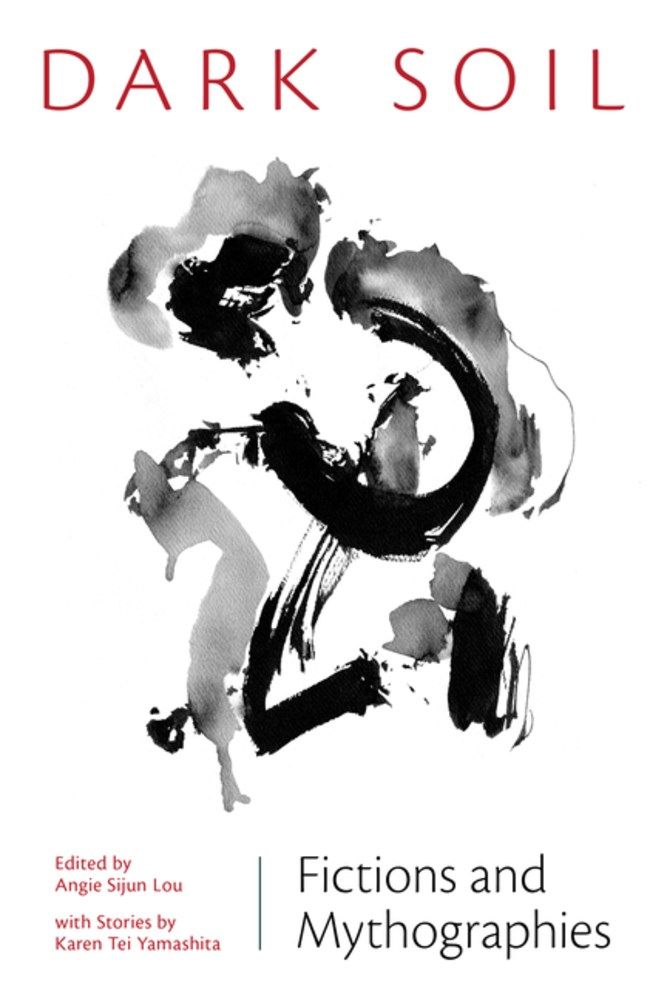
304 pages. Published May 7, 2024 by Coffee House Press. Anthology.
Dark Soil reminds me of, and can be argued to be a form of counter-mapping—traditionally used to mean the ways indigenous and marginalised communities make maps that counter those made by colonisers or hegemonic powers. This wonderful collection starts in Santa Cruz, California, in the US, but enlarges to encompass histories and possibilities elsewhere (the Philippines, and Guam). Some of the writing is fiction, but there’s also poetry and experimental work—an “ekphrastic approach to geography,” as Angie Sijun Lou says in the editorial introduction. All of the pieces are hauntological.
The ten excellent stories in the first section, Santa Cruz Nori, are by Karen Tei Yamashita, and are focussed on the “speculative histories” of Santa Cruz: a haunted spot on a map; a time-travelling boy who gets lost in the grim past; a memorably haunted ticket machine at the entrance to a parking lot (my favourite story) telling the story of an enslaved man and his family;, another grim story after/riffing off Strange Fruit; one on technological development or how terrible chemicals have been used for good (or not, is what you have to decide); Filipino boys who migrate for work and get caught up in racist violence; and the lives and afterlives of Chinatown. The forms of most of these stories are stories in themselves.
In the second section, there are varied pieces by Brandon Shimoda, Craig Santos Perez, Sesshu Foster, Thirii Myo Kyaw Myint, Angie Sijun Lou, Saretta Morgan, Ronaldo V. Wilson, and Juliana Sajr: the history of the Chinese Exclusion Act; a play; ties to home (buried navels, so familiar to me!); a survey of the work and tragic death of Theresa Hak Kyung Cha (Dictee); life on the edge of poverty; the striking ways that borders are a tool for conservation and violence against immigrants; and, finally, a poem about a polluted river.
All of these stories are tied to place, and how place both shapes our narratives and is shaped by us. But these are suppressed or marginalised histories finding their way to the surface, voices that are ignored rather than unheard. The inventive forms allowed me to enjoy words, story and underlying meanings, even as I sometimes reached for Google to learn more about these histories. A deeply affective work.
Thanks to Coffee House Press and to Edelweiss for DRC access.
Affiliate link: Support independent bookshops and my writing by ordering it from Bookshop here.
 Harare Review of Books
Leave a reply to Here’s almost everything I read in October 2024 – Harare Review of Books Cancel reply