
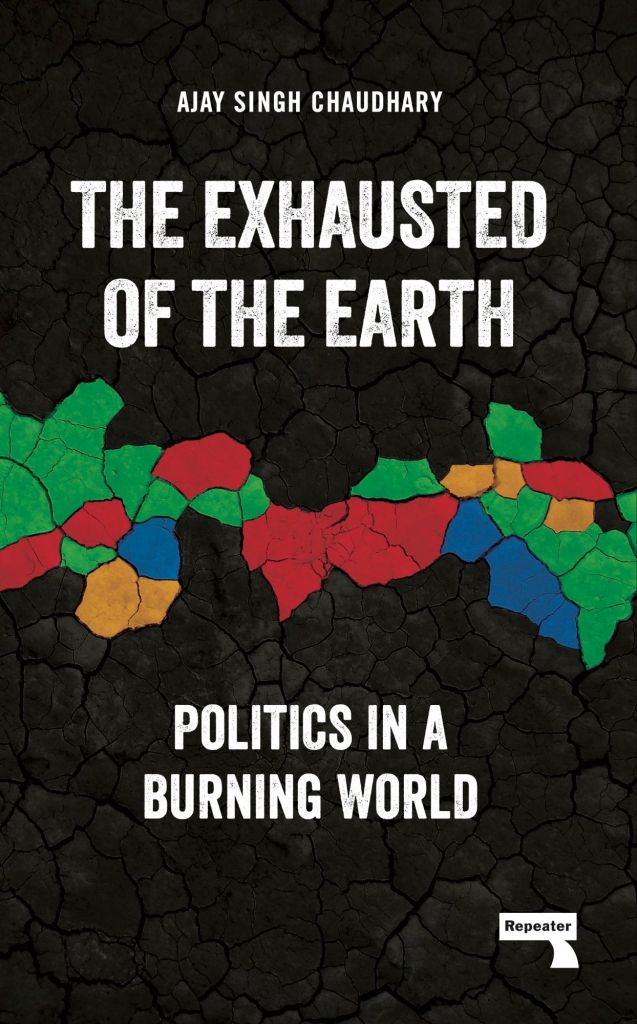
400 pages. First published Feb. 13, 2024 (Repeater Books). Non-fiction.
Spend any time online, and you’ll form the impression that we’re all exhausted. That’s the premise of this book: that we’re all exhausted by capitalism. These days, you can’t talk about capitalism without talking about the climate crisis, how the one has led to the other. Chaudhary begins not with a broad criticism of capitalism, though, but with what he calls right-wing climate realism and the “Rex (Tillerson) Position”. Rex Tillerson is “not a climate denier per se,” but thinks there are engineering solutions to the climate crisis; yet he feels no urgency to switch to renewables. People who take this position want to continue with business as usual—capitalism as it’s operated since the 1970s.
It’s interesting that there’s general consensus that the crisis was well understood by the middle of the 1970s, but Capital chose to ignore and deflect, and continue as usual. Not only that, but the neoliberal experiment saved capitalism in the 1970s, allowing it to continue to extract with impunity. That’s brought us to the present moment; yet, proponents of the Rex Position believe that capitalism will solve itself.
In the second chapter of the book, Chaudhary explains the “extractive circuit”—the mechanism by which capitalism extracts and transports value across the globe, through a network supported by capital, fossil fuels, telecommunications, labour, and other things. This is the basis of our exhaustion, both the planet and people, Chaudhary argues: capital extracts to the point of exhaustion. Chaudhary talks about extractivism, planetary boundaries and ecological depletion, labour—slave labour, and capitalism’s wage slaves, “hyperwork”, our always-on world—how all of these things have run us all down. It’s no secret that depression and other mental health conditions are more common now, a “mental health plague” affecting people all across the world. This was striking (from Chapter Three):
The US farmer suicide crisis echoes a much larger farmer suicide crisis happening globally: an Australian farmer dies by suicide every four days; in the UK, one farmer a week takes his or her own life; in France, one farmer dies by suicide every two days; in India, more than 270,000 farmers have died by suicide since 1995. (104)
What capitalism has promised, it cannot deliver. In Limitarianism, Ingrid Robeyns talks about how the trickle-down that was promised never happened; instead, as we’ve all come to see, wealth trickles up. In Chaudhary’s words:
… [Capitalism] promises a cheap, sleek, efficient path to plenty and prosperity, it delivers instead a costly, privatized system based on impossible inputs in a finite natural and social world — so unimaginably cumbersome and irrational that it requires constant, vigilant, crisis-level maintenance from the scale of the microbial to the human brain to states, geopolitics, and beyond. (72)
But there’s more. The political left, instead of providing solutions, is split into factions. In Chapter Three, Chaudhary introduces us to “Climate Lysenkoism”, nominally left and Marxist perspectives (they do claim this) that aim to maintain much of capitalism’s allure and practices while accelerating growth, until the Rex Position’s “technological solutions” fix climate change. Climate Lysenkoism doesn’t aim to tackle the status quo at all, the concentration of wealth and power at the top. It ignores the current science, opting instead to believe that we’re on the verge of technological breakthrough (in other words, magic!) to fix everything. Therefore, nothing essential needs to change. (Naturally, adherents are neither the beleaguered labourers of the Global North, nor the battered masses of the Global South.)
Somehow, Climate Lysenkoists reconcile two opposing ideas: that they are fighting capitalism (—how?), while they are in fact advocating for it. Unfortunately, at the beginning of the chapter, Chaudhary mostly assumes the reader’s prior knowledge of the Marxist claims of those in this faction; although he later goes into detail, most of what he writes initially is all of his outraged arguments against some of the major proponents. This section of the book is therefore perhaps for those steeped in academia, or activists who are au fait with all of this. However, there is a lot here working through the philosophies of tech billionaires like Bezos and Musk; the trouble with agricultural technology and the failed Green Revolution; the failures of carbon capture technologies; the realities of China’s green energy successes; and the farmer suicides mentioned above. The last part of this chapter finally goes into the politics of Climate Lysenkoism, examining in detail its Marxist claims. Not surpirsingly, these claims have no basis. In a solarpunkian turn, a beautiful section towards the end of the chapter gives examples of green architecture—housing projects in Vietnam and elsewhere, and urban and peri-urban agriculture in Kampala, Uganda, as well as “Red Vienna”, Aranya low-cost housing in India, and the contrasts of all of these with capitalism’s so-called green architecture.
So, what can we do? That mitigation and adaptation are needed is clear; how to achieve all of what’s needed is where most of the arguments happen. This is where proposals like those in Robeyns’s Limitarianism and Kōhei Saitō’s Slow Down come into play. Chaudhary would appear to be agnostic about particular paradigms. Instead, he focuses on a Fanonian analysis of our present psychological state of exhaustion, and what we can do about it—a “politics of exhaustion”, against “resilience”. He points out that “socioecological violence” has moved from the periphery to the metropole, and that for the first time, exhaustion, while uneven, is increasingly global, allowing for global action and solidarity. Lessons can be taken from decolonial struggles, he adds. Intriguingly, here Chaudhary makes a very passionate argument for the role of violence in effecting change, saying,
Exhaustion here is the ground of a possibility — the possibility to finally let go, to externalize, to politicize, to return to a sanity that is not resilience, but rebellion (192)
and points out that this is already happening: organisations such a La Vía Campesina and Extinction Rebellion are already doing the work. Contrary to Thatcher, in other words, there is an alternative. However, continuing his argument, Chaudhary says:
It is simply a fact that this much power, this much wealth, as Fanon began his political theory, will not give way without a movement on all fronts, without force, without violence. (196)
and
It will only be under tremendous pressure, across a wide set of “trenches” and “footholds,” across societies and states, that actually dismantling existing fossil fuel infrastructure, stopping its operations, enforcing energetic and material boundaries, and all the finer points of necessary climate mitigation and adaptation will occur. (213)
Chaudhary doesn’t only make these claims; he also brings “receipts” of actions that have happened around the world.
The final chapter, as one might expect, more or less summarises Chaudhary’s arguments, and outlines our hope for redemption. There are many beautiful examples of places where we might find a vision for humanity’s future—a Yugoslavian public housing block, Split 3; in the architecture of the Šerefudin White Mosque; in passive cooling systems like those of the Red Fort in India, and the Alhambra in Spain; in compressed earth buildings in Niger. That beautiful future is here already, if we know where to look. If we can only hear it above the noisy clamour of Capital.
Thank you to Lauren Cerand and to Repeater Books for the review copy.
Support independent bookshops and my writing by ordering it from Bookshop here.
Read with:
 Harare Review of Books
Leave a reply to Slow Down: The Degrowth Manifesto x Kōhei Saitō, Brian Bergstrom (ARC) – shona reads Cancel reply