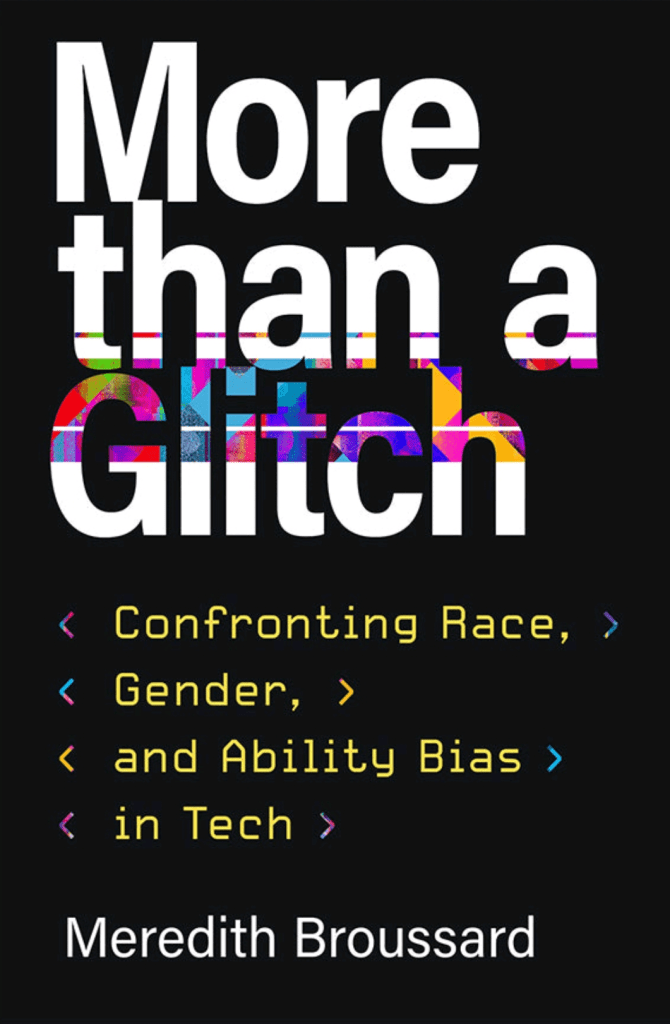
248 pages.
First published on Mar. 14, 2023 (MIT Press)
Non-fiction.
Broussard’s very smart and accessible book has given me new ways of thinking about technology, and new frames for understanding and expressing those thoughts. I was particularly interested in the chapters on disability and on medicine and AI, which are two areas that intersect with my professional training. Broussard covers a lot of ground in other areas too, including racism and other kinds of discrimination in tech, mathematical fairness vs. social fairness, technochauvinism (that computers will fix everything and create utopia), machine bias, AI ethics, cognition, statistics, the justice system, tech regulation, tech and algorithmic auditing, algorithmic justice and accountability, facial recognition and its application and misuse, and a great deal more. She outlines why she believes we should not rely so much on technology, and gives many excellent examples to show where, how and why tech has failed. In that same excellent chapter on medicine and AI, she shares how she used her own medical records to test diagnosis by AI, with intriguing results which have implications for us all.
I learnt a great deal from this book, and I’m so glad I decided to read it, in spite of initially being slightly intimidated by the subject. There are things that will probably be mostly of interest to those working in the fields Broussard covers; however, as tech, algorithms and AI are now part of our daily lives and will only become more so in the future, you will find this a very relevant and timely book.
Meredith Broussard is a data journalist and academic whose work focuses on AI investigative reporting and ethical AI. She is an associate professor at the Arthur L. Carter Journalism Institute of New York University and is research director at the NYU Alliance for Public Interest Technology.
Thank you to MIT Press and to NetGalley for this DRC.
 Harare Review of Books
Leave a reply to March 2023 reads – shona reads Cancel reply