
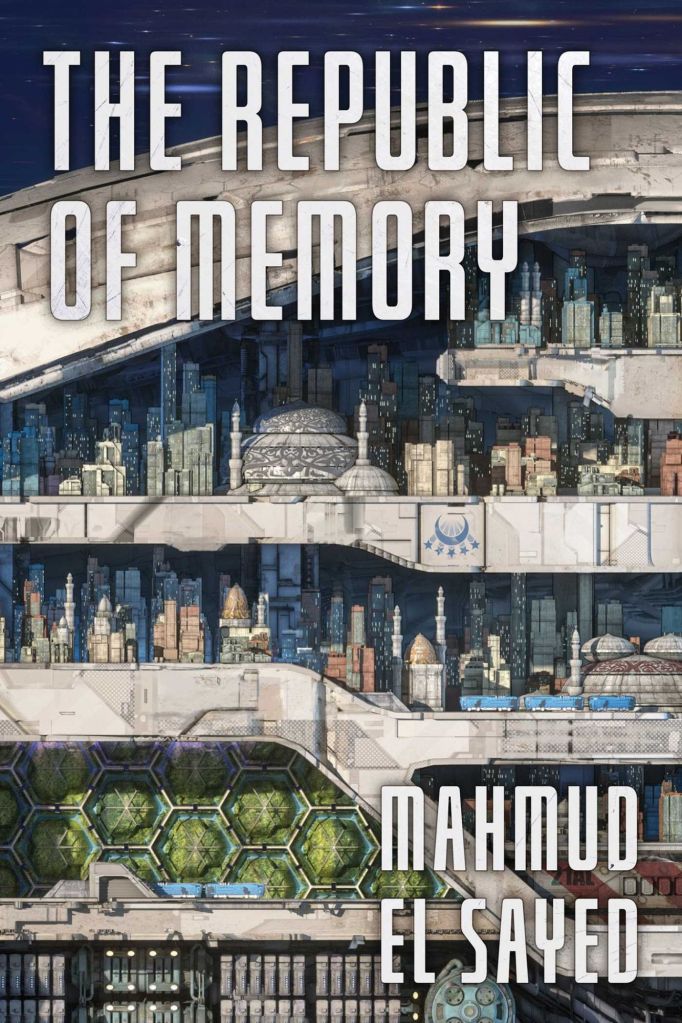
416 pp. May 5, 2026, S&S/Saga Press. SF.
For those who don’t know, generation ships are a staple in SF. What they are is in the name: generations of humans—the original crew and their descendants—live and die on their way across star systems to a distant (usually pre-selected) destination. There’s often cargo on the ship in the form of frozen humans or embryos—either as back-up in case things go wrong with the crew, or people who want to be woken up at destination. These ships serve as a thought experiment to explore what a fairly large group of people in a closed and fragile system might do: their politics, social systems, relationships, responses to crises, and so on. Stories may also explore physics and engineering problems: How would they be powered reliably (an important question, given the cryopreserved humans on board)? What would they be made of (materials, astronomical bodies)? Then there’s the question of why a generation ship in the first place: Has earth collapsed? Are humans exploring because they have gained the ability to do so? Is it just a bunch of billionaires getting away from the rest of us? And then, frequently, these ships are either sentient or have an AI in charge, because it solves the problem of having perfectly proficient humans fly the ship for generation after generation.
The ship in El Sayed’s The Republic of Memory looks to be either a colony ship (1,000-100,000 people) or world ship (more than 100,000), according to this on Wikipedia. Readers meet the characters (crew, in the correct parlance) years after an onboard revolution that took down the ship’s controlling AI and set up a kind of guild system to run the various working parts of the ship: Environment, Stasis (for the humans in cryostasis, called ancestors here), Agriculture, Administration, Manufacturing, and so on. One of the main characters is a translator, because after the overthrow of the ship’s AI, the people on board organised themselves by language across various berths; translators therefore keep lines of communication open between these groups, and between people and Admin.
The people of the Safina are restive; in these language groups, they’ve also organised into gangs according to ideology: language supremacism, power, politics, and how far they’re willing to go. They’re ready to fight for more rights. There’s rebellion fomenting against Admin, the cryopreserved ancestors, and the whole raison d’être of the Safina: the Safina was launched from Earth by the Network Empire towards a planet called Hurriya, where the ancestors will be woken up and the Empire reestablished. These are a lot of themes to tackle in a single novel, and El Sayed is to be applauded for the attempt; also for writing a thoroughly immersive Arabfuturist* novel (the first I’ve read).
In non-Western futurisms (specifically Afrofuturism: see Sun Ra), generation ships are generally about fugitivity and escape, and usually simply about colonising new worlds (Exploration and adventure! Taking over! Civilizing missions!) in Western futurism. Interestingly, in El Sayed’s novel, the Network Empire sent out this group to colonise the new world of Hurriya and to set up the same political system as back on Earth (where the Network Empire had more or less taken over the world). The mutiny on the ship aimed to disrupt that system and set up a more democratic one (the Republic of the title, presumably).
The Republic of Memory’s focus on Arab culture on a spaceship on its way to a new world allows El Sayed to remove this society from Earth’s geopolitics and so to theoretically explore it in a new way (—arguably, division by language across the ship’s berths is quite similar to Earth’s system); but back home, on Earth, it would appear that Arab culture had reached supremacy through the Network Empire, and this group did not leave in search of freedom. Why, then, explore revolution in space at all? Why not back on Earth? The reader can decide, but it would appear the closed system of a spaceship is what interests El Sayed.
So, El Sayed sets out pretty weighty themes; however, it does feel like nothing is fully explored, but rather introduced; very much that this is the set-up for more in the future. An example is in the character who serves as the main protagonist for the first half of the novel; he’s not a convincing hero, but does spend a lot of time fantasising about what he’ll do as a future leader—which doesn’t happen by the end of the novel. A second—and much-needed—revolution (the mutiny being the first) begins, but the book ends on a cliffhanger. The earlier mutiny itself is mainly referred to and not fully explained, perhaps because that would mean going into more detail about the Network Empire—and El Sayed has not done so. Finally, some of the ship’s political groups—its gangs—are represented through individual characters, but many others remain background and shadowy. So this novel reads very much like one laying the groundwork through introducing many themes and ideas, perhaps not in a satisfying way for the reader as there isn’t a feeling of completion when you close the book. It seems at least possible that a future novel may explore the totalising effect of super AI on human social systems. It’s also easy to imagine there could be more about the role of the ancestors and intergenerational relationships, and the ethics of forcing your children and their children etc into servitude.
Anyway! In the end, The Republic of Memory is a pretty traditional generation ship story with fun cultural elements. As Algis Budrys said in 1966:
“The slower-than-light interstellar spaceship, pursuing its way through the weary centuries, its crew losing touch with all reality save the interior of the vessel… Well, you know the story, and its unhappy downhill round, its exciting struggles between the barbarian tribes which develop in its disparate compartments, and then, if the writer is so minded, the ultimate flash of hope as the good guys win out and prepare to meet their future on some noble, if erroneous basis.”
Thanks to Mahmud for the review copy! I look forward to the sequel.
- A thought from the readings linked below: Arab futures cannot be monolithic, because there have been so many varied Arab pasts and there are many Arab presents. Perhaps the term could be Arabfuturisms (see Perwana Nazif’s essay for thoughts on Palestinian futures; also see thoughts on Gulf Futurism in Erika Balsom’s article on Sophia Al-Maria).
Recommended reading:
- Arabfuturism_Science-Fiction & Alternate Realities in the Arab World
- Towards a possible manifesto; proposing Arabfuturism(s)
- Sophia Al-Maria on Dystopias, Gulf Futurism, and Sad Sacks
Affiliate link: Support independent bookshops and my writing by ordering it from Bookshop here.
 Harare Review of Books
Leave a comment