
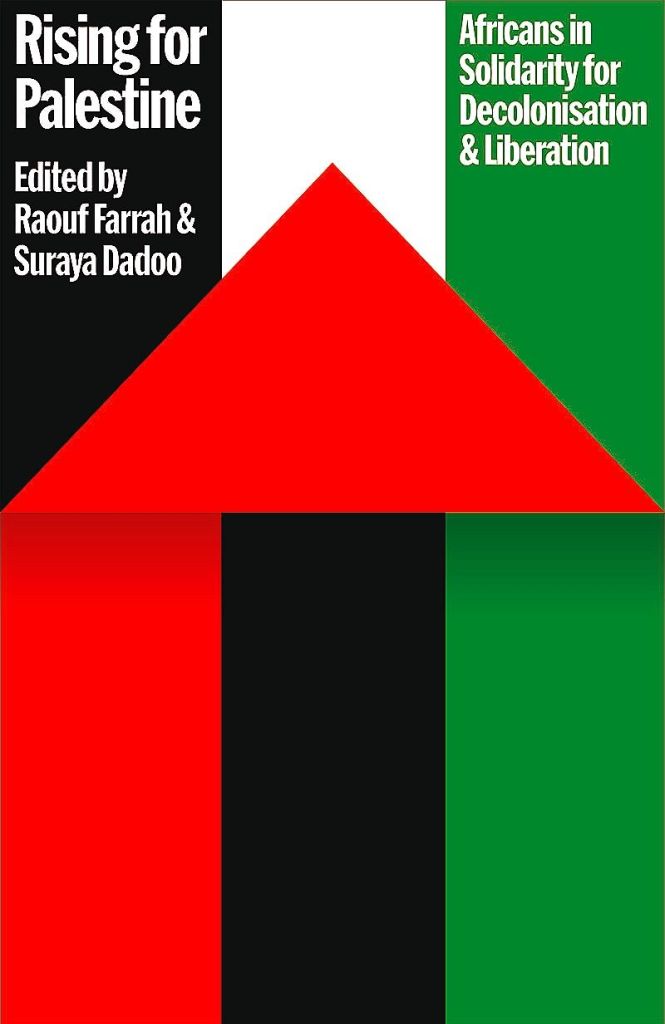
320 pp. March 20, 2026, Pluto Press UK. Non-fiction.
Happy pub day to this rousing collection from Pluto Press.
On October 7, 2023, Hamas carried out attacks at the border with southern Israel that killed 1,195 people. In retaliation, Israel launched a “military action” on the people of Gaza that, to date and in turn, has killed 72,000 Palestinians, according to Gaza’s Health Ministry. But this terrible war is only the latest tragic episode in the ongoing conflict between Palestine and Israel that dates back to about the time of the formation of the Israeli state in 1948.
It’s difficult not to take sides, and not to form strong and immovable opinions. But taking sides has to be right and just. There is a clear aggressor: In 1948, the state of Israel occupied land that was not empty, as they would prefer for people to imagine, but that had people on it, the people of Palestine. In most places, this is called settler colonialism; but in a world where Israel has powerful friends, who are former colonisers themselves, you will be told otherwise. Adding to this, since 1948, there’s been relentless pressure on Palestinians to leave what little land they have left. No real alternatives are offered, despite endless diplomatic meetings on the issue. And why should there be alternatives? Why should any people be forced off their land?
Palestinians argue that they have a right to defend themselves as any people do, and a right to self-determination as enshrined in the UN Charter, in the International Covenant on Civil and Political Rights, and the International Covenant on Economic, Social and Cultural Rights. But in a world with an order headed by a powerful capitalistic hegemony with murky interests, nothing is ever so clear.
Except, perhaps to the Global South, those who were once on the sharp and painful receiving end of the attention of this international order. Particularly Africans, for whom colonialism is within living memory. However, the same murky interests have tried to sway African opinion away from Palestine—through the fear of going up against the US (under Trump, we have all seen gloves off when you do); or perhaps Israel has dedicated resources to courting African countries and also the African Union. And while Palestine formed alliances with many African independence movements and received great support from the OAU (the AU’s predecessor), the achieving of independence for most countries and their being faced with new problems has tempered those historical ties.
Rising for Palestine is a call to action. In it, African intellectuals and activists lay out reasons why Africa should support Palestine, and the arguments are indeed compelling. In the introduction, Raouf Farrah and Suraya Dadoo broadly contextualise the need for this volume, elaborating on our shared struggle against empire and the current state of affairs.
The main part of the book is divided into five sections. Part I: Legacies of Violence: Genocide, Colonialism, and Oppression includes thoughts on and recorded oral history of the genocide in Namibia, a perspective from a Namibian independence fighter; an excellent essay on the Congo that parallels the two struggles, there and in Palestine, as a battle for self-determination; and two essays clarifying what the genocide is, and means.
In Part II: Solidarity and Resistance: Building Shared Struggles are three interviews: with Basem Naim, described as a member of Hamas’s political bureau in Gaza and head of the movement’s international relations Bureau; with Abdal Karim Ewaida, the resident Ambassador of the State of Palestine to Côte d’Ivoire and the non-resident Ambassador to Chad, Niger, Burkina Faso, and the Republic of Congo; and a particularly fascinating (and important) one with Malainin Lakhal, the Deputy Permanent Representative of the Saharawi Arab Democratic Republic to the African Union. There are also essays on reviving global solidarity; on Kenya and its betrayal of the Palestinian cause; on the Sumud convoy from the Maghreb that aimed to reach Rafah by land; and on the challenge of the 2024 African Commission on Human and People’s Rights Resolution on Palestine to the stances of African nations on Palestine.
Part III: Africa–Israel Collaboration: Mapping Engagements and Complicity is where it’s made clear why African governments have vacillated over whether to support Palestine—although they have mostly landed on the right side when it counts, most notably during voting at the UN. An exception has been, unfortunately, Malawi; Suraya Dadoo gives a reason why in the essay “Weaponising Faith: Christian Zionism in Africa.” The other two essays in this section clarify Israel’s aid to and trade partnerships with African governments, mainly through offering “security” services: digital surveillance and spyware (including Pegasus and Circles), often used against political opponents, civil society and journalists. Even Ghana, generally considered a stable democracy, is implicated. So are Nigeria, Zimbabwe, Equatorial Guinea, Morocco, Zambia, Botswana, Kenya, Togo, and Rwanda. As Kribsoo Diallo points out, “Occupied Palestine effectively functions as an open-air laboratory for Israel to test surveillance technology before selling them to repressive regimes around the world in exchange for diplomatic favours.”
Part IV Reimagining Liberation: Decolonising Our Future is important for all of the solutions it presents—for the language we use (Is it colonialism? Should we call it a genocide?), how media could or should report, and the role of international law in the Palestinian struggle. Two essays particularly caught my interest: Hamza Hamouchene’s “The Climate Crisis, Imperialism, and Palestine Liberation,” which presents a truly shocking picture of the precarity of Palestinian lives in the linked areas of water access and climate change (—if you were not persuaded Israel’s actions in Palestine constitute colonialism, perhaps this essay will convince you); and Rosebell Kagumire’s “Our Struggles are One: Pan-African Feminists Keeping Palestine Solidarity Alive,” crucial because as with all movements for justice worldwide, women are at the forefront in Africa too, not just in speaking up for Palestinian freedom, but also organising for it.
If the imperial world order that oppressed Africans and caused so much suffering for so long is still active—and it is—then Palestine is a front where the battle has not yet been won. This is a book about why solidarity with Palestine is important if we are all to be free (echoing the cry of Fannie Lou Hamer) from these systems that oppress us to this day. It’s also a call to morality: No one can in good conscience sit on the fence over this issue—although many African governments have tried.
So readers will learn the term “pragmatic ambivalence”—in how countries have received assistance from Israel, and may be reluctant to let go of these solutions they use for repression. Perhaps most shockingly, South Africa, great moral leader on the world stage and defender of Gaza by bringing a suit against Israel at the ICJ, is still a major supplier of coal to Israel. Without these deals, would Africa be much clearer about which side to take in this long-running conflict? If our consciences were clear and our stances more ethical, would we recall what we concluded in the 1960s, during our own struggles against imperialism, and stand for Palestine? Rising for Palestine hopes to remind us to do so.
Thank you to Raouf Farrah for a review copy.
Affiliate link: Support independent bookshops and my writing by ordering it from Bookshop here.
 Harare Review of Books
Leave a comment