
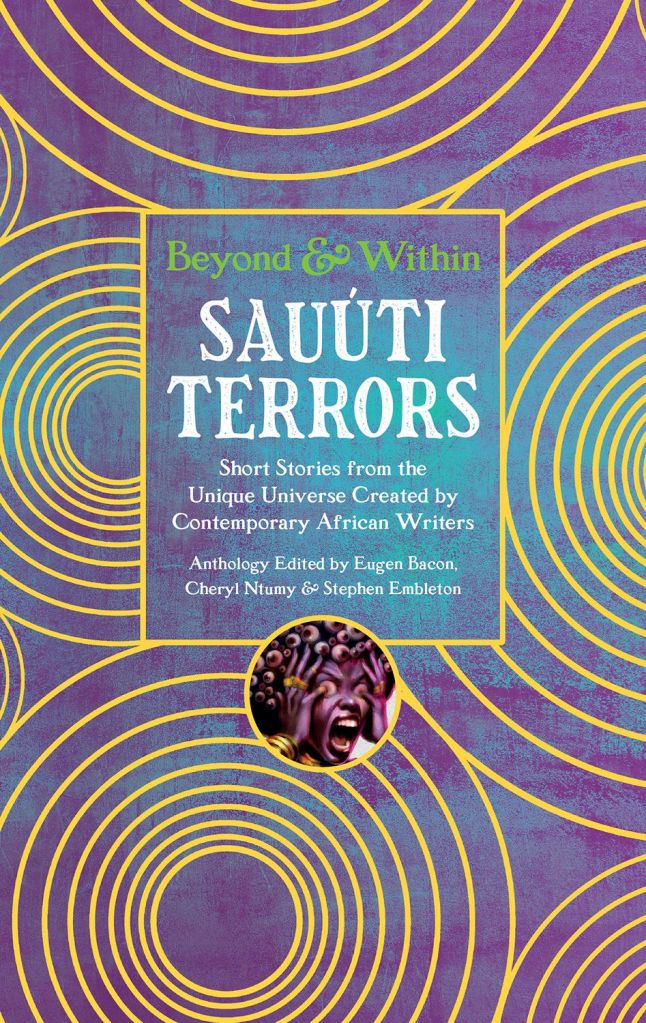
416 pp. January 20, 2026, Flame Tree Collections. African SFF.
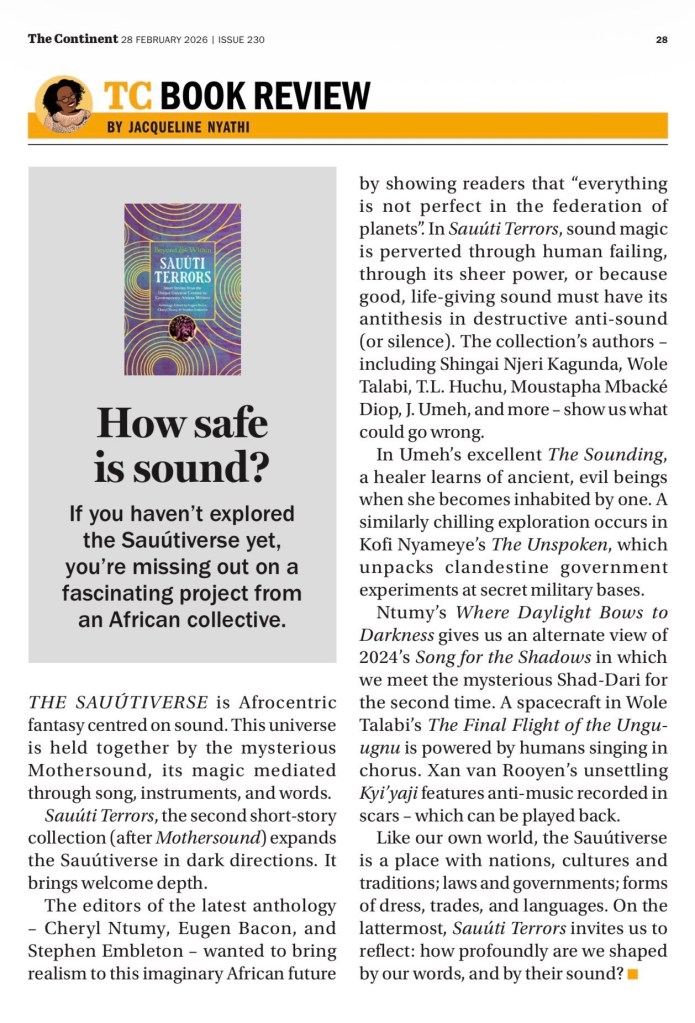
A version of this review first appeared in The Continent, 28 February 2026, Issue 230 (see below).
If you haven’t explored the Sauútiverse yet, you’re missing out on a fascinating project from an African collective. Sauúti Terrors, the second collection (after Mothersound) expands this universe in dark new directions and brings welcome depth. The anthology’s editors, Ntumy, Bacon and Embleton, explain that they wanted to bring realism to this imagining of a possible African future—showing readers that “everything is not perfect in the federation of planets.”
The Sauútiverse is Afrocentric fantasy centred around sound: The universe is held together by the mysterious and generative Mothersound, and magic is mediated sonically—through song, instruments, words. In Sauúti Terrors, sound magic is perverted through human failing, through its sheer power, or because good, life-giving sound must have its antithesis in destructive anti-sound (or silence). The collection’s authors—among them the editors, as well as Shingai Njeri Kagunda, Wole Talabi, T.L. Huchu, Moustapha Mbacké Diop, J. Umeh, and many more—show us through vivid storytelling what could go wrong.
And there are fantastic stories. In Umeh’s excellent “The Sounding,” a healer learns that there are great, evil, old powers when she becomes inhabited by one. A similarly chilling exploration of this is in Kofi Nyameye’s brilliant “The Unspoken”; this time, through the trope of secret government experiments at secret military bases. Ntumy’s “Where Daylight Bows to Darkness” gives us an alternate view of 2024’s Songs for the Shadows: A Sauútiverse Story: We meet the wise and mysterious Shad-Dari again. An intriguing spacecraft in Wole Talabi’s “The Final Flight of the Ungu-ugnu” is powered by humans singing in chorus. Xan van Rooyen’s unsettling “Kyi’yaji” features anti-music that’s recorded in scars, and that can be played back. Shingai Njeri Kangunda’s captivating “The Wound Asks for Air” is about a girl who’s an outsider because her abilities are misunderstood.
The Sauútiverse is also notable for this: Writers are from both the Continent and its diaspora. This collection presents stories from Australia, Botswana, Ghana, Kenya, Nigeria, Senegal, South Africa, Zimbabwe, the U.K., and the US.
It’s intriguing how easy it is to immerse oneself in an alternate reality. The Sauútiverse is a place with nations, cultures and traditions, laws and governments, forms of dress, trades, and language(s). After visiting for some time, one may find oneself imagining more aspects of it, and thinking about how profoundly sound and language affect and shape us. This is one of the Sauútiverse’s successes: to offer a different viewpoint of ways of being, and of futures rooted outside Enlightenment-informed principles. It’s exciting to imagine where it will go next.
Affiliate link: Support independent bookshops and my writing by ordering it from Bookshop here.
 Harare Review of Books
Leave a comment