
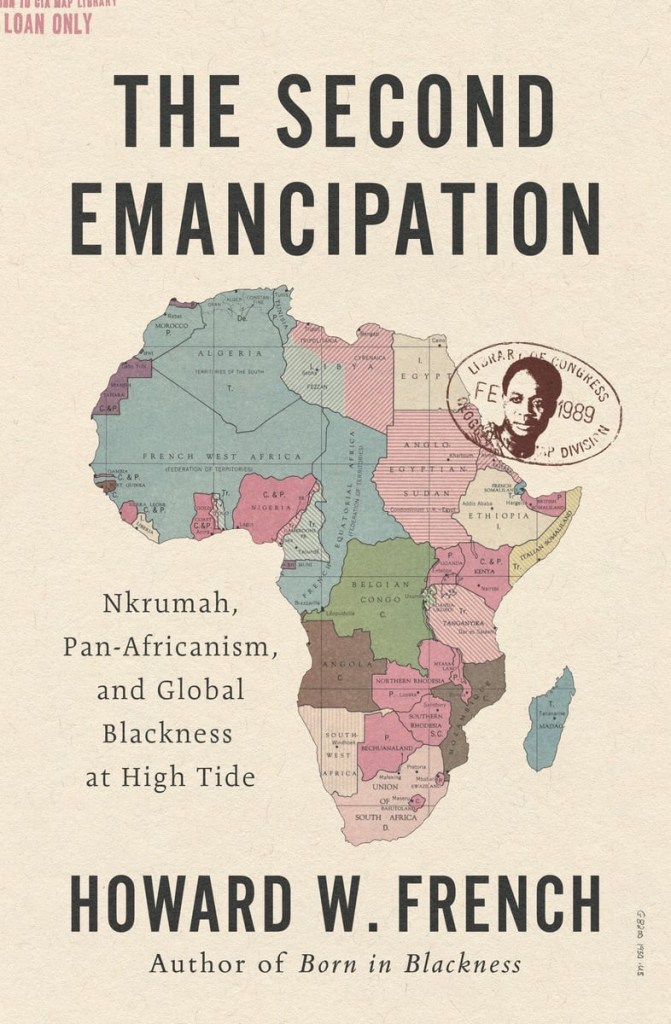
512 pp. August 26, 2025, Liveright. Non-fiction.
A version of the review below appears in The Continent, 24 January 2026, Issue 225 (link to pdf).
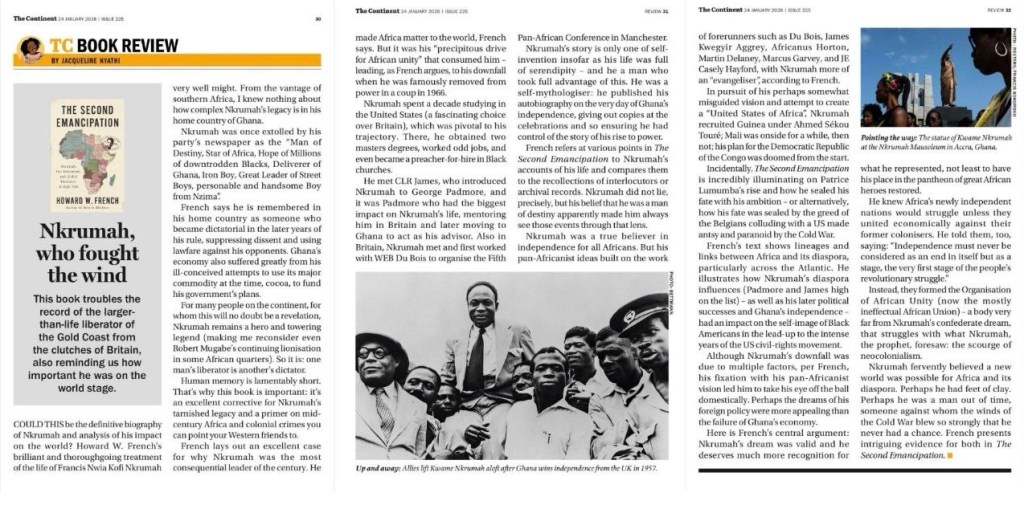
Could this be the definitive biography of Nkrumah and analysis of his impact on the world? Howard W. French’s brilliant and thoroughgoing treatment of the life of Francis Nwia Kofi Nkrumah very well might. I, from the vantage of southern Africa, did not know anything about how complicated Nkrumah’s legacy is; particularly in Zimbabwe, he remains a pan-African hero and towering legend—the thought making me reconsider even Robert Mugabe’s continuing lionisation in the rest of Africa. So it is: one man’s liberator is another’s dictator. French’s book sets out to trouble the record on Nkrumah, larger-than-life liberator of the Gold Coast from the clutches of Britain, and once extolled by his party’s newspaper as the “Man of Destiny, Star of Africa, Hope of Millions of down-trodden Blacks, Deliverer of Ghana, Iron Boy, Great Leader of Street Boys, personable and handsome Boy from Nzima.”
Human memory is lamentably short. That’s why this book is important: it’s an excellent corrective for Nkrumah’s tarnished legacy, and something you can point your Western friends to as a primer on mid-century Africa and colonial crimes.
French lays out an excellent case for why Nkrumah was the most consequential leader of the century. He made, French says, Africa matter to the world. Nkrumah’s mentor and critic, C. L. R. James, said of him that he was ‘“one of the greatest political leaders of our century” and the sort of figure who only appears on the world stage “at long intervals.”’ Not only did Nkrumah preside over the transition of his country to freedom, but he was also the foremost prophet of pan-Africanism—an idea he did not generate, as French points out, but his obsession, a “precipitous drive for African unity” that consumed him—leading, as French argues, to his downfall: he was famously removed from power in a coup in 1966 while travelling to Vietnam to negotiate peace there.
Nkrumah was the most unlikely hero: born into the Nzima ethnic group on the border between Ghana and the Ivory Coast (Nkrumah claimed in 1909, his mother said 1912) to Elizabeth Nyaniba, being her only child, he apparently arrived during his grandfather’s funeral and appeared to be stillborn. He was revived by women who were present. His mother later moved him to a larger town and put him through school (a one-room Catholic mission school) by vending. A priest took notice of him, and took him under his wing, assisting with his fees.
Later, at seventeen, Nkrumah became a ‘pupil teacher.’ He caught the attention, then, of the head of a state training college in 1926, and enrolled. That college was then subsumed into Achimota College, a prestigious college that produced luminaries: ‘five heads of state of Ghana … [T]he presidents of two other African countries, Robert Mugabe of Zimbabwe and Dawda Jawara of Gambia … At one point, no fewer than 126 out of Ghana’s 140 sitting members of parliament were alumni.’
Nkrumah spent a decade in the US for tertiary education (a fascinating choice over Britain, which French explains), which was pivotal: first at Lincoln University, where he excelled, and then at the University of Pennsylvania, where he earned two Master’s degrees, in education and in philosophy, and where he worked towards a doctorate (but his thesis was rejected on what French says are probably specious grounds). He struggled as a penniless student (working at one point in a soap-making factory, and later, washing dishes aboard a ship) but also thrived in the US, even becoming a preacher-for-hire in Black churches, undoubtedly honing his oratory skills, as French points out. The US was also where Nkrumah first met C. L. R. James, who introduced Nkrumah to George Padmore, another Trinidadian. Padmore likely had the largest impact on Nkrumah’s life, mentoring him in Britain where he lived for two years after leaving the US, and then later moving to Ghana to act as his advisor. Also in Britain, Nkrumah met and first worked with W. E. B. Du Bois to organise the Fifth Pan-African Conference in Manchester. Nkrumah’s story is only one of self-invention (as he self-mythologised) insofar as he was a man whose life was full of serendipity, and he a man who took full advantage.
His vision of Africa was expansive. He was a true believer in independence for all Africans; as he said on the night of Ghana’s independence, “Our independence is meaningless unless it is linked up with the total liberation of the African continent.” His pan-Africanist ideas built on the work (he being more of an ‘evangeliser,’ French says) of forerunners such as Du Bois, James Kwegyir Aggrey, Africanus Horton, Martin Delaney, Marcus Garvey, and J. E. Casely Hayford, a very early pan-Africanist who “urged that a federation be created to unite Africans in British and French colonies in West Africa under the banner of self-rule.” In pursuit of his perhaps somewhat misguided vision and attempt to create a ‘United States of Africa,’ Nkrumah recruited Guinea under Ahmed Sékou Touré; Mali was on-side for a while and then not; and his plan for the Congo, halfway across the continent, was doomed from the start under Patrice Lumumba, whom Western powers swiftly assassinated in 1961, five months after his three-month term as Prime Minister. Incidentally, The Second Emancipation is incredibly illuminating on Lumumba’s rise and how he sealed his fate with his ambition—or alternatively, how his fate was sealed by the greed of the Belgians colluding with a United States made antsy and paranoid by the Cold War.
One of the main things French makes this text do is show lineages and links between Africa and its diaspora, particularly across the Atlantic. French explains how from reading, from his influences in the US and contact with other people of African descent—George Padmore and C. L. R. James are high up on the list—Nkrumah learnt about and saw these linkages too, that the oppressions of Black people were the same all over the world. “Nkrumah, like no one before him, made Africa also matter to African Americans,” French says. Nkrumah was shaped by this, and in turn his later political successes and Ghana’s independence had an impact on the self-image of Black Americans in the lead-up to the intense years of the US civil rights movement. (African American author Richard Wright, however, French tells us, was decidedly not impressed with Africa when he visited.)
Civil rights activists were influenced both by Nkrumah’s words and the sheer exuberance of seeing Ghana gain its freedom—the first African country to do so, the first nation of free Blacks after Haiti. Some of these activists were present at Ghana’s independence celebrations: Malcolm X and Stokely Carmichael (Kwame Ture) were there. (Also, interestingly, a reluctant Richard Nixon). The venerable W. E. B. Du Bois was not able to attend, but became a ‘returnee,’ settling in Ghana for the final years of his life. I’ve frequently wondered why these links between Africa and the Black US were so strong in the 1960s and barely exist now: French says this relatedness—this co-identification and mutual desire to help each other to freedom—was unfortunately weakened by both the flood of African nations gaining independence and the increasing urgency of the civil rights movement. French laments: ‘This connection, which was abundantly evident in the era of my own parents, needs to be made patently clear for a younger generation, which has grown up with a very different, not always roseate, image of Africa, or scarcely any idea of the continent at all.’
While Nkrumah’s downfall was due to multiple factors, per French, his fixation with his pan-Africanist vision led Nkrumah to take his eye off the ball domestically, and perhaps the dreams of his foreign policy were more appealing than the failure of Ghana’s economy. The opposition and his former allies (some of them uneasy ones) seized on these failures, applying increasing political pressure. Meanwhile, horrifyingly, Nkrumah suffered multiple assassination attempts. In the end, of course, he was deposed through the aforementioned coup, and spent the rest of his foreshortened life in exile (as ‘co-president’) in neighbouring Guinea—the only other country in his pan-African union.
Here is French’s argument: Nkrumah’s dream was valid, and he deserves much more recognition for what he represented, and to have his place in the pantheon of great African heroes restored. Nkrumah was indeed a long-term visionary: He knew Africa’s newly independent nations would struggle unless they united economically against their former colonisers. He told them, too, saying, “Independence must never be considered as an end in itself but as a stage, the very first stage of the people’s revolutionary struggle.” Instead, they formed the Organisation of African Unity (now the still-weak and mostly ineffectual African Union)—far from Nkrumah’s confederate dream, and struggling with what Nkrumah, the prophet, foresaw: the scourge of neocolonialism.
Nkrumah fervently believed a new world was possible for Africa and its diaspora. Perhaps he had clay feet. Perhaps he was a man out of time, someone against whom the winds of the Cold War blew so strongly that he never had a chance. French presents intriguing evidence for both in The Second Emancipation.
Affiliate link: Support independent bookshops and my writing by ordering it from Bookshop here.
 Harare Review of Books
Leave a comment