
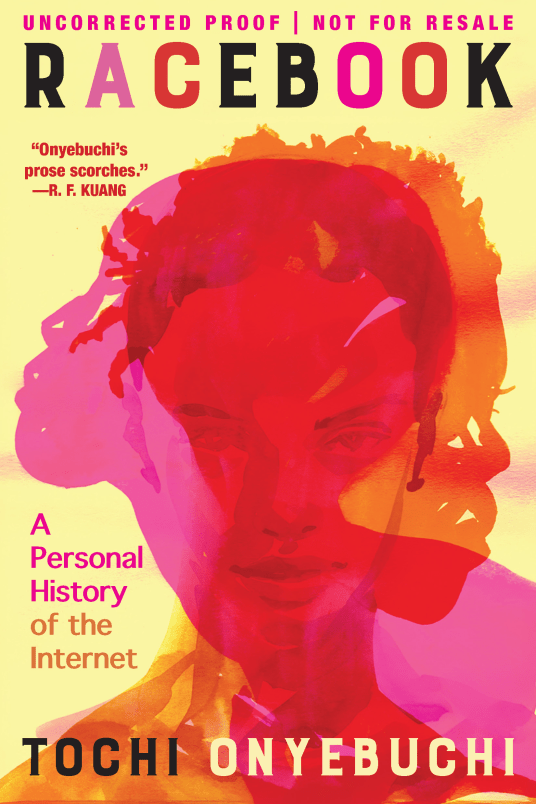
256 pp. October 21, 2025, Roxane Gay Books. Nonfiction.
Are we in hell?
Which is to say, the internet’s become inescapable. And we have lots of fiction (Patricia Lockwood’s No One Is Talking About This—the first half; Fake Accounts by Lauren Oyler, and apparently Feed by M. T. Anderson, which I haven’t read) and a tonne of non-fiction (articles), never mind research, about terminally online life and its effects on us. But what if you’ve grown up online and you happen to be Black? Tochi Onyebuchi has thoughts.
He says,
“At some point during my time on the Internet, the demographic markers I thought I’d shed whenever I logged on had latched back on to me. Gone was the faceless, skinless enjoyer of things, the amorphous yet singular netizen whose only color was that of the Internet’s neon signs glowing on me. Suddenly, it seemed tremendously important that I was Black.”
Being Black on the internet is the same as being a “neutral” (read white) user in some ways, but different in important ones. Mainly, it’s just like irl: You don’t get to be that neutral user for very long once people know the colour of your skin. Also, it takes about five minutes to encounter material that’s racially objectionable, even if it’s just the algorithm (Safiya Umoja Noble’s Algorithms of Oppression is a good read on this).
In this series of essays, Onyebuchi writes eloquently about how Facebook ruined so many things (how friends became followers, our loss of control over our own data, emotional contagion); humorously about the expensive folly that was the Metaverse; how he became defined as a Black writer online (“A writer of Black Things™”); the dehumanising and deadening experience of being a content moderator; the joy of gaming (can’t relate, unfortunately); androids and, specifically, synthetic women; The Great American Internet Novel; and more. Onyebuchi is a witty but mostly serious and deeply thoughtful essayist who feels to the reader like he must be a polymath: articulate on a wide variety of subjects, with fascinating references sprinkled throughout these essays.
All of which to say: Take your time over this collection, because he’ll make you think. And if he writes as a Black man, that’s a good thing here: He’s reacting less to a label put on him, but rather owning what arises from his positionality. And in so doing, he delivers a very important and perhaps less-acknowledged perspective.
Many thanks to Roxane Gay Books and NetGalley for a DRC.
Affiliate link: Support independent bookshops and my writing by ordering it from Bookshop here.
 Harare Review of Books
Leave a comment