
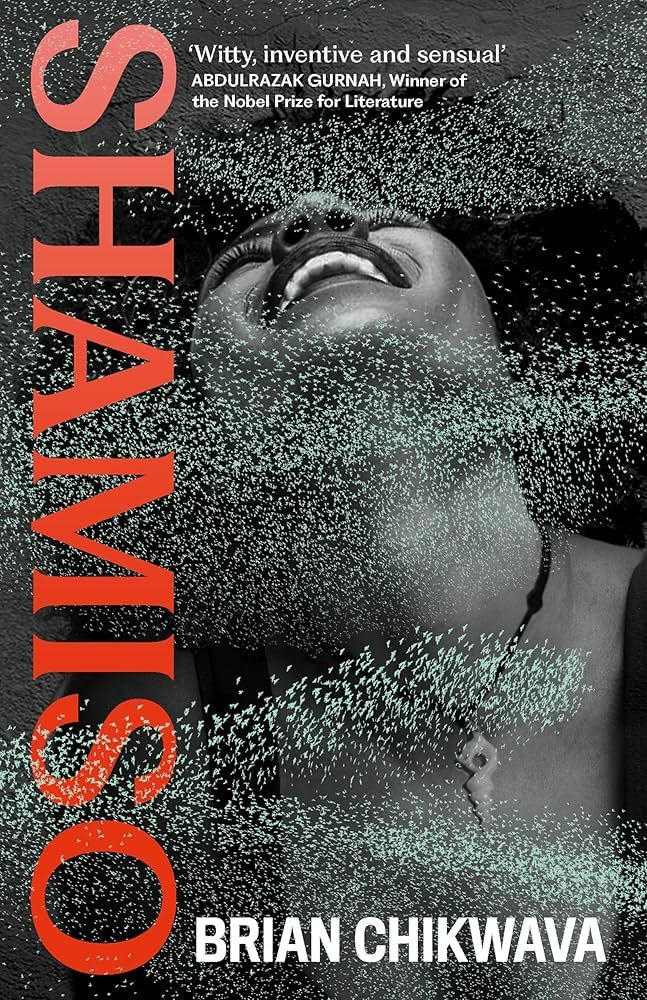
155 pp. August 28, 2025, Canongate. Fiction/Zimbabwe
“Obese with grief, I discovered that ‘I love you’ was the best sentence ever.”
I’m one of the vanishingly few Zimbabweans who’ve never been to Harare North (what we call the UK in local—Zimbabwean—parlance), but Chikwava’s first novel of that name showed me vividly what that experience was like for many of my compatriots—those who became undocumented migrants there. In some ways, Shamiso is a much more polished rewrite of that novel—a similar experience for Shamiso as Harare North’s protagonist’s, but Shamiso’s is much less fraught, and far less brutal.
Right from the beginning, Shamiso roots itself and announces itself to be a novel steeped in Zimbabwean life and culture. It’s in descriptions of how when children are going to fight, they build little mounds of soil and call them ‘your mother’s breast’ before kicking them over; and it’s in how, as Chikwava says, you name your dog to fight with your neighbours:
“The puppy has been named Mapenzi. Morons! It is custom to conduct sprawling, decades-long quarrels by giving your pets names that wind up the hated neighbours. Whenever anyone from Shadreck’s family comes to borrow one thing or another, Jimson’s mother never misses the opportunity to pretend to be calling Mapenzi at the top of her voice.”
Chikwava’s a lyricist, with his beautiful way with words—the main way Shamiso works its strange magic. His prose soars. The eponymous Shamiso says:
“I am still the little girl who spent a chunk of her childhood trying to find her way out of capacious clothes that I was expected to grow into. If my grasp of the world was behind everyone else’s, it’s because I saw it later than many.
You could say I was the last to see the blue sky. I could start the story there. But I will start here: with Jimson at the borehole.”
Jimson, the “old man made of sadza, sweet potatoes, groundnuts and black-eyed peas. My Babamukuru.” I loved that tragic figure, the ostracised and lonely orphan Shamiso’s initial friend and confidant, with whom she was always getting up to shenanigans early on. Jimson, who murdered someone in their youth, who vanished to Mozambique where they spent eleven years travelling “through worlds in which you have to sleep very fast because somebody else needs the pillow.” Jimson, of gravitas in the cultural sense, a hero in the village for their stories of travel in exotic lands. Jimson who “never married, never reproduced” and was “destined to be buried with a maize cob, the symbolic wife for a man who dies wifeless”—but was also “the most senior surviving man from Shamiso’s father’s line, and nothing can be done about that.”
But in the end, Jimson never went to war and so cannot be a national hero as Shamiso’s father, their cousin, is. “They are new men and women at their homecoming. They speak foreign tongues, have new names and walk with the signature gait of people with a new way of looking. The confidence of the terrorist who became a liberator overnight.” Their cousin, Shamiso’s father has “acquired the volatile temperament of young men who have seen war, lost comrades or terminated friends’ lives and become monsters”; he “has been turned inside out often; it’s impossible to tell which way he is now.”
Jimson, overawed. Never living up, then, to what the new Zimbabwe requires. If their status in the city at their cousin’s house and at the hands of their cousin’s wife becomes humiliating, this is what they must try to accept for them to live. Even if this leads to Shamiso’s disenchantment with them. Even if it leads to tragedy.
I loved this, too: the comfort and profundity of the use of the pronoun ‘they’ for elders, customary in many southern African cultures. I believe this is the first book I’ve read in English that does this. The meaning of this is respect for the length of their lives: We refer to elders in the plural as acknowledgement that they are greater than us in wisdom and knowledge. Mostly, in this novel, this respect is given (on and off; pronouns shift and change) to Jimson.
Shamiso means, in ChiShona, a marvel or a wonder. Part of the novel’s strange magic is rooted in spirit. Our protagonist’s first encounter with her spirituality is when Babamukuru Jimson buys her a Nyami Nyami pendant. Gradually, her connection to this snake-headed fish spirit grounds her and gives her courage and a connection to her Babamukuru:
“Babamukuru Jimson was never far away, but I no longer needed him to be there for me to stand up to my stepmother. As long as I could feel him through the pendant, I could hold onto my inner stillness.”
Shamiso becomes haunted. She has what Western medicine would interpret as a breakdown, but what in Shamiso’s own cosmology is a breakthrough to the spiritual world and her ancestors. In some of the novel’s best passages, Shamiso comes to herself to find she has walked 75 km towards the eastern part of Zimbabwe, where her ancestors dwell. She completes the trip by bus and treks up a sacred mountain when she gets there to commune with the spirits. She finds something there, coming away finally with a sense of self and with the determination not to lose her mind.
It’s important to note that this section introduced for me a severely discordant note, as the Nyami Nyami spirit belongs to the Tonga people of the west of Zimbabwe, whereas Shamiso is shown to be rooted in Chimanimani, in the east. The spirits of the various Zimbabwean cosmologies are geographical and belong to particular nations; I don’t believe, then, that Nyami Nyami could make a meaningful connection with Shamiso, or Shamiso with them. As Nyami Nyami becomes a central theme of the novel, it did rather puzzle me that Chikwava made this choice.
Nevertheless, it’s also in this part where the novel acquires a more surreal feel; from this point on, Shamiso is a somewhat less reliable narrator; the goings-on in her life acquire a layer of mystery, and the story becomes more meditative and filled with imagery from the art Babamukuru taught Shamiso to make.
When she’s eighteen, Shamiso is thrust into and welcomes the freedom it gives her to be away from her family and culture: She has won a scholarship to art school in the UK. This is also the section of the novel that, to me, recollects and reimagines Harare North. In the UK, Shamiso finds care and attention in the home of Nishta and Gabriel, who’ve taken her in. She meets George who is, in many ways, her soulmate. Shamiso learns boldness. Her world is much-expanded as a result of her transplantation to this new culture, and she embraces it all. Still haunted and revisited by the traumas of her childhood, she still finds a way to a kind of peace. And now, more than ever, her life is threaded through with and grounded in Nyami Nyami, the snake spirit.
If Shamiso as a sculptor learns to use the subtractive technique, it feels like Chikwava may have, too, in the writing of this novel, “[removed] material from a block until something … [emerged]… [not] imposing form but anticipating.’ We don’t come to the end of Shamiso’s journey; it’s hard to know where she’ll end up. But perhaps that doesn’t matter: We’ve seen her through to yet another beginning by the end of the novel. What she’ll make of it, we can only guess.
A book well worth reading, and recommended. Many thanks to Brian Chikwava for the review copy.
Affiliate link: Support independent bookshops and my writing by ordering it from Bookshop here. (Hardcover coming in 2026)
 Harare Review of Books
Leave a comment