
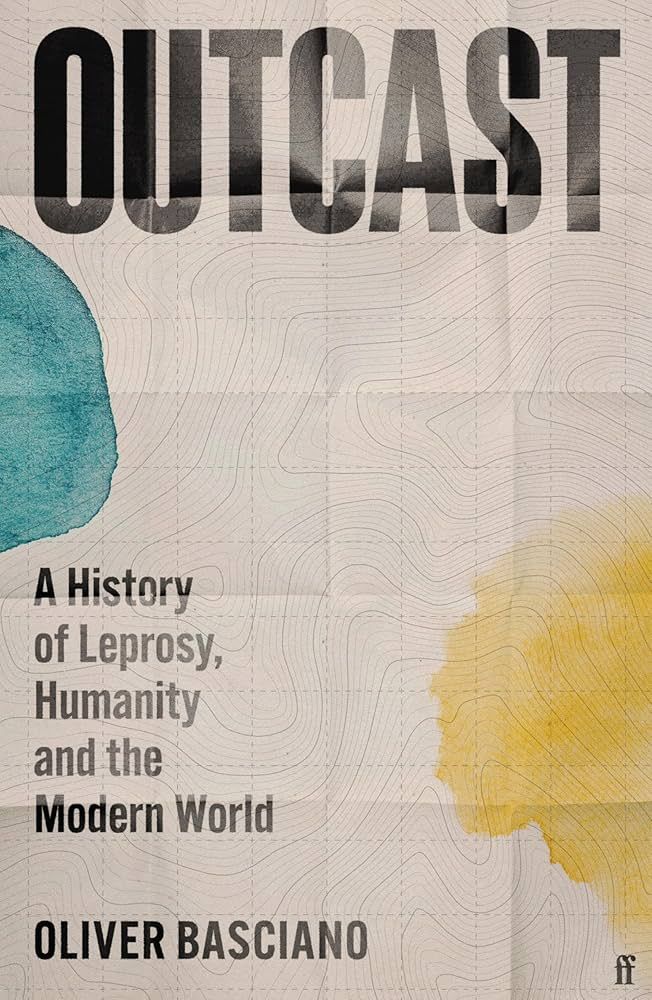
320. June 17, 2025, Faber and Faber. Non-fiction.
It took me longer than normal to read this book; in certain places it’s really hard to get through—for empath reasons. It shows so clearly how humans fail other humans when they (re)make societies—how they’ve failed those who look different, those who are ill… Those who’ve needed the most help. And there’s a reason for my separation of myself from the acts of such humans, as this has not at all been a universal tendency, as the book will show you: The history of leprosy is now inextricably tied up with the history of empire and colonialism.
Basciano’s modern history starts its journey around the world in St Albans, in the UK, where the St Mary de Pré Priory was founded in 1194 for thirteen women with leprosy. (There’s no longer any evidence of a similar institution for men started fifty years before.) Basciano uses this a stepping off point to explore the medieval history of leprosy in Europe, through to the first leprosy conference in 1897 in Berlin, and the emergence of more “modern” methods of isolation that led to the stigma leprosy patients have suffered through in the last two hundred years. Much is down to Norway’s famous son, Gerhard Armauer Hansen, who identified the bacterium (Mycobacterium leprae) that causes the disease, and who gave his name to it (particularly in Brazil and Japan). Hansen was a dedicated and conscientious scientist, but an inhumane policy maker: as Norway’s Chief Medical Officer for Leprosy, he pushed for the seclusion of patients in leprosaria through the Seclusion of Lepers Act of 1885, a draconian policy that disproportionately affected the poor. Because of the politics of the time—the heyday of colonial exploits—and the association of the disease with poverty and lower class, it was not long before colonial administrators made it a ‘tropical’ disease and used it as an excuse for segregationist health plans in the colonies. Basciano explains this while detailing how Britain made leprosy the dirty disease of India.
Through the book, we learn about personalities in the history of leprosy around the world—like Father Damien, a Belgian missionary, who lived among people with leprosy in Hawaii, and eventually succumbed to the disease. (Leprosy arrived in Hawaii with foreigners; it was unknown before that.) This section of the book is exceedingly uncomfortable to read, as Basciano outlines white saviourism, exoticism, and a weird sexual fetish associated with the disease by some, including writers Jack London, Paul Theroux and Roald Dahl. And American Charles Warren Stoddard may not have focussed on racial differences when thinking about leprosy, but he apparently “found” a kind of freedom for his queerness among those living with leprosy there.
On the other side of the world, the formidable Kate Marsden, a British nurse, signed up at eighteen in 1877 to serve as a Red Cross nurse in the Russo-Turkish war. Interestingly, she too, queer and an outcast, found refuge in serving those with leprosy, first encountering two men with it on the Bulgarian banks of the Danube during the war. Marsden’s story is fascinating: she later taught first aid to miners in New Zealand and also found there what she thought was leprosy (it may have been eczema) among the Maori. She eventually travelled to St Petersburg ‘via Alexandria, Jerusalem, Constantinople and Tiflis’ on a “roving commission to hunt up lepers wherever she had an inkling of their existence,” through incredible trials. Basciano speculates that Marsden may have been a ‘leprophiliac’, after Graham Greene (another unsettling section of the book follows). Marsden gained both fame and notoriety in Victorian England; she was elected to the Royal Geographical Society, among the first woman to achieve this. However, she also gained powerful enemies, leading to her precipitous fall from grace.
Another gripping aspect of the history of leprosy in Basciano’s book is the previously unknown to me association of Robben Island with the disease: Leprosy patients from the Cape were interned there from 1845 for nearly a century before the maximum security prison whose most famous inhabitant was Nelson Mandela was built. In 1883 Alexander Crombie, a member of the Board of Health, testified before a select committee:
“‘I can speak merely from what I see daily in my rounds about the streets of Cape Town, and I can say that it is rapidly increasing … amongst the lower classes; chiefly the coloured races.’”
Shortly after, the 1884 Leprosy Repression Bill was passed, and in 1891, Rhodes “ratified the leprosy segregation law”:
“[T]hose with signs of the disease were pulled from their homes in the likes of District 6 without warning, often in handcuffs, the authorities worried that otherwise they might go into hiding.”
Segregation, at this point, was clearly race-based, with the Medical Officer for Health stating (CW):
“Here you have a very different population to deal with. A people largely composed of native and coloured, unreliable, indifferent to the dangers of the disease, ignorant and devoid of the simplest knowledge of hygiene.”
Basciano tells us that by 1915 there were 600 people interned on Robben Island, and that “white patients were presented as victims of the supposed hygienic dereliction among Black people.” The movement of people because of empire only increased stigma and strengthened racist ideas of disease: Indians being taken to South Africa as indentured labour were considered to be unsanitary and carriers of disease, bringing bubonic plague with them. Much of this was used as a pretext for urban clearance and early segregation (‘zoning’) based on race; and segregation was also applied to the residents of the leprosarium on Robben Island—enforcing the idea that all ‘lepers’ were not created equal.
Impressive as the book is up to this point, Basciano is hardly done. He also explores the experiences of people with leprosy in Romania under the Nazis (and their eugenicist policies—Basciano goes into detail about this) and Antonescu, and then under the megalomaniac Nicolae Ceaușescu. Basciano records the haunting personal testimony of people interned at Tichilești, which ironically provided patients shelter “from the worst excesses of the regime,” in Basciano’s words, and for which they are now nostalgic. Of all the people Basciano spoke to for the book, these residents appear to be faring best, receiving decent government care.
Basciano travels to northern Mozambique, at the time (and still) in the midst of a rebel insurgency, complicating and stymieing the government’s response to the health emergency: Mozambique has once of the highest incidences of leprosy in the world (despite having declared leprosy eliminated in 2008). Northern Mozambique also suffers from being far from the capital and relatively inaccessible and underdeveloped, stemming from and leading to government neglect in a vicious circle, the effects of capitalist corruption and neocolonialism (it’s an area rich in natural resources, including oil and gas) and from frequent cyclones (Eline, Idai and Kenneth are recent ones that have brought devastation.) There are non-governmental relief agencies—primarily the Leprosy Mission—working to overcome these challenges, and awareness and community management of the disease has improved: the people are ‘saving themselves’.
And then there’s Brazil, which has the second-highest incidence of leprosy in the world after India. According to Basciano, leprosy is most prevalent in the north, north east and central areas of the country, coinciding with lower economic status:
“One patients’ rights activist summarised it to me: ‘In Brazil, leprosy has a colour, a class and a gender; it is Black, poor and male.’”
The Brazilian story of leprosy is most striking for leprosy’s advocates and patient-led rights groups: they campaign for medication and more rights for patients, often succeeding in influencing or changing government policy. There’ve been battles on and off with the government over the land and buildings of leprosaria and the rights of residents to those. Unfortunately, patients have also had to battle organised crime for territory (it’s been easy for criminals to take over former colonies). The wins of these groups, however, are remarkable: President Lula signed laws offering compensation and pensions to patients forced into isolation and to their children who were taken away from them.
Basciano also investigates leprosy in Japan, where, as in other parts of the world, patients were isolated in leprosaria and where, as in Brazil, patient-led initiatives forced change to happen and brought improvements in management:
“Zen-Ryo-Kyo [the National Association of Residents of Hansen’s Disease Sanatoriums] began to build its soft power, not just at the movies but also through the construction of a series of museums. Today, all Japan’s sanatoria have such institutions, all established by the patients themselves, permanent storage facilities for a collectively lived life, a repository of a people whose social attachments were systematically destroyed.”
A decision was made in 2001 that the Japanese government apologise for the way patients were treated and to pay compensation.
The way society treats those it would sideline or oppress—’the least of these,’ in the words of Jesus—is a signal to everyone, within and without, of the values of that society, and what rights can be taken away in the blink of an eye. The history of leprosy, as Basciano shows in Outcast, is very clear on this. Outcast fascinating and expansive; you’ll likely never read anything more magisterial. If you read just one non-fiction/history book this year, make it this one. Highly recommended.
Thank you to Oliver for the review copy.
You can learn more about Outcast here.
 Harare Review of Books
Leave a comment