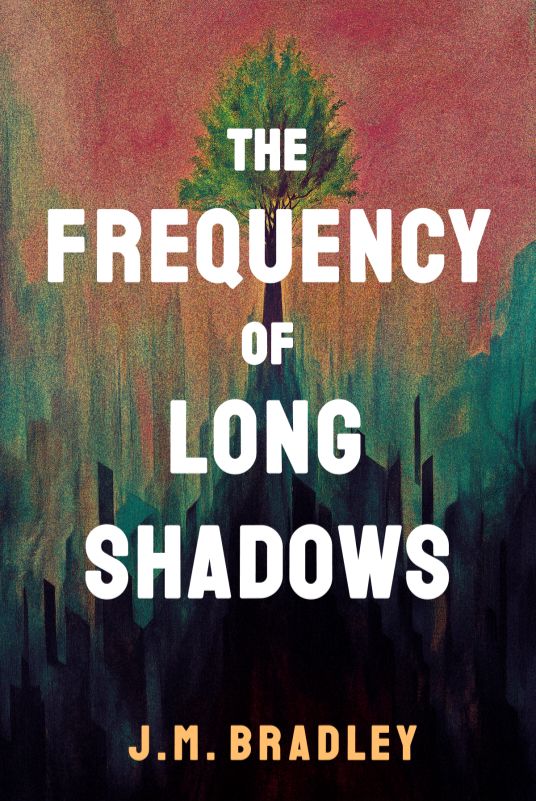
456 pp. May 13, 2025, Odd-Books LLC. SF.
What if it was 2077 and Klaus Fuchs had never joined the Manhattan Project? And FDR had lived until the early 1950s, and General MacArthur had become president of the US? And the Soviet Union had failed earlier? Alternate universes are not a new thing in SF—obviously—but this was an interestingly envisioned one.
The Frequency of Long Shadows explores accelerationism in a parallel universe (complete with a character called Clarc Axelsson, so that’s as subtle as a hammer) called Branch Four-Four. The MC Orson’s dad is a genius who’s solved the whole multiverses thing and set up a company for the extraction of advanced technology from other branches (yes, I hate this). When we meet them, Orson and his genius dad are about to traverse to Branch Four-Four.
At first, my experience of the novel was what felt like the author’s inexperience: the early part of the book is the MC’s interiority and is both overwritten and, also, the character is obnoxious and unlikeable, when I think it’s all meant to be earnest. The novel improves a lot, however, when it stops being all about Orson’s whiney thoughts about how much of a genius he knows himself to be and about his absent father, and becomes about this strange parallel universe they’ve both landed in (although what’s really strange, of course, is he—and his dad—to the locals). It’s all very vividly realised: The alt-US has megacities and super-fast transportation (almost teleportation, but more sciencey), and somehow Rio de Janeiro is part of the US now? Rio is now Pebbler Bottom New Rio, and it’s where the underclass lives (telling you what the book’s politics are, more or less).
This is YA, and the standards for realism (such as you expect in SF, anyway) are appropriately lower, which is fine. It’s also rather like the author tried to fit Hogwarts into a science fictional setting, which is kind of weird … but also kind of works, maybe? Maybe. It’s one of the frustrations of the novel. More importantly, though, this is a book that explores accelerationism, and boy … it does tend to get on that soapbox. (Even it tries to be dialectical, I sense that this is a book written in support. I think you’ll agree if you read it, too.)
The Frequency of Long Shadows did, in the end, turn out to be a really decent read, mainly because of the fascinating depiction of Branch Four-Four. Orson is set up to be the One True Hero (no surprises there: typical YA wish fulfilment, complete with The Girl). Readers are also set up for possible sequels through a pretty big twist near the end; it’ll be interesting, therefore, to see where the author takes Orson in the future (although it must be noted I’m really not a fan of (SF) series in general).
My verdict? Although it had some exasperating bits, it’s a good and even fun read, and I recommend it.
Thanks to Odd Books and NetGalley for DRC access.
 Harare Review of Books
Leave a comment