
304 pp. July 15, 2025, Flame Tree Press. SF.
I’m a fan of Nadia Afifi’s writing; she’s the author of The Sentient (Bookshop link), The Emergent, The Transcendent, and she was in the recent Palestinian SF collection, Thyme Travellers: An Anthology of Palestinian Speculative Fiction, edited by Sonia Sulaiman.
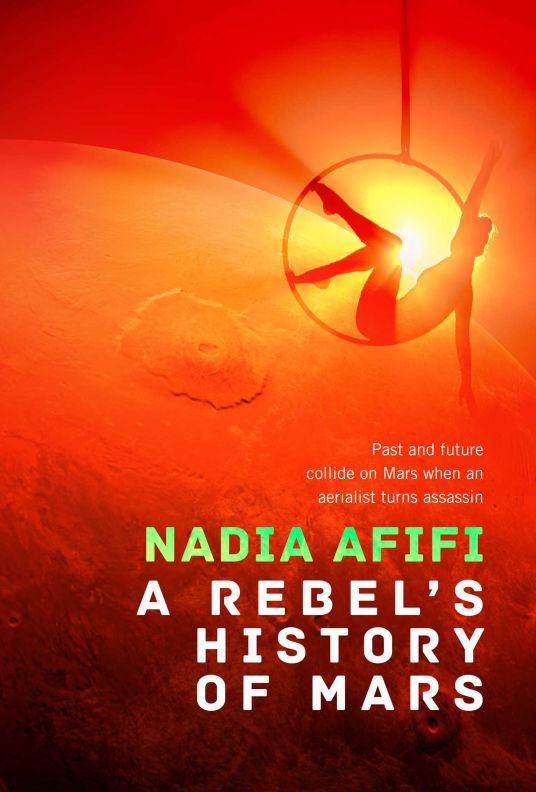
A Rebel’s History of Mars is about, as it says on the tin, the history of a future Mars and rebellion, written from two POVs in two time periods: that of Kezza, an aerial performer in the circus on Mars (bread and circuses anyone), and Azad, a thousand years later on a planet called Nabatea. The novel starts off really well: Azad is on doctor duty (not like we know, as medmechs do all the work) when a patient comes in and essentially liquefies before him. As she dies, she says to him, “You look just like her.” It turns out that Azad has a missing twin, Ledo, that he thought long dead. This incident sends him across space in search of her. What he finds along the way is a bunch of historians and the mystery of an old class conspiracy that created the society he now lives in on Nabatea.
So many cool ideas—like this stratified future society with the superhuman Vitruvians who can do as they wish and travel across space and all kinds of fun stuff, while regular Nabateans are the riff-raff that do all the work (slightly confusing in a society where robots do a lot of the hard stuff, but I guess plausible as humans will find any reason to create a hierarchy). And in the novel’s past, a Mars with domed corporate cities, where workers owe their very lives to the companies that run things—fertile ground for rebellion.
Being a fan, this one both thrilled and somewhat disappointed me. There’s a fair bit of “magic” in this novel—by which I mean unexplained things in the world-building, and incidences of deus ex machina. It’s possible Afifi wanted to focus mostly on the character arcs; and of course no author needs to explain every little thing that’s going on… But those niggling things make this novel’s world feel unfinished. On the other hand, Afifi extrapolates common societal problems into the future really well: This novel considers the what if of humans taking their determination to rule over each other (supremacist ideas) into the future, and out into space. It’s also a novel about megalomania and unfettered power, and the destruction it always brings to ordinary lives. And while A Rebel’s History ends on a note of hope (yay, genetic engineering for everyone because we all want to be superhuman innit*), the ending rings a little hollow—and, again, deus ex machina.
Still, a rollicking good read about class and humans still humaning even when they’ve become interplanetary, which, you know, fits.
Many thanks to Flame Tree Press and NetGalley for early DRC access.
* I’m not a fan of transhumanist ideas that suggest we will be happier if we’re more physically perfect and less human, so that didn’t please me.
Affiliate link: Support independent bookshops and my writing by ordering it from Bookshop here. Ebook | Hardcover
 Harare Review of Books
Leave a comment