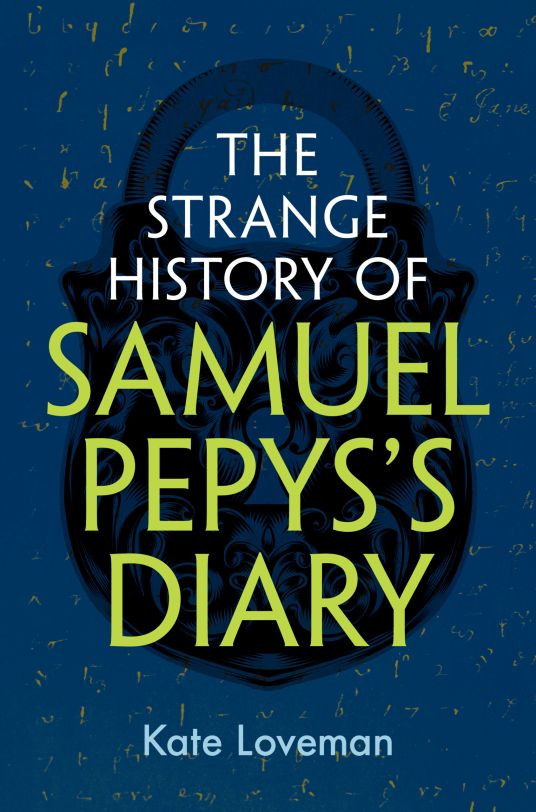
254 pp. June 26, 2025, Cambridge University Press. Non-fiction.
I recently found one of my old diaries, from when I was 15. That person is so foreign to me now, that everything I read was new to me again, almost fictional. I know (or suspect) that while writing I was projecting a self I probably wasn’t, as many of us do when faced with the self-consciousness you get when writing to the future about yourself—the spotlight of that blank page. It’s one reason I kind of admire Samuel Pepys’s nerve… But perhaps he was projecting a self, too.
I had some exposure to Pepys’s diary before reading this book, but not a lot—some from cultural diffusion, and some from following the Bluesky bot that posts entries linked to pepysdiary.com, a long-running project that Loveman explains at some length in the book. Which is to say: You don’t have to have read the diary (as Loveman explains, most people, even some who claim to have transcribed it of it, have not) to find The Strange History of Samuel Pepys’s Diary fascinating, which it is.
Pepys (pronounced Peeps, I learnt from Loveman) is known for the secret diary (or series of diaries) he kept for a decade in the 1660s—yes, that’s “16”, not “19”—detailing political scandal and also naughty details of his and other people’s sexual exploits. It serves, above all, as an insider’s record of the Restoration period in England. Pepys was connected to the Stuarts through his patron, and was at one point Chief Secretary to the Admiralty. He was also, although not explored in this book, an apparent fashionista.
Loveman says “the early editions of Pepys’s journal fuelled the development of what would now be termed ‘social history’,” a fascinating claim. It made historians pay attention to not just the big events of the world and the big men who made history, but also the daily lives of ordinary people. Pepys is also the reason we know what it was like to experience the Great Fire of London, as well as what it was like to live through the plague of 1665—both events recorded in his diary.
Loveman begins with a painstaking explanation of why most people have not, in fact, read the real diary: It was written in Pepys’s idiosyncratic version of shorthand, which only a couple of people in the centuries since have deciphered (Loveman is one). Access to the original diary (bequeathed to and kept at Magdalene College, Cambridge, England) has also, so far, been restricted to just a few people. The first “transcription”—more accurately a translation and much redacted and censored—was published in 1825, “a very limited selection chosen by Lord Braybrooke”; and there exists only one complete edition of the diary, published in a series of volumes from 1970 to 1976: that of Robert Latham and William Matthews (a great story on its own). Most modern editions, including pepysdiary.com, are based on Wheatley’s censored 1890s edition (Loveman points out that this is mostly because it’s out of copyright, and therefore freely available).
Loveman ends the main section of the book with a chapter, Reading Against the Grain, on what we don’t see in the diary—namely, how Pepys’s exploits affected his wife, Elizabeth, and (may have) hurt the women he pursued (including non-consensual sex). In fact, Loveman points out, the power discrepancy between Pepys and many of these women means it’s likely his advances didn’t come from a place of mutual interest (apart from, notably, his dalliance with Mrs Bagwell, who wanted a promotion for her husband—but how Pepys navigated that is problematic, too). Secondly, there is the presence in their absence of Black people, who we now know were very much part of London and English life at that time. There is fascinating detail tracking a man named Isay William Mingo, at first enslaved, but who later found freedom.
In summary, this is a great read on a subject I did not think I would find this engrossing. The Strange History of Samuel Pepys’s Diary is the best kind of monograph—detailed and engaging. Highly recommended.
Thank you to Cambridge University Press and NetGalley for early access. And so to bed.
Affiliate link: Support independent bookshops and my writing by ordering it from Bookshop here.
 Harare Review of Books
Leave a comment