
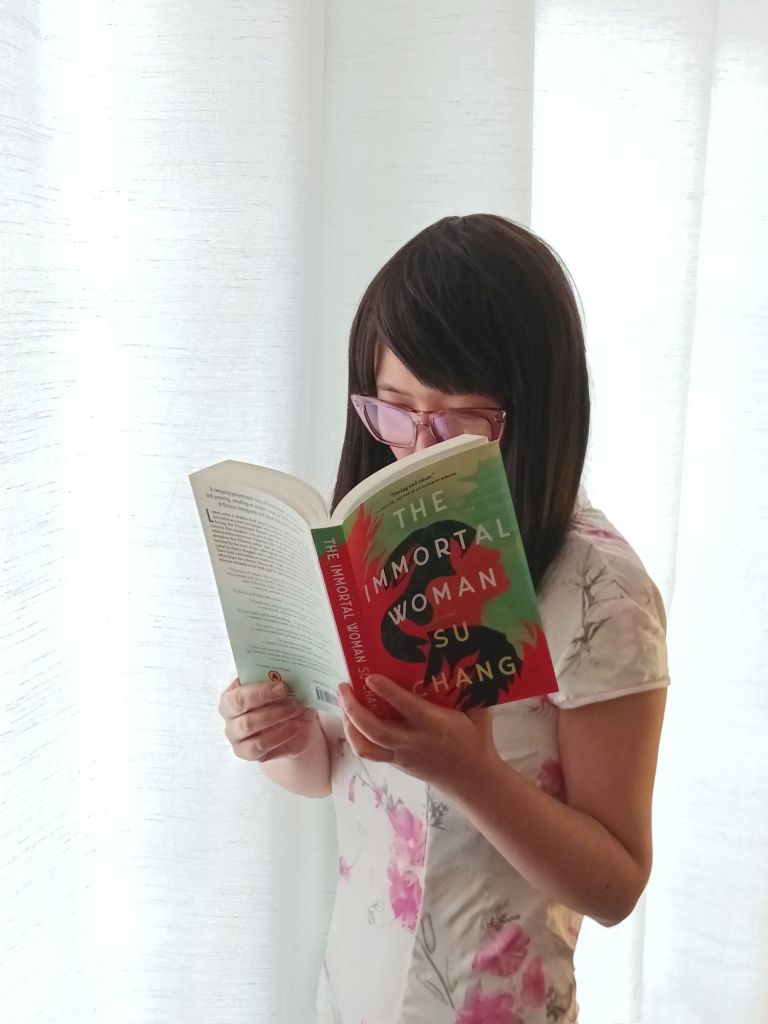
Su Chang graciously agreed to answer questions HRB had about her novel, The Immortal Woman, as well as a few other things HRB was nosy about.
Su is a Chinese-Canadian writer. Born and raised in Shanghai, she’s the daughter of a former (reluctant) student Red Guard leader. Her fiction has been recognized in Prairie Fire’s Short Fiction Contest, Canadian Authors’ Association (Toronto) National Writing Contest, ILS/Fence Fiction Contest, the Masters Review’s Novel Excerpt Contest, Tennessee Williams & New Orleans Literary Festival Fiction Contest, among others. The Immortal Woman (House of Anansi) is her debut novel. (suchangauthor.com)
Jacqueline for Harare Review of Books: Hi Su! Thanks for agreeing to do this. HRB appreciates your time.
This is your debut novel. How did you come to write it, and how long did it take?
Su Chang: Some version of this story has been in my head for more than a decade, but I kept changing the structure and details of the plot. I kept reading and researching and mapping out the book until around 2021, when I finally sat down and wrote a full draft during the COVID lockdown.
HRB: The heart of the novel is the mother-daughter relationship. Lemei (the mom) is a very complex and traumatised woman—one of my favourite characters of any novel, in fact, and so memorable. She loves her daughter dearly, and wants to protect her. As a child, Lemei, whose name means happy girl, transitions from a confident and outgoing girl to one who grapples with difficulty, including time as a reluctant Red Guard. How did you manage to make this history come to life so vividly, and how difficult was the research on this for the novel?
SC: Thank you for your generous comment. Part of this book was inspired by the experiences of my father, who in his teenage years reluctantly served as a student Red Guard leader. I grew up hearing some of his stories, but I couldn’t trace them in my history books. It was only after I immigrated to North America that I began to have access to the tabooed past of my birth country, and started to make sense of the incongruency that had haunted me. Over the years, as I labored to find footing in my adopted country as an adult immigrant, I also spent my evenings and spare time researching – from books, documentaries, lectures, and talks – the history that was missing from my childhood textbooks. Because what I found eventually tied into my family history, the project felt personal. I was motivated and very much enjoyed the research. When I wrote the book, incorporating written/oral histories and witness accounts, I could visualize the scenes in my mind’s eye, and perhaps that was why the result, as you said, was vivid.
HRB: The Immortal Woman tackles really difficult themes—like generational trauma, and resulting mental health struggles; the effect of a mother’s struggles on her daughter, and a daughter’s own mental health even as she navigates life as a migrant. This is in fact quite central to the novel. Lemei and Lin deal with their struggles in quite different ways, but silence haunts both women. Could you tell us more about silence, generational trauma, and Chinese history?
SC: Yes, the mother and daughter had a lot of trouble communicating with each other, partially because they were so used to being silenced. There is a lot of collective amnesia in the Chinese modern history – a period of political upheaval would eviscerate lives but then, right after it, people were told to move on and look into the future, instead of taking a moment to reflect and heal. This happened to Lemei’s generation after the Cultural Revolution, and then again after the Tiananmen Square protests. Lemei dealt with her pain by forcing her daughter to become a Westerner. She erased the history of her culture (by destroying Chinese books/calligraphy) and her family (by refusing to tell Lin what happened). But the erasure of history only exacerbated intergenerational trauma, as Lin could not understand the reason behind her difficult upbringing and identity crises. They finally started listening and talking to each other at the end of the book, and that was the only path towards reconciliation.
HRB: The novel is about recent Chinese history—the Cultural Revolution, Tiananmen Square. We know what we’ve read in the news and some history books, but I love how you made big history personal to these characters. In my review of The Immortal Woman, I said how portraying history through its effect on the lives of characters makes a reader care so much more about what may seem like distant politics. How important was it to you to make this history accessible to your readers?
SC: It was important for me to make the complex history accessible to my readers. This objective dictated my decision to go micro (relatively speaking), focusing on only a handful of individuals, even as I press them against the backdrop of massive historical movements. Following one particular family’s journey allows me to delve into my characters’ deep psyche, and through that process, release my own emotional truth—something I hope readers can connect with.
HRB: In my review, I also asked this question: Who or what needs protection, with respect to the delicate relationship between the Chinese Communist Party and Chinese citizens. It’s there in how you wrote the novel, and is a sensitive subject. Could you address this?
SC: As a fiction writer, I’m interested in diverse personal experiences against the backdrop of complicated history. I try my very best to approach fiction without any political agenda. I want to offer a kaleidoscope of personal stories and opinions. In Western narratives, the destructiveness of Communist revolutions is well acknowledged, and I certainly didn’t shy away from that. At the same time, there are also characters in my book who present balancing viewpoints, which are also interesting and important to me. Without hearing those balancing points, we risk being blind to the sophistication of contemporary propaganda, and to the popular (and sometimes genuine) sentiments of “the people over there.” We risk being perpetually puzzled by the origin of nationalism in non-Western countries.
HRB: Lemei was used and discarded by the State, and her formative experience of home is one of alienation—something she passes on to her daughter. Lemei’s experience of China is contrasted so well with that of the characters we’re introduced to later in the novel, who are very China-positive—true nationalists. These characters are in fact flag carriers for Chinese propaganda. Is this divide in opinions a fair reflection of reality in the Chinese diaspora?
SC: That is my observation. China has been rising rapidly, lifting millions out of poverty and even elevating many to the global elite class. Coupled with a new president who promotes the “China Dream” and encourages nationalism, it’s not surprising that many Chinese are becoming ardent nationalists. The younger generation also has limited exposure to the traumatic aspects of Chinese history; for them, there was nothing to forgive or forget. Moreover, to be critical of one’s country of origin can erode one’s sense of identity and pride, and eventually it becomes its own source of pain. And for new immigrants, it can be shocking to come face to face with their visible minority – even “alien” – status. The Western government and media often brand China as an “enemy state.” This sort of Cold War mentality and suspicion of dual loyalties takes a psychological toll on the new Chinese immigrants. As we see in the novel, someone like Dali cannot find belonging in his adopted country and eventually turns to nationalism for solace.
HRB: Another thing I really appreciate about The Immortal Woman is its “own voices” aspect: to hear about China from someone of Chinese descent, rather than from a Western perspective. Was this part of your motivation for writing the novel?
SC: Yes, indeed. While books from children of immigrants have become common in the market, so have the coming-of-age stories by authors who immigrated as young children, adult immigrants’ own-voice novels like this book are still rare. I hope to present an insider’s perspective on Chinese history and new immigrants’ lives.
HRB: Do you think of your novel as being in conversation with any other book?
SC: I think of Madeleine Thien’s Do Not Say We Have Nothing as a forebear of the historical part of my book. During the early stages of my research, I felt a self-imposed responsibility to do what my elders couldn’t do: write about the modern history of my country truthfully. When I read Do Not Say We Have Nothing for the first time in 2016, I thought Thien had done just that, and to perfection. And strangely (and not to be self-aggrandizing), I also felt the weight on my shoulder lifted – someone brilliant had written a Book of Record so our future generations would not forget. So now I was free to explore the (relatively) micro, the personal, the bodily and psychological experiences – of the survivors and their children – without feeling the immense responsibility to narrate the enormity and entirety of those historical periods. That was the approach I eventually took with The Immortal Woman, so my book is heavily indebted to the reading experience of Do Not Say We Have Nothing.
For the contemporary part of my book, I was in conversation with Ayad Akhtar’s Homeland Elegies, even though I don’t share the same cultural/religious background with Akhtar. At one point in his book, the narrator Ayad identifies as part of the Muslim world who has been vilified by the American empire, but within the same paragraph, he speaks as an American who’s still mesmerized by American exceptionalism. This dual identity invites constant suspicion of where his loyalty lies, even as he becomes part of the new cultural elite. I explore similar themes in my book. And like Akhtar’s protagonist, the Chinese heroines in my novel are oriented towards the West and exhibit “colonial mentality,” which I find fascinating – a people who haven’t been formally colonized may still adopt the ready mindset to worship the West and suffer from internalized racism.
HRB: What’s your writing process like?
SC: I am not a pantser, and I outline my book before getting down to write. I can get paralyzed facing a blank page, so I need a roadmap to boost my confidence. Some say that could take the surprise out of the process, but I find there are always so many surprises at the granular level of writing that I’m not missing out on the fun. I also like to have a daily word count target when I’m in the thick of drafting.
HRB: What are five facts about you that nosy readers would enjoy knowing?
SC:
1. In Grade 3, I wrote and published my first story in a national youth magazine. Of course it was in Chinese.
2. I don’t listen to music at all when I’m writing, but I do sometimes use music to access a certain memory or mood before a writing session.
3. I can memorize a melody after hearing it once and often play it by ear on the piano.
4. I dog-ear pages and annotate books in the margins like I’m having a private conversation with the author.
5. It’s not easy to write with young children in tow, but I owe my kids all my creative energy.
Links:
- HRB on The Immortal Woman
- Where you can get the novel: Support independent bookshops and my writing by ordering The Immortal Woman from Bookshop here.
- Author website: suchangauthor.com
 Harare Review of Books
Leave a comment