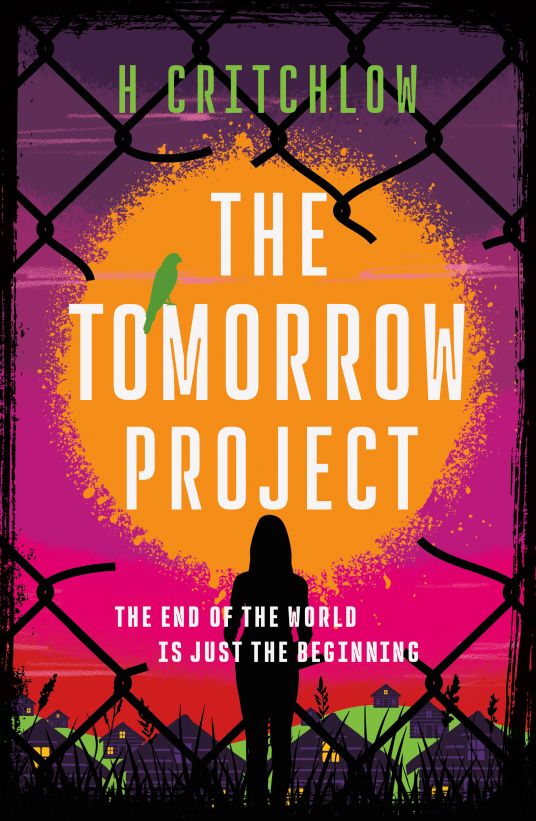
320 pp. Published May 15, 2025 by Canelo. SF.
It’s kind of weird to read a pandemic novel after 2020 and all that year brought. In some ways it’s still so fresh in the memory, and so traumatic, you don’t want to relive it. It would even be cathartic, I suppose, if COVID wasn’t still so very much with us, and still killing people. Nevertheless—we love to read about disasters, right?
We are thrust directly into the action as readers—in media res: there’s a spreading virus, parts of the world are already incommunicado, and we meet the British PM’s press secretary, and sometime lover, Marianne, as London falls. Marianne is also suddenly, and without planning to be, part of an underground movement to save children by sending them out to the countryside (reminiscent of the Blitz, and WWII); in the process, she saves Maia, who is the main character for the rest of the novel.
We watch Maia grow up in an evacuation camp on a remote farm, and learn about all the ways the community finds to survive. But eventually, after many years, the question becomes inescapable: did anyone else make it? Is there life outside the camp?
There’s so much that’s lovely about this novel, and the beginning is truly thrilling. But then… The middle does drag and lose its way a bit. (It could probably do without roughly 75 pages of the narrative.) I felt another thrill near the end, so things did pick up—enough for me to give The Tomorrow Project a high rating.
There are so many end of the world stories; what sets this one apart? Well, the protagonist for one: she grows up with no real knowledge of the old world except the tiniest memory of her mother, that’s the thing that eventually drives her to leave the camp. Another thing is how much thought Critchlow put into imagining how a group of people might survive in isolation—made more real, of course, now, by COVID. I also enjoyed the post-apocalyptic parts of the novel: there are no easy or pat answers, which is as it should be. There’s cooperation, but also conflict between the survivors, which is also realistic.
I think a lot more thought went into writing the female characters than the males; one male in particular came across as creepy throughout the novel, but that seemed to peter out at the end….? for reasons unclear. My favourite character is a mother figure—a teacher who takes Maia under her wing; I thought she was the most well-written side character.
So, themes? Post-Apocalypse. Like I’ve said already, how humans survive, cooperate, and fight each other. The enduring bond between a daughter and her mother, and how a very similar bond can be made between women and children who are not their own. Oh, and governmental ineptitude and corruption, undoubtedly still at the forefront of everyone’s mind after 2020. Finally, coming-of-age in a time of chaos.
Really very decently executed, and a very good read. Thank you to Canelo and NetGalley for DRC access.
 Harare Review of Books
Leave a comment