
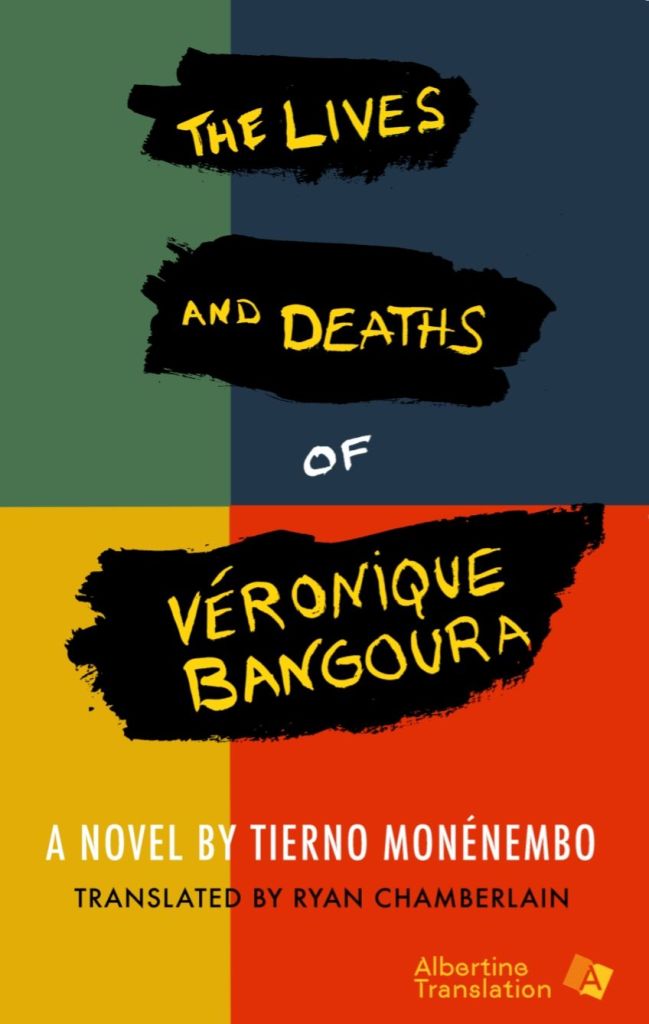
240 pp. First published March 4, 2025 by Schaffner Press. Fiction/African Literature.
Sometimes I pick up a book and in the first few pages I get that sinking feeling that says I will not connect with it—in this case, because of the writing style. This sometimes happens with works in translation: something of the original language comes through in things like expressions and how language is used, and it’s usually so distracting that it disconnects me from the flow of the story. This is how I felt when I began reading this novel.
But, dear Reader, I’m so glad I kept going, because the tale that the woman who will be known as Véronique Bangoura narrates is enthralling. Véronique, we learn, goes on daily jaunts with her wheelchair-using husband and on one of those meets another woman, Madame Corre. Madame Corre engages with Véronique as she recognised the language she heard her speak on the phone sometime as originating from Guinea. Madame Corre wants Véronique to tell her story—why she’s in Paris, how she came to be (as Madame Corre mistakenly believes) a personal care assistant to the man in the wheelchair. Madame Corre, you see, has her own painful history to share, and suspects Véronique does too. And it is, indeed, from this shared place of pain that the women begin to bond—and even, in Véronique’s case especially, to understand one another across their seeming divide.
“You’re forcing my hand, Madame Corre. Could you imagine me, Véronique Bangoura, writing a book? Belting out my life on the plaza like a convict or diva? With whose breath, exactly? What pen? Of course not. There’s nothing special about my life, I promise. I only have this handful of events to my name because they happened to other people as I passed by. Do I look like a Carmen or Lolita to you? I’m just me, your neighbor: the simple woman in apartment 43. The one whose personality pairs so well with anonymity and quiet. And what would be the point? Mine or someone else’s, they’re all the same shocks, the same endless hurricanes. Better to keep quiet, clamp down around it, take things as they come. That’s what I think, anyway. Grit your teeth and bear it. Then, soon as you can, forget—forget everything. That’s all I’m interested in. I’m not here to tell a story: what I want to do is turn the page, empty the memory. Dump my grief and regrets down the drain.”
The Lives and Deaths of Véronique Bangoura is a story that weaves in the atrocities that happened in Guinea under Sékou Touré from 1956-1982. From Wikipedia:
“In 1960, he declared his Democratic Party of Guinea (Parti démocratique de Guinée, PDG) the only legal party in the state, and ruled from then on as a virtual dictator. He was re-elected unopposed to four seven-year terms in the absence of any legal opposition. Under his rule many people were killed, most notably at Camp Boiro.”
After my initial struggles with style, I began to enjoy the rhythm of this work and Véronique’s singular voice. Véronique Bangoura is an outstanding character, the survivor of a complicated past, who through a series of unlikely events has escaped to that place in exile where she encounters Madame Corre—a woman whose own past shares unlikely parallels to Véronique’s. All stories of political turmoil make more sense to us on a human level. In this emotional and moving retelling of the brutality of Touré through the lives (and many deaths) of Véronique and Madame Corre, Monénembo brings what would otherwise be a distant news story and past history to the present experience of the reader.
An excellent and memorable read! Thank you to Lauren for the review copy.
Affiliate link: Support independent bookshops and my writing by ordering it from Bookshop here.
 Harare Review of Books
Leave a comment