
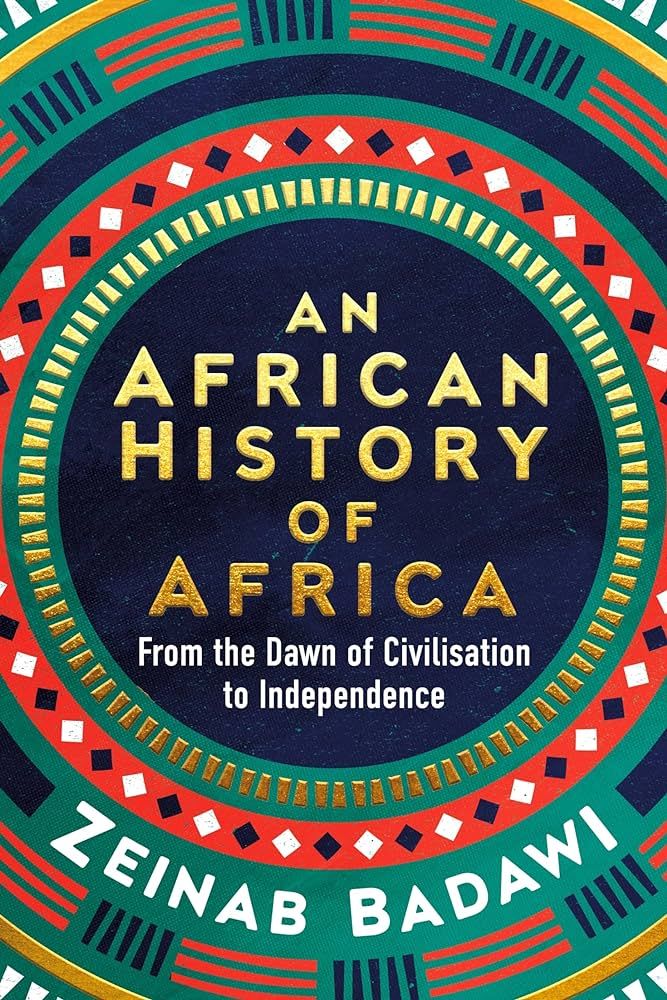
531 pages. Published on April 18, 2024 by Ebury Publishing. Non-fiction.
Forewarned is forearmed: These are my long-winded thoughts on the book (and a kind of summary).
V. Y. Mudimbe, the Congolese author, philosopher and professor, argued in The Invention of Africa¹ that (African scholarly) knowledge of Africa is based on European constructs—that is, the colonial library, which collects accounts of a few early European travellers and presents them as the whole sum of possible knowledge about a continent that covers over thirty million square kilometres. Hugh Trevor-Roper, a Professor of History at Oxford University, said, in 1965, as quoted in An African History of Africa, that Africa has been and is outside of history:
“Perhaps, in the future, there will be some African history to teach. But at present there is none, or very little: there is only the history of the Europeans in Africa. The rest is largely darkness … And darkness is not a subject for history … (From The Rise of Christian Europe)”
Zeinab Badawi wrote An African History to address the deficits in knowledge of Africa’s history, travelling across thirty countries, in her words, “in pursuit of a first-hand experience of Africa’s history from the perspective of Africans,” to highlight and celebrate the achievements of Africa’s people, focussed on precolonial times. Badawi acknowledges the massive amount of work done by African scholars as part of UNESCO’s General History of Africa² project, which has produced eight volumes in its first phase.
She begins by laying out the research into our origins—all of our origins—on the continent, following the trail of fossil discovery. From there, she takes readers to the Hadzabe in Tanzania’s Rift Valley, who still live much as our ancestors did. A summary of human development follows, from our time as hunter-gatherers, to settling into cooperative communities as pastoralists and farmers, through the discovery of iron smelting and its impact, creating economic and trade systems.
And so to kingdoms and empires: first, Egypt’s three Kingdoms, with a description of Egyptian culture, society and architecture, dynastic rule, and links to the wider region. The discovery of the Rosetta Stone by Napoleon Bonaparte’s expedition led to an “Egypotology” craze in Europe, and Egypt’s civilisation was also a source of Black pride for the African American luminaries of the Harlem Renaissance. Badawi acknowledges the controversy around treating Egyptian history as ‘African’: “In my view,” she says, “the point is not to define ancient Egypt as being African or not on the basis of the race of its inhabitants; it is about the need to challenge our definitions, and perhaps our stereotypes, of Africans.”
Then to the Kush, much overlooked although more or less coterminous with (and fighting territorial wars against) Egypt’s kingdoms, and which lasted three thousand years. Archeological exploration is hampered by the sheer size of the area of present Sudan, by the heat of the desert, and by poor funding. Kush endures: Kushite female co-regents were called Kandakes, a term that was applied to prominent female protesters in Sudan’s popular revolution of 2019.
Other empires, dynasties and kingdoms—the territories they covered, their rulers, economies and trading networks, political and diplomatic links, and their cultures and societies: Aksum; the Zagwe dynasty; the Solomonic Empire of the Horn of Africa; the Berber/Amazigh Dynasties; the Soso Kingdom; the Songhay Empire; the Ghana Empire; the Asante Kingdom; the Kingdom of Benin—famous even in the seventeenth century for its beautiful capital with wide streets, large houses, and street lighting, and lately for its Bronzes, looted by the British. In the south: Leopard’s Kopje, predecessor of kingdoms such as Great Zimbabwe, which colonial settlers persisted in denying were built by local Africans, and the largest ruins south of the Sahara, and more.
Africa’s history is replete with amazing personalities: Queen Hatshepsut; Tutankhamun; Ramesses II (Ramesses the Great); Cleopatra, the great and scheming Egyptian queen, lover to Julius Caesar and Marc Antony; Ahmed Gragn the Left-Handed, of the sultanate of Shoa; Piankhi the Conqueror; Shabaka; Taharqo; Queen Sheba; Menelik I, son of Sheba and, by tradition, King Solomon; Ezana, Aksum’s most important king; Queen Yodit, said to have destroyed Aksum; Lalibela, who built (or finished) the rock churches of Ethiopia; Massinissa; Juba II; Augustine of Hippo; Queen Kahina of the Berbers; Sundiata I, proclaimer of the Manden Charter of 1236, which “guaranteed liberty, dignity and equality“ to all citizens of the Mali Empire, and one of the oldest constitutions in the world; and Mansa Musa I, king of the Mali Empire (consisting of four hundred urban centres), the richest man who ever lived, who famously made Hajj with a retinue of twelve thousand people.
‘Tippu Tib’ was a notorious slave trader; Queen Idia and her son Esigie were rulers of Benin; Nyatsimba Mutota of Great Zimbabwe left to found the Mutapa Kingdom (or Monomutapa, for his regal name, Mwene Mutapa) further north; Changamire Dombo was a Mutapa Kingdom rebel and founder of the Rozvi Empire, which fought against the Portuguese; Soshangane was founder of the Kingdom of Gaza; and Ngungunhane, the last king of Gaza, was deported to Portugal, where he died. Asante kings and queens included founder Osei Tutu, Opoku Ware, Abena Pokou (of the Baoule Kingdom), Prempeh I, and Yaa Asantewaa, the warrior queen.
Lukeni lua Nimi, founder of the Kingdom of Kongo, Queen Nzinga of Ndongo and Matamba, Kimpa Vita, a Kongolese prophetess and religious leader, who led a revolt against the Portuguese, and Nzinga Mbemba all shaped central African history through to the European Scramble for Africa. In Sudan, The Mahdi resisted the Ottomans and Britain, and Al-Sayid the British and Italians in Somalia. Ethiopia (Abyssinia), the only African country to never be colonised, resisted occupation, winning at Adwa against the Italians. Khoikhoi chief Autshumao, uShaka kaSenzangakhona, Cetshwayo, Lobengula, and Mzilikazi were history-makers in southern Africa. Last century’s heroes, among them the Mau Mau of Kenya and the FLN of Algeria, and Emir Abdul Qadir al-Jazairi, Leopold Senghor, Hastings Kamuzu Banda, Patrice Lumumba, [[Julius Nyerere]], Nelson Mandela, and Kwame Nkrumah, fought for Africa’s freedom.
In her treatment of slavery, Badawi begins with the less well-known and much less discussed Indian Ocean trade in enslaved persons, in which Swahili traders collaborated with Arab traders; Zanzibari businessman Tippu Tib is perhaps the most famous. An estimated fourteen million people were trafficked from eastern Africa’s ports between the seventh and nineteenth centuries; slavery was slow to end after the slave trade was abolished in Zanzibar in 1876, and there is still a reluctance in East Africa to confront this history, although there are monuments. Badawi compares this trade to the immense brutality of the transatlantic one, initiated by the Portuguese (with African collaborators) and expanded by the Spanish, Dutch, French Danish, Swedes, and the British, in which at least twelve and a half million Africans were trafficked between the sixteenth and nineteenth centuries. Badawi contends with the idea, popularised in European defence, that slavery already existed in Africa, as indigenous slavery held the potential of freedom, and was more akin to indentured labour, for both men and women. In the transatlantic trade, an estimated two million people may have died before reaching their destination, and the lifespan of an enslaved person on the plantation was only about seven years.
Ayuba Suleiman Diallo, Charles Ignatius Sancho, Ottobah Cugoano, Omar ibn Said, and Oladuah Equiano are some of the formerly enslaved who left written accounts. Important stories of resistance include the early Zandj Revolt of Mesopotamia against Arab overseers in 869 CE, that of the women of Nder in Senegal in 1819, against Arab slavers, mutinies on slave ships (the Clare, and the Amistad), and the rebellion that led to the world’s first independent Black republic, Haiti. Black people were also active in the abolition movement.
The European settlement and exploitation of southern Africa is also discussed at length, from the arrival of the Dutch at the southern Cape, overrunning the lands of the Khoisan, to the subsequent arrival of the British, leading to their competition for dominance with the settled Dutch (who became known as Afrikaners). Again, Africans resisted: Dingane, Shaka’s successor, fought the Dutch settlers. His successor’s successor, Cetshwayo, won a great battle against the British at Isandlwana, but ultimately lost the war. The consolidation of British power and the discovery of gold at Witwatersrand and diamonds at Kimberly sealed southern Africa’s fate, and led to the rise of mining magnate Cecil John Rhodes, who shaped a huge part of precolonial southern Africa. A line can be drawn from the establishment of these mines to the rise of apartheid.
As readers will see, An African History of Africa is a dense work—necessarily so: there’s no easy way to fit this great history into the pages of one book, but Zeinab Badawi makes a terrific effort, using her privilege of access—to scholars, historians, presidents and government officials, kings and African elites, even family members of historic figures—to extraordinary effect, bringing Africa’s history to Africans and to the world. Badawi set out to counterbalance the prevailing and ahistoric view of a dark precolonial Africa, and An African History succeeds.
¹ V. Y. Mudimbe, The Invention of Africa (Bloomington and Indianapolis: Indiana University Press; London: James Currey, 1988).
² General History of Africa | UNESCO, accessed September 12, 2024.
Affiliate link: Support independent bookshops and my writing by ordering it from Bookshop here.
 Harare Review of Books
Leave a comment