
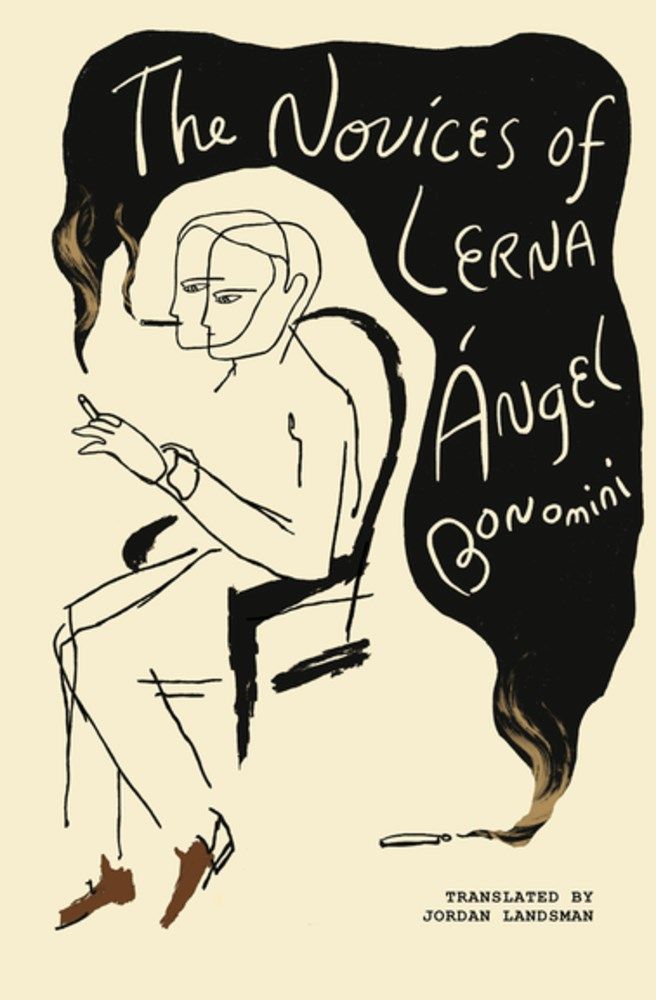
200 pages. Published May 7, 2024 by Transit Books. Fiction anthology.
Some spoilers follow
In the surreal and unsettling first story in this collection, the title novella, a man is invited to join an academic department in Lerna, Switzerland, on a fellowship where he finds that everyone there looks identical to him. If that weren’t unsettling enough, they all start dying, one after the other.
In the short story The Fire, an arsonist watches from a distance while the church he’s just set on fire burns down, and ponders. The Bengal Tiger is a story that ties itself up in knots. Central to the story is the narrator’s realisation that earth’s surface is a mirror:
Ergo, everything that happens happens simultaneously in reality and on another plane: the surface of the planet. The surface is the consciousness of the species.
But the narrator then immediately contradicts himself, as if the mirror and indeed reality are as unreliable as the narrator.
The Model continues Bonomini’s campaign to unsettle the reader with unreliability: a man hooks up with a woman who apparently died ten years ago. A ghost, or is time not real or linear? In a note after the story, the author tells us that it’s based on a true love story, and then admits that he lied about most of the prior facts—except that she’s very beautiful.
The CCC is about how two cousins who go to a chain coffee shop discover that they’re being replicated every day in the chain’s different locations, but only there. It troubles them so much that they come up with an extreme solution to the problem of their multiplicity. The Singer is a run-on sentence about the death of a singer, and the strangeness of our connection to celebrity: our deep identification with famous people, the simultaneous realness and made-up-ness of them. Theories repeats the heme of mirrors and unreality: what if reality is just something we’ve dreamed up together?
Mirrors appear again in The Report, in which a junta amusingly declares that Aristotelian logic is false, and treasonous, and that time is in fact moving backwards. Anyone who’s been faced with propaganda—and we all have, at this late stage of human history—will find all of this familiar; Bonomini’s protagonist cleverly subverts reality by suggesting that mirrors are unreliable, while arguing at the same time that they tell the truth. Propaganda doesn’t ever really care what the truth is, and contradicts itself at every turn. And in By the Word, a man literally dies by them—words, that is. An allegory for a writer?
In all of these stories, Bonomini is playing with apparent fixity—time, reality, identity—as many other South American writers do. It’s fabulism, yes, magical realism even, in search of hidden truths. Whether Bonomini himself found these truths as he wrote, I don’t know; but certainly his collection challenges the reader, playfully, to re-examine everything they think they know. Others perhaps do it better; but this is a collection worth reading.
Thanks to Transit Books and Edelweiss for DRC access.
Affiliate link: Support independent bookshops and my writing by ordering it from Bookshop here.
 Harare Review of Books
Leave a comment