
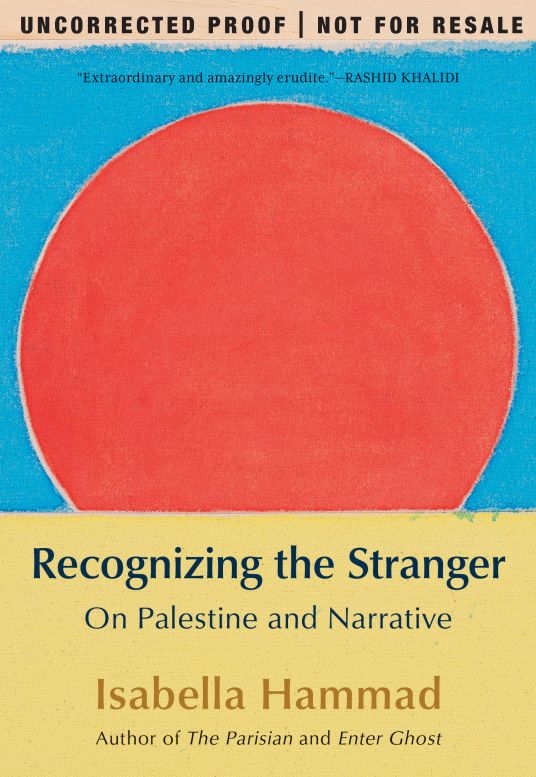
96 pages. Published September 24, 2024 by Grove Press. Non-fiction.
All quotations below from the title under review.
The flow of history always exceeds the narrative frames we impose on it.
Stranger. It’s the word we use in the English language for those with whom we have no acquaintance, those we don’t know personally. Depending on your culture or personal inclination, a stranger’s a future friend or neighbour; or, conversely, someone to keep at a distance, to ignore, to fear for their difference. In a world as riven by war, evil and suffering as ours is, it’s usually the latter.
Isabella Hammad’s Edward W. Said Memorial Lecture, delivered at Columbia University on September 28, 2023, just days before the fateful events of October 7, examines, in her words, the ‘narrative shape’ of the Palestinian struggle, and is concerned—amazingly in retrospect, with October 7 in the rearview now—with turning points. Because, she argues, we do not know or see history as we’re living it. As Georgi Gospodinov’s narrator says, in the novel Time Shelter, quoted by Hammad,
“Most likely, 1939 did not exist in 1939, there were just mornings when you woke up with a headache, uncertain and afraid.
It feels now, though, like we might be living through the pivotal moment, more and more so as the war in the Middle East rages on and on, with new outrages every day.
Hammad examines at some length what the novel does (because the novel, says Hammad, was the primary instrument through which Said viewed the world), and brings us to what she calls ‘recognition scenes,’ or what Aristotle called anagnorisis, a movement from ignorance to knowledge: those points when both the protagonist and reader gain insight—what Oprah famously referred to as aha moments.
In the classic shape of rising action that reaches a peak before falling with the denouement or the unraveling, it’s at the peak, at the moment of tragic reversal, that the anagnorisis usually takes place.
How many aha moments does it take, Hammad muses, for the world to recognise the humanity of Palestinians? Is there any story that can be told, at this late date, that can lead to recognition of the Palestinian not as a stranger, but as part of the family? How many (individual) epiphanies will tip the scale? How much ‘education’ of Westerners will make them see? But
…not everyone can be unpersuaded of their worldview through argument and appeal, or through narrative.
And if there’s no recognition scene, can there be a denouement?
Hammad’s lecture ends on a hopeful note, because empires and edifices do fall and have fallen. Hammad’s Afterword: On Gaza is understandably full of anger, grief and despair, some loss of hope:
[We] don’t know in which direction we are moving. Are we seeing the beginnings of a decolonial future, or of another more complete Nakba?
But defiance too:
Of course they will harden Gaza each time they bomb her; of course they will force her resistance fighters underground. Possibly they know this very well, and even desire it, since it provides a pretext to keep bombing. But they can never complete the process, because they cannot kill us all.
Hammad is one of our voices of clarity on the Palestinian question, an unfailing guide even through her ambivalence as we fail to reach the moment of recognition. This book ends, beautifully, appropriately, and poignantly, with the words of Wael Dahdouh, the Al-Jazeera journalist whose family was killed by Israeli bombs:
“One day this war will stop, and those of us who remain will return and rebuild, and live again in these houses.”
Thanks to Grove Press and NetGalley for early access.
Affiliate link: Support independent bookshops and my writing by ordering it from Bookshop here.
 Harare Review of Books
Leave a comment