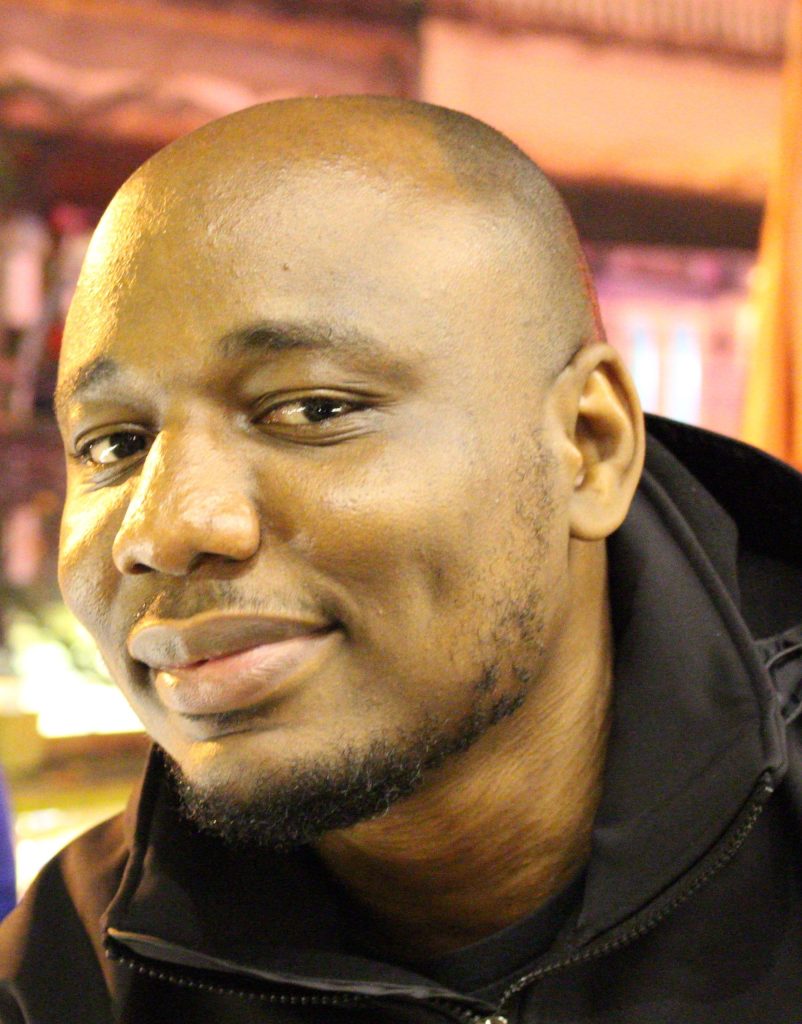
HRB is super excited to bring you this interview with Wole Talabi.
Wole Talabi is an engineer, writer, and editor from Nigeria. He is the author of the Nebula, Locus and BSFA award nominated novel Shigidi and the Brass Head Of Obalufon, one of the Washington Post’s Top 10 Science fiction and fantasy books of 2023. His short fiction has appeared in places like Asimov’s, Lightspeed, Tor.com and is collected in Convergence Problems and Incomplete Solutions. He has been a finalist for the Hugo, Nebula, and Locus awards, as well as the Caine Prize, the Nommo award and the Sidewise award. He has edited five anthologies including Africanfuturism: an Anthology and Mothersound: the Sauútiverse Anthology. He likes scuba diving, elegant equations, and oddly shaped things. He currently lives and works in Australia. (SFWA)
Wole Talabi recently announced that he’s “permanently recusing” himself from all future Nommo awards, that he’s “drinking and dropping the cup”, a very generous gesture to support up-and-coming authors.
Jacqueline for HRB: First of all, CONGRATULATIONS on Shigidi and the Brass Head of Obalufon winning this year’s Ilube Prize for Best Novel—a well-deserved recognition of its excellence. It’s been nominated for so many things now, including being recently announced as a finalist for the World Fantasy Award. How do you feel about Shigidi’s success?
Wole Talabi: Thank you very much. It’s been great to see how many different groups of people have found something to commend in this novel. Mostly, I feel very grateful and a bit surprised. I took several risks with this book and while it’s one thing to hope for an award nomination, it’s another to get nine. I try to keep even tempered about it all though. Awards are as much a function of visibility, timing and hundred other external factors as they are about the writing itself. But given the range of awards so far, I think the opinions all converge to positive. I do hope the awards acclaim gets more people interested in reading the novel. It could do better in terms of sales, especially in North America.
HRB: You released your debut novel, Shigidi, and a collection of short stories, Convergence Problems, within a relatively short space of time, although you’ve been writing for many years. How did these book deals happen so close together?
WT: This is one of those cases where two unrelated things create the illusion of activity. The truth is, Shigidi was originally meant to be released in 2022 and I was expecting Convergence Problems to come out later in 2024. However Shigidi was delayed by the publisher and Convergence Problems was scheduled much earlier than I thought it would, bringing their release dates to within 6 months of each other. It has allowed me the opportunity to promote both books at the same time though, so there’s that.
HRB: Convergence Problems is a wonderful collection, with many excellent and thought-provoking stories, like An Arc of Electric Skin, which actually struck me because of bizarre scientific racism beliefs about Black people’s skin. Was that on your mind at all when you were writing this story?
WT: It was. Since I was playing with the idea of melanin as the basis for a kind of superpower, I was very aware of some of those false beliefs about black people having a higher tolerance for pain and having thicker skin, etc – which according to polls, many medical professionals still unfortunately believe. But in this sense, I was using it more as a metaphor so the falsehood leans into that.
HRB: I have to ask: in Debut, the first story in the collection Convergence Problems, AI makes art. There’s a big debate on this in arts circles right now. Do you really think AI could make art?
WT: Short answer: No. I don’t think AI can make art. At least not what we are calling AI these days anyway.
Longer answer: We are dealing with two nebulous concepts here. What is intelligence? And what is art? Both have been defined in multiple ways with controversy and disagreement on what exactly they mean and whether or not they are universally definable or quantifiable in any sense. To me, the question of what they are, and the ensuing discussion is more interesting than any supposed answer because in exploring them, we learn things about ourselves and how our minds work. Personally, I think any definition of intelligence should include some aspect of self-awareness and creativity which is why I think what we call AI today is not actually intelligence – these are statistics engines built on existing knowledge bases that are very good at guessing what should come next, given a specific context. But they are still just tools. The creative wellspring still requires a human. So no, these tools cannot create art. Now, humans could potentially use them as tools to make art – just as we have for millennia but there are many things that need to be resolved before these ‘statistics machines’ can even be part of the conversation to be used widely and ethically. The main one is the knowledge bases they are built on and are pulling from – which is mostly stolen/unethically obtained data. The second is the utility to which they are put, which right now is capitalistic exploitation/undercutting of creators and flooding of markets with lowest common denominator material or so-called “content” which is the exact opposite of what tools could potentially be used for.
HRB: Could AI one day take your job (i.e., write stories as good as yours)?
WT: I think any true artificial intelligence that writes stories as creative, meaningful and – most importantly – authentic as a human writer, is probably nearing the threshold of personhood and no longer a tool to assist writers in achieving their own creative visions. And that is a whole other conversation, some of which I explore in Debut and its sequel Encore.
HRB: How’s Debut’s sequel coming along? 🙂
WT: It’s coming out soon. In a few months. It is set 3 million years in the future, and will be published in the anthology Deep Dream: Science Fiction Exploring the Future of Art edited by Indrapramit Das. I’m excited for people to read it.
HRB: You’re very philosophical in your approach to writing. Where do you think that comes from?
WT: I’m not sure. I suppose I am naturally interested in philosophy and so that makes its way into my writing. It is also probably related to my childhood where I would watch documentaries on all sorts of topics with my father and we would have discussions after, discussing the why, what, and how of whatever we just saw. Whether it was a science show or something about a historical event, we built a habit of asking questions about everything and I have kept that mindset.
HRB: You’ve said before, in response to a question about the genre you write in, how your writing combines Western philosophy and traditional Nigerian folklore elements; that you’re interested in the intersection between, or commonalities you see in those worldviews; that you link SF ideas with traditional beliefs. I saw this a lot in the stories in Convergence Problems. Could you tell us a little more? I know this is a big idea, and difficult to summarize in a few words.
WT: Perhaps it’s more accurate to say that what I try to do is incorporate traditional African sciences, culture, philosophies, beliefs, and histories in my stories right beside any science fictional and technological development I envision. I like to do this because I am interested in the role of deep intellectual African thought in the present and future world. A lot of which has been sidelined or ignored by the dominant Western philosophical hegemony. I think it’s important to foreground as much of African knowledge systems as possible and acknowledge the vastness of what is not yet known in the universe and all the different ways in which people have filled those gaps. Every way of seeing the world has flaws but it’s when we bring together all these multiple ideas and viewpoints that we can understand, analyze and take the best elements of each to move forward.
HRB: What’s the most interesting feedback you’ve received recently about your writing?
WT: I’ve received so much feedback on my writing, some of it useful, some of it weird, some of it contradictory, that I have no reasonable scale by which to measure what is interesting and what isn’t. Also I like to try different things and am constantly trying to improve so responses to each story vary widely.
HRB: SF is no longer the preserve of white men, hallelujah. Do you see yourself as a pioneer? Are there Black/African writers you see as people on whose shoulders you stand?
WT: I don’t think SF has ever truly been the preserve of any one specific group. People of every culture and society have hopes, fears and dreams about the future, about technology, about different ways of being human. And many of them have been telling stories about those things for a long time. But not everyone everywhere has historically had the resources, infrastructure and industry in place to reach the wider global SF audience. That is changing, thankfully.
I don’t really see myself as a pioneer. Perhaps I am more like a link in a longer chain of pioneers that are constantly helping to move things forward. But yes absolutely, there are many many people ahead of me in that chain who inspired me and opened doors for me to walk through. Many of them. If I had to name a few of the African authors that have most directly propelled me forward in writing the kinds of stories I write – Nnedi Okorafor, Cyprian Ekwensi, Tade Thompson, Lauren Beukes, Kojo Laing, Sofia Samatar, Amos Tutuola, Tendai Huchu, Helen Oyeyemi, Ivor Hartmann, Tochi Onyebuchi, Ben Okri come to mind.
HRB: Were you a reader, growing up? Do you remember the first book you loved?
WT: I was an avid reader. I read a lot of things growing up, not just fiction. I read everything I could get my hands on. Novels, non-fiction, magazines, newspapers, all of it. I read my dad’s entire encyclopedia collection before I was nine years old even though I didn’t really understand most of what I was reading, but I was reading it anyway! The first book I remember loving is Asimov’s Biographical Encyclopaedia of Science and Technology which was filled with biographies of scientists and philosophers, from ancient to modern times. It’s non-fiction and riddled with the usual biases and heavy on the Western focus but each entry is mostly written as the personal stories of these people who supposedly made great contributions to technological development. Their habits and flaws, rumors and anecdotes about them. It was very entertaining, educational, thought-provoking and influential on my young mind.
HRB: What’s your favourite SF book or series of books, ever? (JT: Mine is possibly Kim Stanley Robinson’s Mars Trilogy.)
WT:An impossible question. The real, boring answer is Schroedinger’s answer: I simultaneously don’t have any favorites and I have many favorites. Every time you ask me, you will probably get a different answer. So since you’ve asked, the answer for today is Embassytown by China Mieville.
HRB: What’s your favourite imagined place, world, planet or culture in all of science fiction?
WT: Another one of those impossible questions. How about I flip the question around and give you a favorite imagined time period. The Years Of Rice And Salt by Kim Stanley Robinson. Which imagines how world history might have been different if the Black Death had killed 99 percent of Europe’s population, instead of a third as it did in our reality. It’s a thoughtful, rich and poetic rendition of a world that could have been.
HRB: What about one you’ve written?
WT: Ah. I’ll stick with imagined times and say the alternate history version of Yoruba culture in my story A Dream Of Electric Mothers is a favorite.
The imagined far-future version of the universe in my story Encore is probably a close second because it’s so wild and trippy and fun but that’s not published yet so I can’t have it as number one.
HRB: Do you lean towards a dystopian or utopian view of humanity’s future?
WT: Utopian, usually. Even though by volume, my fiction may lean the other way a bit. But while I don’t believe in utopias as an endpoint or final state, I do believe in continuous, hard-won, non-linear progress. I believe in the potential of humanity to continuously improve. To learn better ways of being together, being in the world and overcoming our past mistakes. There will always be ups and downs as we go forward and it will require us to work for the future we want but generally I believe the arc of human progress is long and as long as we keep applying hope and effort, it will asymptotically bend toward better.
HRB: What would it take for you to become a full-time author?
WT: A five million dollar cheque? Ha! I’m kidding. But to be honest, nothing, I think. People have asked me this before and I genuinely don’t think I want to write full time. I like engineering, I like figuring things out. Always have. Even if I got that 5 million dollars, I’d probably still do what I’m doing now. Engineering and writing. I like doing both. Maybe I’d shift from full-time engineering to being a consultant or teaching engineering while I write more so I’d probably split my time more 50-50 than the 80-20 it is now.
HRB: Whose writing do you get excited about these days?
WT: So many people! There are so many great authors I love, it’s hard to say. I’ll limit it to African books and stories I’ve read in the last few months that I was excited by. I absolutely loved Pemi Aguda’s debut collection Ghostroots which is just a perfectly constructed, beautiful collection. I also recently enjoyed Tlotlo Tsamaase’s raw, lyrical and incandescent Africanfuturist tale, Womb City, Eliane Boey’s beautiful and tense novella diptych Other Minds, and Tobi Ogunidran’s excellent fantasy novella In the Shadow of the Fall. CL Hellisen’s writing is always awesome and their latest story Godskin is no exception. Suyi Davies Okungbowa’s Lost Ark Dreaming is great and thoughtful and shares themes with much of Convergence Problems.
HRB: What music would go with Shigidi? And with Convergence Problems?
WT: You’re in luck! I made a playlist for Shigidi to answer this exact question. It’s got afrobeats, power metal, pop, rock, Malaysian hip hop, R&B and more. Some of the songs are mentioned in the book. Some are songs I wrote a specific scene to. And some are songs I imagine playing during some of the action. I think it’s cool and I still listen to it from time to time.
Convergence Problems is trickier since every story evokes different moods and probably needs its own unique pairing music (and the collection includes the story Saturday’s Song, for which I wrote an actual song!). Generally though, I would recommend Exogenesis Symphony by Muse. It’s one of my favorite songs, has three separate movements and evokes the same sense of contemplation and wonder Convergence Problems is generally going for (even though I think the composition could use some more drums).
HRB: Are you a techno-optimist? Do you think technology can/will save us?
WT: No, I’m not a techno-optimist. Not in the absolute sense. While there are many parts of the techno-optimist manifesto I agree with, there are many fundamental techno-optimist ideas I completely disagree with – for example the belief in endless growth as a measure of progress and that there is no real-problem that cannot be solved by technology. These are viewpoints I have explicitly argued against. However, I am generally optimistic about humanity’s ability to leverage technology to help us save ourselves.
HRB: What’s on your bedside table right now? What are you reading?
WT: I’m reading M. H. Ayinde’s A Song Of Legends Lost and it’s great so far – epic, moving and well written. I also just started reading How Beautiful We Were by Imbolo Mbue which is a very different thing but also very good.
HRB: Without jinxing it—are you working on anything right now?
WT: I’m working on my second novel (HRB: Yay!) – which is simultaneously a near-future thriller and a meditation on the nature of memory, legacy, and connectedness featuring assassins, aliens, AI, ancestral memory, and a lot more. More to come soon.
So grateful for the time Wole gave HRB to pick his fascinating brain on so many cool things! You can find him at wtalabi.wordpress.com and at @wtalabi online.
Books (Bookshop affiliate links):
Shigidi and the Brass Head of Obalufon (paperback out in 2025)
Convergence Problems
Incomplete Solutions
More links:
Wole Talabi in conversation with Gary K. Wolfe
An interview with Wired JP
 Harare Review of Books
Leave a comment