
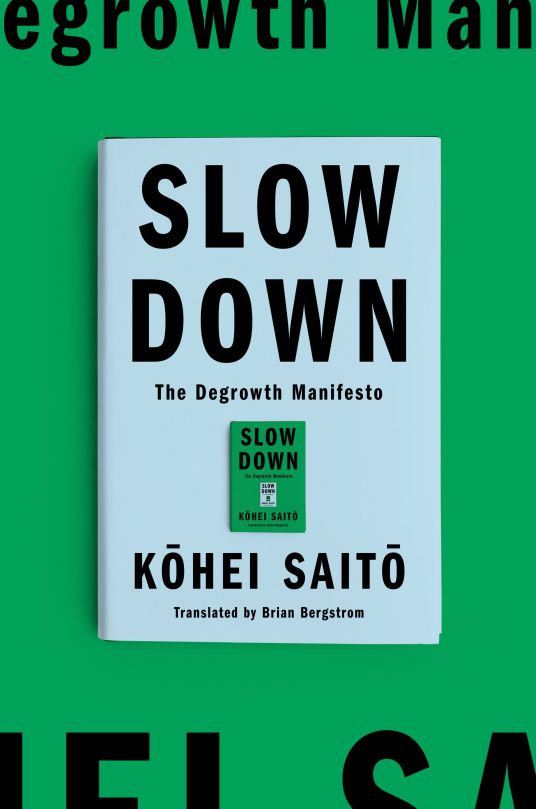
272 pages.
First published Jan 9, 2024 (Astra Publishing House)
Non-fiction.
How to solve a problem like capitalism? Kōhei Saitō suggests we get rid of it completely, which seems … fair. In his bestselling book, translated from Japanese by Brian Bergstrom, Saito advocates for degrowth communism as an alternative. Capitalism’s pursuit of endless growth and limitless prosperity, Saito argues, is unsustainable.
The first half of the book clarifies why. Among current arguments from the proponents of capitalism are Green Keynesianism, in the form of relative decoupling, which allows continuing emissions while, for instance, implementing green technologies; Negative Emissions Technology (NETs); Bio-Energy with Carbon Capture and Storage (BECCS); and green technology itself, which is never as green as it hopes, as even the production of lithium-ion batteries depends on extraction under terrible conditions in the DRC. Even when it doesn’t, lithium production is a huge drain on groundwater. The production of biomass energy requires vast tracts of farmland. Solar farms are creating controversy—even where they are located on apparently unused land—as they disrupt ecosystems. Do most of these solutions sound like unrealistic techno-optimism? That’s because they mostly are.
Some of Saito counters: the Netherlands Fallacy, where apparent decoupling in Global North countries is in part due to displacement of carbon emissions to the periphery or the exterior, the Global South; thermodynamic limits mean there are very few alternatives to the incredible energy efficiency of fossil fuels; Jevon’s Paradox, which suggests that cheaper alternatives to fossil fuels will only lead to increased consumption of fossil fuels; and yes, the magical thinking of many green technologies, which have still not delivered all they’ve promised.
Even degrowth capitalism is not the answer, Saito says. He spends a lot of time making a strong and convincing case that Global North consumption is made invisible by extractivism and exploitation of the Global South, in a kind of “ecological imperialism”. No Green New Deal will fix the crisis we’re in, for the reasons outlined above. As long as we pursue profit and consumption, we will exceed planetary boundaries, and end up with an unliveable Earth.
Proving the unsustainability of current levels of consumtion:
The truth is, the total consumption of resources in 1970—including mineral resources, ores, fossil fuels, and biomass—was 26 billion 700 million metric tons, while in 2017 it surpassed 100 billion metric tons. By 2050, this figure is predicted to rise to 100 billion 800 million metric tons. Only a mere 8.6 percent of these resources are recycled, a proportion that’s actually decreasing in the face of the rapid increase in consumption.
Your paper straws and bamboo toothbrushes are simply not going to cut it.
Saito’s central argument rests on the following, that there are four possible futures for humanity:
- Climate fascism, where a “special class of elites” uses the planet’s crisis as a business opportunity (see Naomi Klein’s The Shock Doctrine: The Rise of Disaster Capitalism);
- Barbarism, where the 99% rebel and overthrow the ruling class, plunging us all into chaos;
- Climate Maoism, which would end free markets and democracy in favour of authoritarian policies to narrow the gap between the rich and the poor;
- Saito’s Degrowth Communism, a proposal for a “just, sustainable future”, where there is no central political control, as it depends on mutual aid and other individual strategies.
In a kind of callback to Ingrid Robeyns’s Limitarianism, Saito talks about the impact on the planet of the 0.1%. Unlike Robeyns, however, Saito emphasizes that the middle class of the Global North is part of capitalism’s consumption problem, as that class is in fact part of the world’s richest 10%, and:
The fact is, if the world’s richest 10 percent were to lower the amount of emissions they produce to that of the average European, overall emissions would decrease by a full third.
As Saito says:
We cannot solve a problem triggered by capitalism while still preserving capitalism, as there is no other root cause.
and
[The] solution to this problem cannot be the tepid call to modify neoliberalism and tame the capitalist system until degrowth can be brought about within it…. This is because the devil destroying the global environment is none other than the capitalist system itself and its demands for constant unlimited growth. … [If] we allow things to continue as they are, capitalism will transform every inch of the Earth’s surface into an environment unable to support human life. This is the endpoint of the Anthropocene.
Saito and Robeyns both acknowledge that the gap between the world’s wealthy elite and the poor is unacceptable; how to change that is where they differ, with Robeyns seemiingly supporting the maintainance of capitalism’s central tenets—free markets, private property, and so on—while Saito’s approach is communism. Saito is unequivocal:
A true transition to a degrowth or steady-state economy cannot be brought about by laws and policies meant to prioritize sustainability and the redistribution of resources as long as the fundamental essence of capitalism is left intact.
Saito spends the whole of Chapter Three of the book making the argument that degrowth capitalism will never work, for reasons of sustainability (capitalism’s dependence on limitless growth in profits, expansion of markets, displacement, and extraction of human labour) and politics (the wealthy are able to exert outsized influence to drive policies in directions that benefit them). To Saito, the very term “degrowth capitalism” is in fact an oxymoron.
Saito talks about protest as a way of bringing about change, in the end, like Ajay Singh Chaudhary in The Exhausted of the Earth: Politics in a Burning World; however, Saito is for non-violence, where Chaudhary argues for the (realistic) place of violence in bringing about change. Also like Chaudhary, Saito believes salvation may be found in worldwide solidarity. The magic figure, according to Erica Chernoweth—quoted in the book—is 3.5%: [The] percentage of a population that must rise up sincerely and non-violently to bring about a major change to society.
We cannot afford to continue to choose capitalism, Saito says. And when we all realise this and work together for the alternative, there may be hope after all. This, argues Saito, is the revolutionary trinity: overcoming capitalism, reforming democracy, and decarbonizing society.
Thank you to Astra Publishing House and to NetGalley for the DRC and for food for thought!
Support independent bookshops and my writing by ordering it from Bookshop here.
Read with: Limitarianism: The Case Against Extreme Wealth x Ingrid Robeyns (ARC) and The Exhausted of the Earth: Politics in a Burning World x Ajay Singh Chaudhary
 Harare Review of Books
Leave a comment