
289 pages.
First published April 12, 2023 (Carnelian Heart Publishing)
Fiction/Zimbabwe.
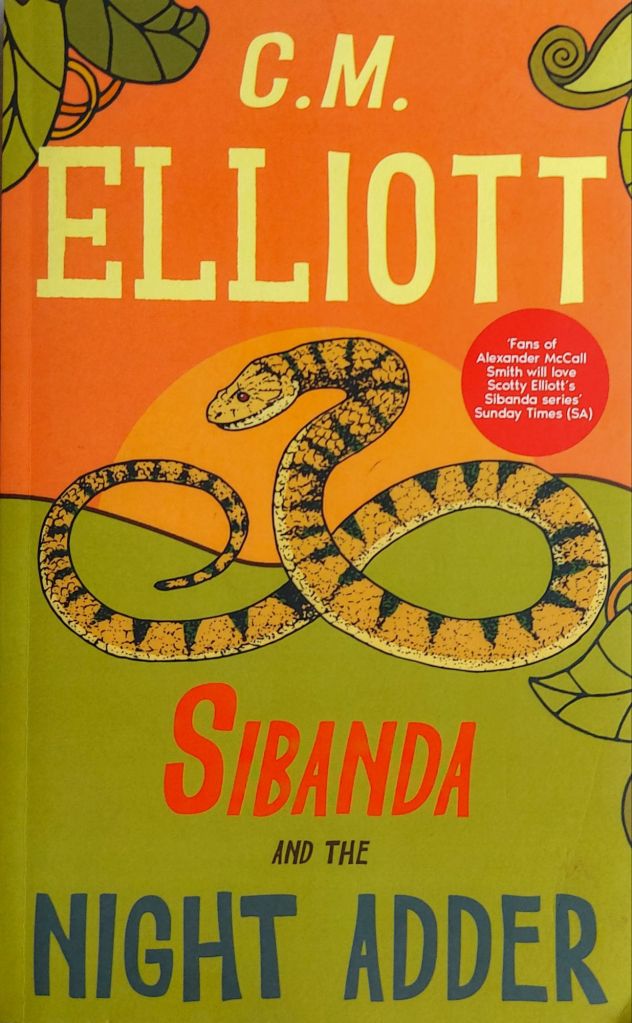
I wanted to love Sibanda and the Night Adder—a well-written, fun romp—but had such complex feelings about it, and it’s made me hesitant to review it, although I finished it some weeks ago. The reason is right there on the front cover: “Fans of Alexander McCall Smith will love Scotty Elliot’s Sibanda series” (Sunday Times). (McCall Smith was recently honoured as Knight Bachelor by the UK’s King Charles). I remember Mma Ramotswe of McCall Smith’s The No. 1 Ladies’ Detective Agency as reminiscent of the Mammy historical stereotype in the US: a “traditionally built” (i.e. fat), “good”, rural Black woman, who feels “called” to help her “people, her brothers and sisters”. This help includes investigating cases of disappearing husbands, degree fraud, theft.
More about the Mammy stereotype from Wikipedia:
Kimberly Wallace-Sanders includes other characteristics of the mammy in Mammy. A Century of Race, Gender, and Southern Memory (2008): A large dark body, a round smiling face, a deeply sonorous and effortlessly soothing voice, a raucous laugh. Her personal attributes include infinite patience, self-deprecating wit, an implicit understanding and acceptance of her own inferiority, and her devotion to whites.[2]
And Binyavanga’s famous article, How to Write About Africa is instructive:
The Loyal Servant always behaves like a seven-year-old and needs a firm hand; he is scared of snakes, good with children, and always involving you in his complex domestic dramas (emphasis mine) … Also be sure to include a warm and motherly woman who has a rolling laugh and who is concerned for your well-being. Just call her Mama … African characters should be colourful, exotic, larger than life—but empty inside, with no dialogue, no conflicts or resolutions in their stories, no depth or quirks to confuse the cause.
In Sibanda and the Night Adder, the eponymous detective, Sibanda, is strikingly handsome, loves birdwatching, spent time in the UK and has close connections there, is witty, always speaks far above Ncube (his sidekick)’s understanding, and is in love with a white woman. In contrast, Ncube is fat, very flatulent, of limited intelligence, a rural man with multiple wives who’s usually only thinking of or about to think of food, and whose most excellent attribute is his loyalty to Sibanda (he follows him around like a loyal dog). It feels to me that Sibanda is somehow “redeemed” for us by his proximity to the trappings of whiteness (as described above), where Ncube is presented as a complete caricature of a rural Black man. The reader is invited to laugh at Ncube, and to admire Sibanda. Caricatures can be funny, but in the real world, racial dynamics exist, and caricatures of Black people not only serve the cause of racism, but cause immense harm through their continuation of the propagation of distorted images of Black people and culture.
That aside, as I said, this is a really well-written novel, with lots of adventure and fun. I even enjoyed the references to Zim’s politics (diamonds, multicurrency, etc), and really enjoyed the setting (south-west Zimbabwe—including the Victoria Falls and Hwange area). The imagery is very vivid, and the shenanigans are fun. I also enjoyed Elliot’s obvious knowledge of Ndebele culture and language. Read Sibanda and the Night Adder for all of the fun bits—a car chase on a rural Matableleland road, an escape from baddies through a national park full of dangerous animals, and a clever plot built around Zimbabwe’s diamonds—but perhaps note my proviso: we need more nuanced portrayals of Africa and of Black people and Africans as whole, complex people, and fewer characters like Mma Ramotswe and Ncube.
Thank you to Carnelian Heart Publishing for providing a copy for review.
 Harare Review of Books
Leave a comment