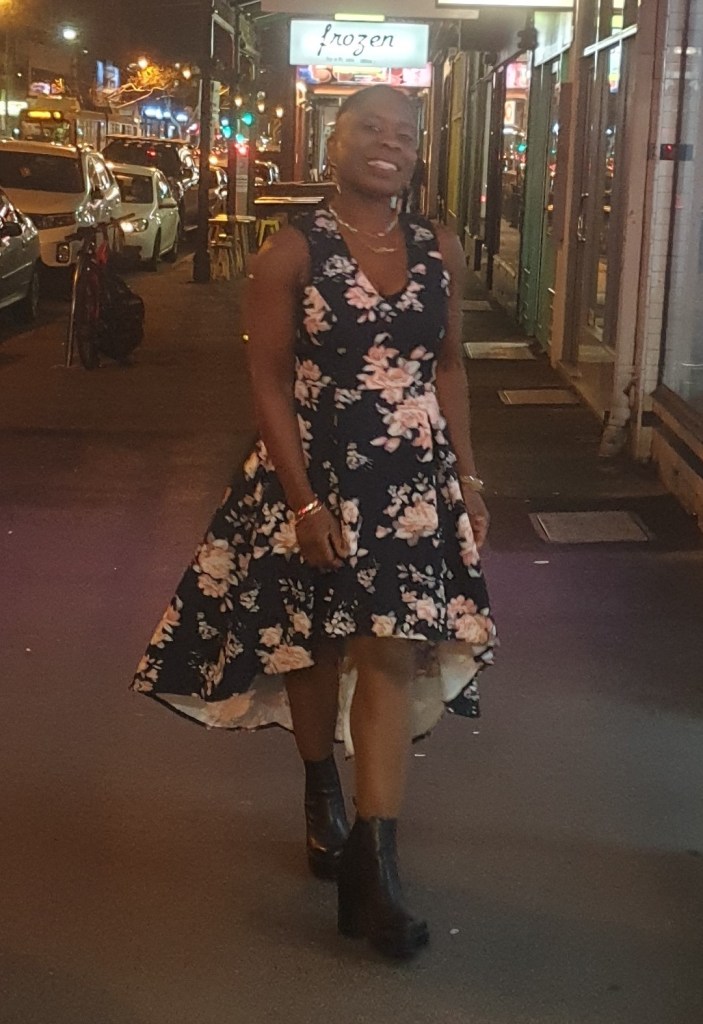
I am super excited to bring you this interview with Eugen Bacon, the author of Danged Black Thing, Serengotti, An Earnest Blackness, and numerous other works.
Eugen Bacon is an African Australian author of several novels and fiction collections. She’s a twice World Fantasy Award finalist, a British Fantasy Award finalist, a Foreword Book of the Year silver award winner, and was announced in the honor list of the 2022 Otherwise Fellowships for ‘doing exciting work in gender and speculative fiction’. Danged Black Thing by Transit Lounge Publishing was a finalist in the British Science Fiction Association, Foreword, Aurealis and Australian Shadows Awards, and made the Otherwise Award Honor List as a ‘sharp collection of Afro-Surrealist work’. Eugen’s creative work has appeared worldwide, including in Apex Magazine, Award Winning Australian Writing, Fantasy Magazine, Fantasy & Science Fiction, and Year’s Best African Speculative Fiction. Eugen has two new novels, a novella and three anthologies (ed) out in 2023, including Serengotti, a novel, and the US release of Danged Black Thing. Visit her website at eugenbacon.com and Twitter feed at @EugenBacon.
Jacqui for Harare Review of Books: Thank you again, Eugen, and welcome.
African Australian is an intriguing identity, particularly in the world of literature. If you may, please tell us more about your background, and how that positionality informs your writing?
Eugen Bacon: Thank you so much, Jacqui. I was born in Tanzania, near Mt Kilimanjaro, then my family moved to Kenya when I was a toddler—I lived in Nairobi for the greater part of my early life before migrating to the UK, then to Australia.
For a long time, overseas, I struggled with my identity—I was trying to be African, trying to be Australian. No one said to me, ‘Why can’t you be both?’ And then I started writing Black people stories, because I wanted to ‘write myself in’, like Octavia Butler. I wanted to write stories where characters looked like me—brown-eyed, tight curly haired—not blue-eyed, blonde. The act of heroing black protagonists was like coming out, a discovery of the self.
I became more comfortable with myself, at ease with my hybridity, the self and other. I acknowledged that I am African Australian—this is how this identity came about for me. I am a duality. I am okay with my hybridity; the one is not exclusive form the other. I am betwixt. A sum of parts. I am many.
HRB: You’ve won a stack of awards; congratulations! Have you always known that you wanted to write? And had you any idea you’d win so many accolades?
EB: Truth is, I’ve worked very hard. But I have also been fortunate—for which I am grateful.
I discovered a passion for writing from a very early age. I understood that, sometimes, I needed to write it down to understand what I was feeling, what I was thinking, what I was curious about. I grew up in a rich culture of storytelling. You would know this, Jacqui, how the African tradition is rich with oral storytelling, riddles, proverbs, song and dance—these cultivated my passion.
When I visited my grandmother in a village on an island of Lake Victoria, if I was naughty, she didn’t chase me up a tree to give me the walloping I deserved. Instead, she would shake her head and say, ‘Let me tell you the story of the naughty hyena and how she lost her hind legs.’
My father understood my passion for stories, and rewarded me with books. I grew up on the works of Chinua Achebe, Margaret Ogola (how-and-why-stories: why the crocodile swims in the water; how the leopard got his spots…), Camara Laye, Ngũgĩ wa Thiong’o… As I got older, I stumbled across Toni Morrison, Michael Ondaatje, Peter Temple, Ray Bradbury, Octavia Butler… writers as mentors, who enthralled me find the power of the word.
These writerly mentors continue to nurture my hunger for writing.
HRB: What I’ve read of your speculative fiction so far is incredibly inventive in style and form. Is your style something you’ve consciously cultivated? Are there any particular influences on your writing style?
EB: I am an immersive writer. I feel the text and the characters—these shape my style and voice. I have always loved poeticity, and I think writers like Toni Morrison and Michael Ondaatje have influenced the richness of my text.
HRB: Your fiction writing is usually labelled Afro-surrealism, a genre not many people know about, but one with an important lineage and future. Are there Afro-surrealists who inspire you?
EB: I have not consciously read Afrosurrealist writing, but there are histories of the surreal in Toni Morrison, and in the Negritude movement, where Black people sought their own Black joy in their art, song, dance and creativity. I do not consciously seek to write in one way or the other. My writing is instinctive, text that experimentally charts itself, arising from my writerly immersion and readerly curiosity. I am, after all, my work’s first reader.
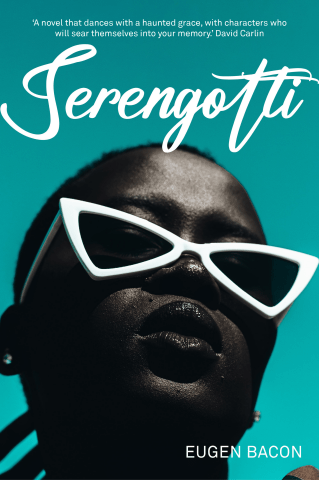
HRB: Turning to Serengotti, your latest novel: the central character, Ch’anzu, is non-binary, and of African descent. Is representation important to you?
EB: It is, very much so—representation matters. My writing engages with difference, and I sought this in Ch’anzu (pronouns zie/hir), a migrant character who is an ‘other’, seeking to find their place in a discriminating world. In a queer protagonist, I think I also wanted to explore my own bi-curiosity.
HRB: The story focuses on an African migrant town in rural Australia, something I don’t think has ever been imagined before. How did that setting come to you, and is it extra significant in the Australian context?
EB: I originally intended to set my novel Serengotti in Tasmania, a quaint Australian state lush with scenery, unique wildlife and history. But I loved the smallness and almost rural feel of Wagga Wagga, a real Australian city with its own rich history. Serengotti is an invented migrant town set in Wagga Wagga. You may know this, that the term ‘Serengotti’ is a play with words, a derivative from ‘Serengetti’, a national park in Tanzania that borders the Masai Mara in Kenya. I wanted to create a setting that embraces the hybridity of my African-Australian world.
I was quite fortunate to receive sponsorship through Writers Victoria and the Neilma Sidney Literary Travel fund to explore Wagga Wagga and bring to life character and place.
HRB: One of the central themes in Serengotti is past trauma in the lives of the inhabitants of the town (or village). Why was this important for you to explore in the novel?
EB: The theme of engaging with difference also recognises we are children of our pasts. We have a choice on our presents, and how we shape our futures. In a way, Serengotti is Afrocentric futuristic: Ch’anzu—divorced from hir past—must redefine hirself in the future present.
HRB: Serengotti is very much informed by African mythology and cosmology. Ch’anzu’s Aunt Maé in particular, and the twin healers, Tau and Lau, are steeped in it. Much of this will be very familiar to African audiences. Are we who you had in mind when writing the novel?
EB: I think, at heart, I wrote this story for myself—reconnecting with my roots, embracing the mother, the Aunt Maé, I wanted in my corner during all those rough moments I endured as a migrant. My parents, bless them, returned to our ancestors early—I miss them dearly. I think they were leaning over my shoulder as I wrote, being my Aunt Maé and whispering the wisdoms of ancient healers Tau and Lau.
HRB: Have you faced any particular challenges as an African Australian writer?
EB: Breaking through as a writer, let alone an African-Australian writer, was especially tough. I had no tangible benefactors or a network of support. It took two masters degrees, a PhD and awards, together with enabling publishers like Meerkat Press and Transit Lounge Publishing, to get visibility. I feel that I have worked harder than most people to be where I am today. I am now represented by Jennie Goloboy of Donald Mass Literary Agency, and my story is just beginning.
HRB: You are a prolific writer! You also write non-fiction; An Earnest Blackness, which recently won a Locus Award (congratulations again!) is on my TBR. You are a frequent editor, and a prose poet. Where do you ever find the time to do all of the things you do?
EB: I write across forms and genre, and I am extremely focused! I finish projects, this is my secret. You’re talking to a person who finished a PhD in two-and-a-half years—see how focused I get.
HRB: Are there any projects or books you are currently working on that we can look forward to?
EB: In 2023, I have three anthologies, a novella (Broken Paradise) and two novels (Serengotti and Secondhand Daylight—co-written with Andrew Hook, a slipstream writer who focuses on the literary strange)—I think that’s plenty already by many standards. I have a collection of short stories, A Place Between Waking and Forgetting, out in 2024 by Raw Dog Screaming Press.
My agent has a brand-new collection of short stories for placement, together with a groundbreaking project I am working on with African writers on their Afrocentric futurisms—I am both an editor and a contributing author. Looking forward to sharing these with the world.
HRB: Thank you for your time, Eugen!
EB: My deepest pleasure, Jacqui!
 Harare Review of Books
Leave a comment