
256 pages.
First published on May 9, 2023 (Farrar, Straus and Giroux/MCD)
Non-fiction.
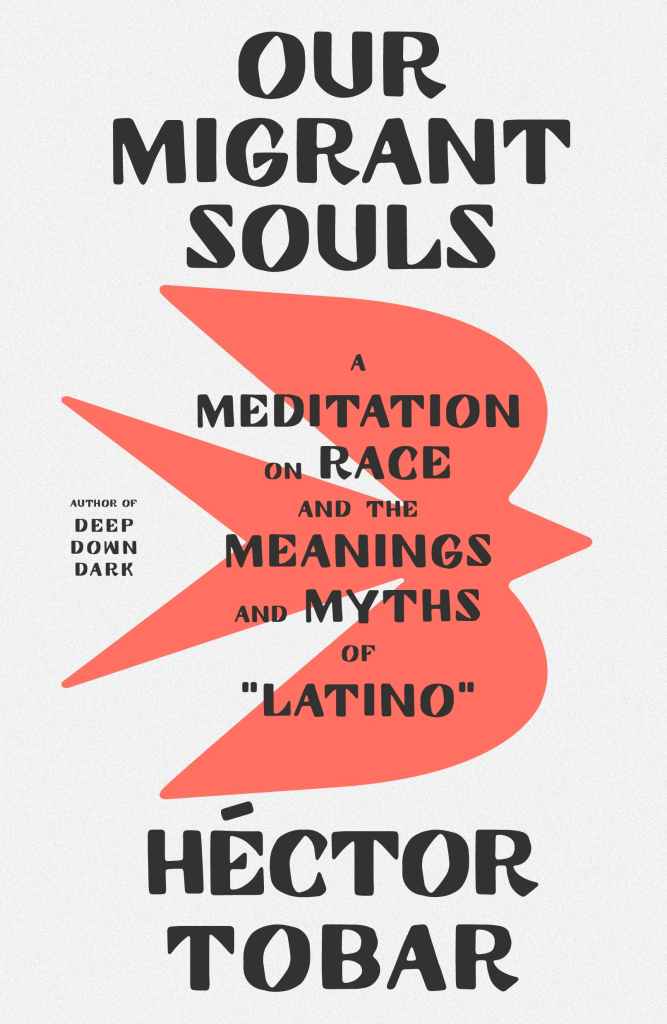
As in all issues with two loud and opposing poles, in talking about “race,” groups positioned between Black and White are often rendered irrelevant. This book acts as a corrective for the varied peoples labelled as Latino, Latin(x), or Hispanic in the United States—people who, as Tobar says, keep the United States running in quiet and unobtrusive ways. They are gardeners, farm workers, nannies, construction workers, mechanics, teachers and professors, doctors, dentists, and a million thing besides. Yet they—for their labour, in their humanity—often remain unacknowledged, perhaps because of the invisibility of the caste they’ve been assigned to in the American imagination, as a(n often) menial labour force.
Tobar’s treatise is both a lament and a call to hope, not just for Latin(x) people, but for other marginalised peoples of the United States. Mostly, though, it is a love letter to these people who are united, perhaps, only by the mixedness of their heritage: Spanish, Afro-descent, and Indigenous South American, and additionally everything else a person can be. Tobar asks us to come on a journey, meeting people in Los Angeles, the city of his birth; and then across the US, down to the border with Mexico, with all the complexities thereof—the Wall, separated families, undocumented migrants, unaccompanied minors. He takes us to Guatemala, where his family originated; and then back to L. A. and across the US to meet all kinds of Latin(x) people in all kinds of places, from a Mormon in Utah, to a Donald Trump supporter in Idaho, and young Puerto Rican-Americans in Spanish Harlem. To be Latin(x), it seems, is not only to be mestizo, or mixed, but also to have stories of migration flowing through your veins.
Tobar’s words are poetic, and sometimes read like Martin Luther King Jr.’s speeches (which may not be accidental, as it happens). But he has poured what feels like his entire heart and soul into helping readers understand the power, pain and beauty of all of the various, mostly invisible people the US has classed—raced—into this group. He unravels for us all that we must see, in opposition to the drive to make “Brown” peoples an undifferentiated horde of migrant criminals—as that recent US president and his supporters have tried to do. At the end of the book, Tobar also reminds us what the ultimate point of reinforcing such ideas always is: it is in the service of capitalism, and the imperial agenda. He asks us to resist, and to dream in new ways of new utopias—unworlding, as N. K. Jemisin would put it, and also the example of the resistance movements of the 1960s and 1970s. That’s the message I have taken away from the book; but all of the stories of individuals that Tobar shares in it will also stay with me.
Thank you to NetGalley and to Farrar, Straus and Giroux/MCD for this ARC.
You can support independent bookshops, and my writing, by buying it on Bookshop here.
 Harare Review of Books
Leave a comment