
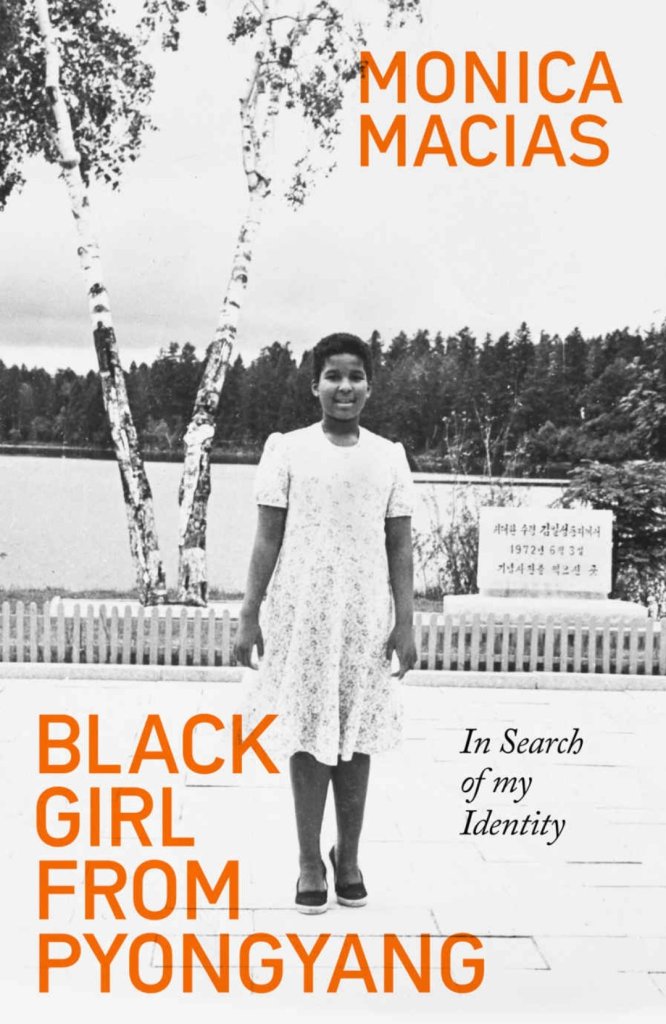
304 pages.
Expected publication date: Mar 2, 2023 (Duckworth Books)
Non-fiction/Memoir.
Monica Macias is the youngest child of Francisco Macías Nguema (Masie Nguema Biyogo Ñegue Ndong), known as Macías, the first president of Equatorial Guinea, who was deposed in 1979, and later executed by firing squad. (In this write-up, Macias will refer to Monica Macias, the author.) Monica Macias had been sent to be the ward, along with her siblings, of Francisco Macías’s friend, North Korean leader Kim Il Sung. On her father’s death, her mother, who had accompanied them, returned to Equatorial Guinea. Monica and her siblings were then educated and raised in North Korea, leaving only after they had each completed university.
Monica was seven years old when her father was killed. She had been Spanish-speaking, but lost her language and culture during her education (and, frankly, indoctrination) at the military boarding school she attended just outside of Pyongyang. This book is the story of her life from her earliest childhood memories, through her years in North Korea, her leaving, and later, as she made her way as a woman with a complicated identity. Her decision to leave was driven by her desire to see the outside world, to connect to her past, and to find out whether her father was really a cruel dictator.
Macias considers that she had two fathers, both reviled by the world. She is Brown (self-identifying, as she is from an Equatoguinean father and a Spanish-Equatoguinean mother), yet she is culturally Asian, and Korean to be specific. She is completely dislocated from her father’s culture, except as she encountered it as an adult (and she hates the food, except for plantains). The memories of those closest to her of Francisco Macias, and their accounts of his rule, do not align with the world’s image of him, which she attributes to propaganda created by Equatorial Guinea’s former colonisers, the Spanish, and her father’s Equatoguinean enemies. At the beginning of the book, she promises to outline evidence that her father was not as bad as he was portrayed to be, and was rather the victim of circumstances, but she does not do this. Instead, she talks briefly about how people around him were killing innocent people in his name, without presenting evidence.
This book is fascinating on the level of the uniqueness of Macias’s rather improbable perspective, with wonderful biographical details. It was delightful to read about her childhood, and I could empathise with her painful circumstances. She even had me feeling for the children of the former leader of my own country, because yes, it is true that the family becomes collateral damage. However, Macias’s frequent declamations and the solutions she advances for fixing the world, when she stands on her soapbox, are far less interesting, and most of my notes on these are on how perplexing bias can be to those watching.
This is an excellent read. Many of my fellow Goodreads readers are offended by the fact of her being, and by the sheer effrontery of her advancing her view on things; I, however, am not. I think there is much value in her entreaty to consider the perspective we use to judge world leaders, because, as she points out, history is written by the victor (or, perhaps, in the case of North Korea, by the all-powerful Superpower), sometimes to the detriment of real progress. However, I did find myself sneering, too, at her attempts to sanitise the images of her two fathers: we all know that if the devil is your bestie, you’ll be moved to comment on his cute curls and how he used his fork to help plough your field that one time you really needed help. In other words, no one is truly the caricature that those who demonise them claim; but that can never mean they have not committed — or are not able to commit — atrocities. Macias cannot be blamed for speaking for those she cares for or loves.
I enjoyed this for its honesty, for her remarkable and truly fascinating story, for the insight she provides into life in North Korea, for the spotlight, however flawed, on Equatoguinean life, and for her perspective on life as an eternal migrant in Spain, the US, the UK, South Korea, and other places. There are many highlights, and I loved that she included so many photographs. Her account of her first visit to China from North Korea is hilarious, and sad. In all, Macias is a brave and complex woman, and I’d love to invite her to that hypothetical dinner party.
Absolutely read this.
Thank you to NetGalley and to Duckworth Books for this excellent ARC.
 Harare Review of Books
Leave a comment