
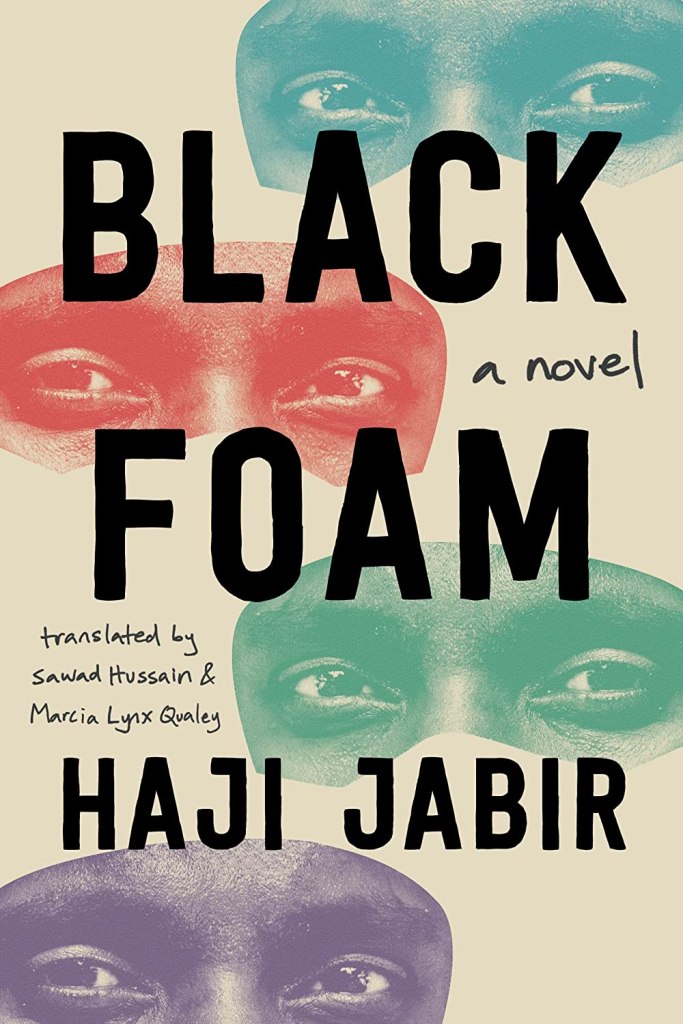
224 pages.
First published on Feb 7, 2023.
Genre: Fiction/Migration.
Such a pleasure to read Eritrean literature for the first time. The author of Black Foam, Haji Jabir, is an Eritrean journalist working for Al Jazeera, and is based in Doha.
Adal/Dawoud/David/Dawit is a man of multiple identities, on a journey to find a place to call home. He’s not even rooted in the place he was born—he is the child of liberation fighters, born on the front, and never to know which of the women who pass him from arm to arm is his mother.
Echoing his childhood, Adal/Dawoud/David/Dawit passes from place to place as a refugee, from Eritrea, to Ethiopia, where he poses as a Falasha Jew (from the Beta Israel community) so as to join a group of refugees who are about to migrate to Israel. Once in Israel, he still feels excluded from that group (which is itself not fully accepted by the locals), and at first he seeks to blend in with other, mostly undocumented African migrants, and then later with the descendants of Africans who settled in Jerusalem. “Black foam” refers to how Adal/Dawoud/David/Dawit never truly belongs, how he’s always on the surface of the communities he seeks to join—partly because of their exclusion, but, as becomes increasingly clear, also because of him.
I didn’t enjoy the writing (or perhaps translators’) style—staccato, disjointed, in places, and generally uneven; but this works with the fact that I certainly didn’t like the protagonist, although I felt empathy for his struggles. He’s not easy to like: he lies all the time, and he has unsavory thoughts about women. But then, who knows if we’d like everyone we met if we knew their deepest thoughts and predilections? Even when we knew the reasons for those? What’s clear is that Adal/Dawoud/David/Dawit is a man who has been shaped by cruel circumstances, and his inevitable arc is heart-breaking.
The research that went into this moving and important novel is impressive. I’m left with impressions, ideas, and new knowledge, all wrapped up in story, which is the great work of good literature.
Thank you to NetGalley and to Amazon Crossing for this ARC.
 Harare Review of Books
Leave a comment