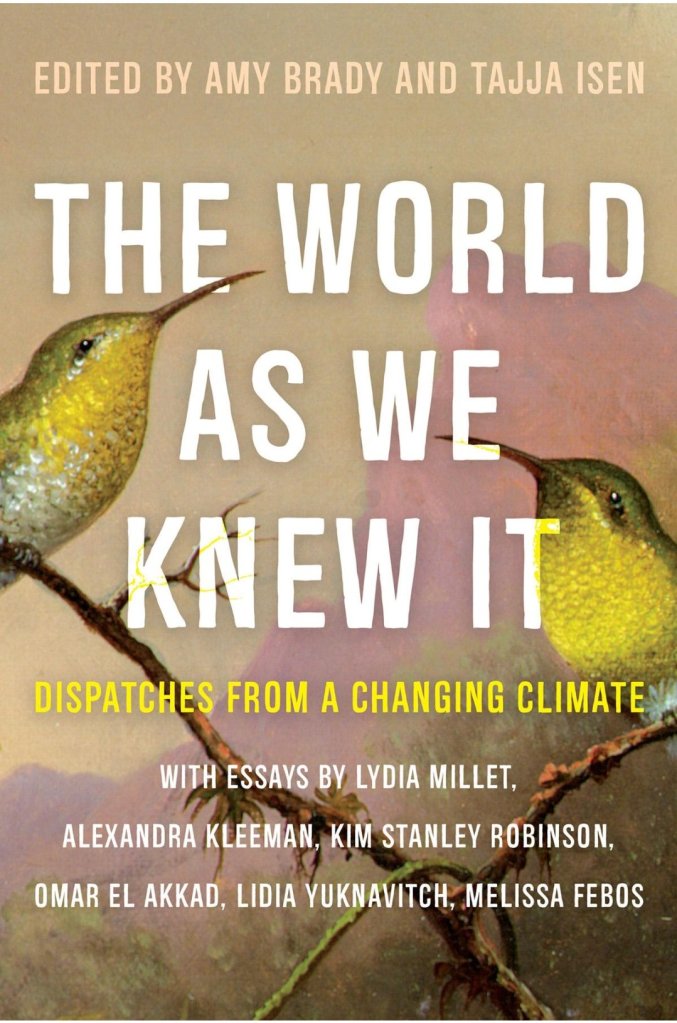
288 pages.
First published on June 14, 2022.
Non-fiction anthology.
With all of the flashing red lights clamouring for our attention these days, the climate emergency manages to mostly feel less urgent. I’m always glad to come across good writing about it, partly to encourage me to think about it, but also to make a little more sense of something that can feel quite distant. So, I had been looking forward to reading this as soon as I heard about it, and also because the list of authors includes some of my favourite writers. I was somewhat disappointed by my faves, though; instead, I have discovered new-to-me authors like Delia Falconer, whose work I’ll be looking out for.
Some of the essays in the collection were written before COVID, and others have been written since. This is the question the editors asked their contributors to consider:
“At a time when our planet is experiencing terrifying and unprecedented levels of change, what corresponding transformations have you witnessed in your own lives, yards, neighborhoods, jobs, relationships, or mental health?”
Here’s the list of essays and authors (highlights mine):
- From This Valley, They Say, You Are Leaving – Lydia Millet
- Starshift – Gabrielle Bellot
- A Brief History of Breathing – Pitchaya Sudbanthad
- What We Don’t Talk About When We Talk About Antarctica – Elizabeth Rush
- Iowa Bestiary – Melissa Febos
- How Do You Live with Displacement? – Emily Raboteau
- Faster Than We Thought – Omar El Akkad
- Unearthing – Lidia Yuknavitch
- Leap – Meera Subramanian
- Come Hell – Lacy M. Johnson
- After the Storm – Mary Annaïse Heglar
- Walking on Water – Rachel Riederer
- Mobbing Call – Tracy O’neill
- Moments of Being – Kim Stanley Robinson
- Until This Snow Reaches the Ocean – Nickolas Butler
- Season of Sickness – Porochista Khakpour
- The Development – Alexandra Kleeman
- Cougar – Terese Svoboda
- Signs and Wonders – Delia Falconer
Many of these washed over me, like I’ve said, or were slightly bewildering. A few were interesting. The stand-out ones for me, however, were Pitchaya Sudbanthad’s A Brief History of Breathing (the title of which makes me want to take huge gulping breaths), Omar El Akkad’s pensive and nostalgia-filled Faster Than We Thought , and Delia Falconer’s Signs and Wonders, my favourite by far, eloquent, and deeply moving.
Overall, rating the collection 8/10, and that’s mostly for those three essays. The collection as a whole (greater than the sum!) is thought-provoking, and very much worth reading; I’m sure everyone will find something that resonates. This is also, hopefully, a small wake-up call to all of us, and, as the editors express as their hope, a snapshot and record of this point in our time (aka The Anthropocene).
I will end this post with some of the things I highlighted on my Kindle (again, highlights mine):
When people laud a new world made smaller by air travel and the internet, they often neglect to mention that these new intimacies have been made possible only by ravenous empire.
From A Brief History of Breathing, by Pitchaya Sudbanthad
In the age of capitalism everything is a placeholder for its more lucrative replacement.
From Faster Than We Thought, by Omar El Akkad
We have framed climate change as a crisis of the future because its worst ramifications are still to come, and because the future is something we feel we can still control.
From Faster Than We Thought, by Omar El Akkad
The places in which our stories took shape will become entirely changed…
From Faster Than We Thought, by Omar El Akkad
… to see nature, as the anthropologist and writer Michael Taussig puts it, “not . . . as the dead, soulless object of European modernity but as something roused into life through the wounds and war conducted against it.”
This nearly made me sob. If only! From Signs and Wonders, by Delia Falconer
 Harare Review of Books
Leave a comment