
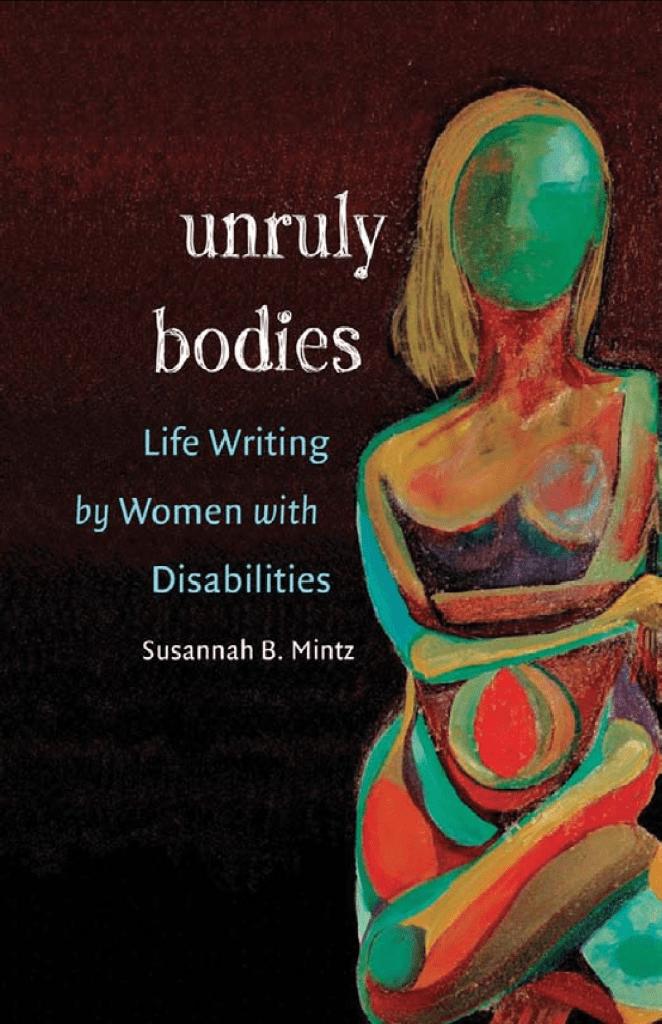
264 pages.
First published in 2007.
Finished reading on 4 Sept 2021.
Genre: Non-fiction.
Blurb: The first critical study of personal narrative by women with disabilities, Unruly Bodies examines how contemporary writers use life writing to challenge cultural stereotypes about disability, gender, embodiment, and identity.
Combining the analyses of disability and feminist theories, Susannah Mintz discusses the work of eight American autobiographers: Nancy Mairs, Lucy Grealy, Georgina Kleege, Connie Panzarino, Eli Clare, Anne Finger, Denise Sherer Jacobson, and May Sarton. Mintz shows that by refusing inspirational rhetoric or triumph-over-adversity narrative patterns, these authors insist on their disabilities as a core–but not diminishing–aspect of identity. They offer candid portrayals of shame and painful medical procedures, struggles for the right to work or to parent, the inventive joys of disabled sex, the support and the hostility of family, and the losses and rewards of aging. Mintz demonstrates how these unconventional stories challenge feminist idealizations of independence and self-control and expand the parameters of what counts as a life worthy of both narration and political activism. Unruly Bodies also suggests that atypical life stories can redefine the relation between embodiment and identity generally.
I have finally finished what was a long and complex read. Much of it is impenetrable, partly because of the writing style, but also (primarily?) because it is a scholarly work. However, I found the final two chapters, Alternative Motherhoods, and A Brief History of Aging, excellent.
Some representative quotes:
…disabled people seldom consider themselves a group…. Only the shared experience of stigmatization creates commonality…
Jacobson claims that the very apparatus that earns her the label of ‘‘severely disabled’’—her power wheelchair—is in fact distinctly empowering: ‘‘I’m much more ‘able’ than I ever was on crutches,’’ she writes…
David is adopted, and Jacobson is disabled and moves in a wheelchair; no part of their relationship seems ‘‘natural’’ or whole. This situation exemplifes what Lois Keith calls ‘‘doing disability’’: having to maneuver oneself in an environment that does not accommodate the mechanics of disablement and, more egregiously, spending time managing ‘‘other people’s preconceptions and misconceptions.’’ Jacobson is repeatedly overlooked as David’s mother, as when a van service driver speaks to her housekeeper as if Jacobson were not there (116), or when paramedics direct questions to a stranger instead of Jacobson when David hurts his fnger. The wheelchair, the erratic body movements, the slurred speech—these equate to baby talk, to a baby’s inability to control its motions and its dependence on caregivers…
Broadly speaking, woman are invited not to accept aging, still less to appreciate or enjoy it, but rather to ‘‘defy’’ its visible signs, a concept used ubiquitously in women’s cosmetics advertising.
Roberts and Beth Blue Swadener in the introduction to their edited collection Semiotics and Dis/Ability: Interrogating Categories of Di√erence: ‘‘What happens to the person whose physical body or intellectual or perceptual world is quite di√erent from the normative features of a cultural fabula[?] … What about the experiences and events of a person outside the typical stories of growing up, achieving maturity, being successful or not successful, reaching resolution, collecting the expected markers of a life?’’∂ The obvious presumption behind these queries is that such a person disappears from the cultural landscape; to be ‘‘di√erent from’’ or ‘‘outside of ’’ is to be unrecognized by, or unintelligible within, a culture’s prevailing stories about selfhood…
A decent place to start when thinking about disability perspectives, and presents important analysis.
Rated: 6/10.
 Harare Review of Books
Leave a comment